Punch cards were a standard form of program and data storage for decades, but you’d never know it by looking around today. Card punches and even readers are becoming rare and expensive. Sometimes it takes a bit of hacking [YouTube link] to get that old iron running again!
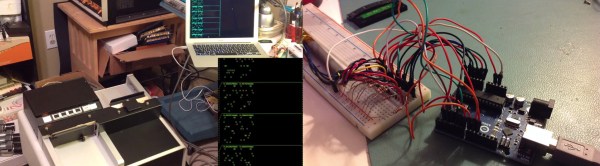
[Antiquekid3] managed to score an old punch card reader on Ebay, but didn’t have a way to interface with it. The reader turned out to be a Documation M-1000-L. After a bit of searching, [Antiquekid3] managed to find the manual [PDF link] on BitSavers. It turns out that the Documation reader used a discrete output for each row of data. One would think the Documation reader would be a perfect fit for the PDP-8 lurking in the background of [Antiquekid3’s] video, but unfortunately the ‘8 lacks the necessary OMNIBUS card to interface with a reader.
Undaunted, [Antiquekid3] threw some modern hardware into the mix, and used an Arduino Uno as a Documation to Serial interface. The Arduino had plenty of I/O to wire up with the card reader’s interface. It also had a serial interface which made outputting data a snap. The ATmega328 even had enough power to translate each card from one of IBM’s many keypunch formats to serial.
[Antiquekid3’s] test deck of cards turned out to be a floating point data set. Plotting the data with a spreadsheet results in a nice linear set of data points. Of course, no one knows what the data is supposed to mean! Want more punch card goodness? Check out this tweeting punch card reader, or this Arduino based reader which uses LEGO and a digital camera to coax the data from the paper.

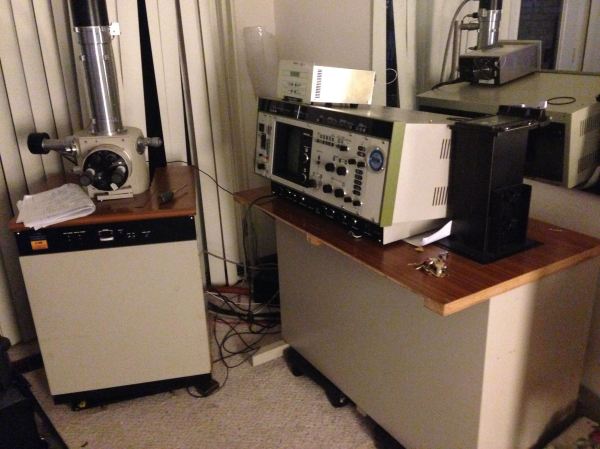
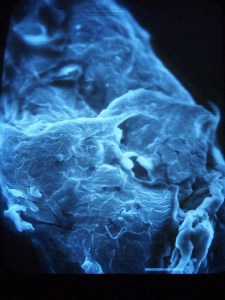 The SEM sprang to life and gave [Macona] and a friend their first images. However, SEMs are finicky beasts. Eventually the filament burned out and needed to be replaced. New filaments are $500 US for a box of 10, which is more than [Macona] wanted to spend. It turns out filaments can be built at home. A bit of .089mm tungsten wire and a spot welder were all it took to fix the issue. Next to go bad was the scan amplifier. While SEMs use many exotic parts, the Hitachi used relatively common Sanyo STK070 audio amplifiers for the purpose – an easy fix!