Building The Best Homebrew Computer Ever

A few days ago when I posted a homebrew Motorola 68000 computer spectacular, I briefly mentioned a truly spectacular homebrew computer built by [Simon Ferber]. When I posted a link to a Youtube demo of his 68k board, he was working on a website to document the architecture  design, hardware, and software. That website is now up (cache if you need it) and now we can all get a good look at the best homebrew computer ever built.

Built around the 68008 CPU – slightly less capable than the 68000 found in the original Macs, Amigas, and the TI-89 – [Simon]’s Kiwi computer has peripherals out the wazoo. A Yamaha V9990 Video Display Processor provides a 640×480 display with 32k colors. Two SID chips taken from a Commodore 64 provide stereo chiptune audio, and a floppy disk controller, IDE/ATA bus, and CS8900A Ethernet controller provide all the practical functionality you’d expect from an awesome computer.

On the software side of things, [Simon] is running Enhanced Basic 68k, but of course he can’t just use BASIC to fiddle around with all the cool chips on the Kiwi. With that in mind, he came up with a C-based toolchain that included porting libc to the Kiwi.

Like any good homebrew computer project, all the schematics, a bit of code, and a BOM are provided. [Simon] is currently working on (slightly) redesigning the PCB layout of the Kiwi, and we’ll be happy to see those files released. Anyone up for a Kiwi PCB group buy?

Homebrew 68k Extravaganza

Introduced in 1979, the Motorola 68000 CPU was first used in very expensive and very high-end workstations from the likes of Sun and SGI. As the processor matured it became well-known for its use in the original Macintosh, early Amigas, and even the TI-89 graphing calculator and a few video game consoles such as the Sega Genesis and Atari Jaguar.

A few days ago when I posted a homebrew computer build based on the 65816 CPU, I lamented the lack of builds using the venerable Motorola 68k. Hackaday readers were quick to point out the many homebrew computers making use of this classic CPU, and I’m glad to post them here.

First up is an amazing 68008 build featuring an IDE disk interface, a floppy disk interface, 10base-T Ethernet connectivity, a real-time clock, and two SID synthesizer chips. As far as features go, this build takes the cake. Pity I can’t find a writeup.

Here’s a 68000-based computer built around the S-100 bus. Like the first computer to use the S-100 bus, the Altair 8800, this computer is plugged into a backplane that breaks out the data, address, and interrupt lines to every device on the bus.

Of course, no mention of backplane computers would be complete without a Eurocard version. [N8VEM] built a 68000 computer able to be plugged in to a backplane along with an IDE controller card and a display controller.

Finally, in true ‘giant mess of wires’ spirit, [Dajgoro] sent in his 68k single board computer featuring 512 kB of RAM and a 16k ROM. [Dajgoro] also took the time to wire in a PIC microcontroller, allowing him to expand his computer far beyond what vintage components would allow.

The 68k was – and still is – a very powerful CPU that far surpasses the capabilities of the 6502 and Z80 homebrew computers we see from time to time. Short of building a 486 or Pentium-based computer from scratch, building a 68k machine is one of the crowning achievements of hardware hackery, and something we hope to see more of in the future.

Saving A Bricked Phone With A Pencil Lead

[stompyonos] bricked his Samsung Captivate. Not wanting to be without a phone for a while, he researched a fix online and found shorting a pair of pins on the USB port would put the phone into download mode, saving his phone. The only problem for this plan is [stompy] didn’t have any resistors on hand. Instead, he came up with a wonderful MacGyverism using a piece of paper, a bit of graphite, and a pair of paper clips.

The process of unbricking a Captivate requires a 300 or 330 kΩ resistor across pins 4 and 5 of the mini USB port. This can be done with a few resistors, but [stompy] only had a multimeter lying around. After scribbling a good bit of pencil lead on a piece of paper, he attached two paper clips to make a variable resistor, dialed it in to about 300 kΩ, and cut up an old Nokia charger for its USB plug.

Not bad for a very easy fix that didn’t cost [stompyonos] a dime, and certainly better than a $500 paperweight.

Turning A MIDI Sequencer Display Into A Tetris Clone

led-midi-display-tetris

Tetris is unquestionably a game for the ages. Despite its simplicity, someone, somewhere will always find a way to port the game (Translation) to just about any electronic device that can handle it.

Earlier this year we showed you a slick MIDI sequencer project that was constructed using an Arduino Mega, which also happened to drive an incredibly detailed touch screen display. [Christian] must have gotten bored with his awesome creation one day, because he pulled the drum level display out of his Arduino Sequencer 808, and turned the LED array into a mini Tetris game.

As you can see in the video below, the game runs pretty well, though from what we can see it lacks any sort of score keeping. We dig it because we never really tire of Tetris clones, and we think it’s great that he kept his 808 sequencer design modular enough that he can pluck different components out for reuse in other projects.

Continue reading “Turning A MIDI Sequencer Display Into A Tetris Clone”

Homebrew Computer Is 16 Bits Of Awesome

We’ve seen our share of homebrew computers over the years. Usually, these bare-bone systems use a small, early 80s-era microprocessor such as the Z80 or 6502. These little 8-bit machines are awesome, but somewhat limited in their capability. [BigDumbDinosaur] sent in a computer he’s been working on for a few years now featuring the infamous 65816 CPU – the same CPU found in the Apple IIgs, the Super Nintendo, and [Jeri Ellsworth]’s C-ONE computer.

The 65816 is a direct descendant of the venerable 6502 CPU found in the Commodore 64, Apple II, and just about every 80s microcomputer of note. [BigDumbDinosaur] chose the 65816 for its backwards-compatibility with the fun to program 6502 and the ability to use high clock rates and tons of address space for a very cool design.

After a ton of careful design and consideration, [BigDumbDinosaur]’s computer included a real-time clock, a watchdog timer, a serial port, 256kB of ROM, and 128kB of RAM.

It’s a really wonderful build, but [BigDumbDinosaur] isn’t done with this project yet. He’s working on version 2 of a 65816 computer that will use programmable ‘glue’ logic, a lot more RAM, have a SCSI interface (for a hard drive), and have preemptive multitasking.

An awesome job, and it’s wonderful to see the wonderful 65816 make its way into another homebrew computer. Now if only we could find a 68000-based homebrew computer…

Uncovering Easter Eggs In Old Mac ROMs

The picture you see above is taken from the ROM of a Macintosh SE made in the  late 1980s. This black and white image remained buried inside old Macs until [Adam] and [Trammell] at NYC Resistor reverse engineered these old Mac ROMs and found a few really cool Easter eggs.

[Adam] and [Trammell] have been dumping ROMs from old computers for a while now. Their modus operandi is finding old 27C-series EPROMs on old computers, prying the out of their comfortable home, slapping them in a breadboard, and wiring up an Arduino clone to dump the data to a computer.

Recently, the guys found an old Mac SE lying on the side of a road in Brooklyn and brought it over to NYC Resistor. They had known about images hidden in the SE ROM, but the guys wanted to know how and where these pictures were stored. After carefully inspecting the binary file generated from dumping the ROM, [Adam] was able to recover three images hidden in every Macintosh SE.

The folks at Apple – especially in the heady days of the Apple II and 68k Macs – hid quite a few Easter eggs in the ROMs of their computers. For instance, the Apple IIgs has audio data stored in the ROM, and the Macintosh Classic hid an entire operating system – System 6.0.3 – in the ROM of the machine.

via Make

Hackaday Retro Edition Roundup

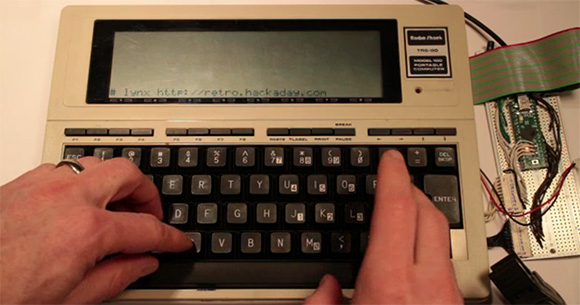
In case you’ve forgotten about it, we still have a retro edition of Hackaday. It’s our simple, hand-coded HTML site featuring a few random hacks from Hackaday’s 8-year history. There’s also a retro successes page where our readers can log on with their old boxxen and claim their prize as a master of retrocomputing. Here’s a few retro successes that came in over the past month or so:

Our second OS/2 Warp submission comes from [Chris]. He got an HP Omnibook 800CT running OS/2 Warp 4 to load up our retro site.

A few of you may be wondering what the upper bound of what we consider a retro computer is. [Witek] used a Wyse thin client from the year 2000 to pull up our retro edition. These terrible computers used a Compact Flash card plugged directly into an IDE port to load up Windows CE. Yeah, it’s technically a SSD. [Witek] put the GRUB bootloader on one and loaded up our retro edition with Debian Squeeze. We have too many bad memories of these thin clients, and we’ve got to commend [Witek] for putting the effort into doing something useful with one.

[leadacid] is on a roll. He gave us our first OS/2 Warp submission and has since moved onto an IBM RS/6000. Previously, he got a Macintosh 8100 and a Quadra 840AV to pull up the retro site. Nice job.

Those are all the retro submissions for now, but if you have an old computer lying around, try pulling up our retro site and send it in.