Hackaday Superconference Talk: Cory Grosser

When we look at a product or project here at Hackaday it is likely that our interest has been caught by its internal technology, or perhaps by its functionality. It is easy to forget that there is another angle to each and every item that graces these pages, and it is every bit as important as those we have already mentioned. Aesthetic design, the look and feel of a product, is something that is so often overlooked.

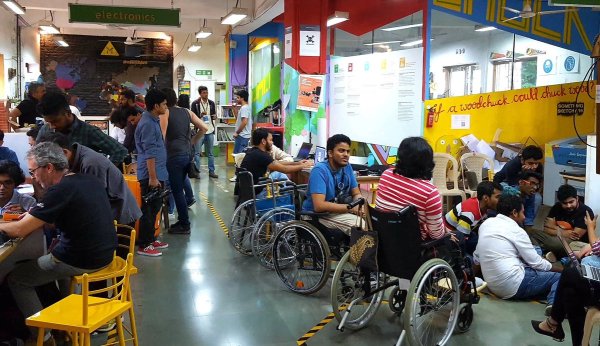
One of the speakers at the Hackaday Superconference was [Cory Grosser], one of America’s leading independent product designers, and the designer of the Supplyframe Design Lab in which the Superconference was being held. In his talk he covered some of the principles of design, touching on its psychology and its purpose in creating a successful product. In doing so he delivered a fascinating talk full of insights into the design of products both famous and somewhat obscure.

Continue reading “Hackaday Superconference Talk: Cory Grosser”

34C3: The First Day Is A Doozy

It’s 5 pm, the sun is slowly setting on the Leipzig conference center, and although we’re only halfway through the first day, there’s a ton that you should see. We’ll report some more on the culture of the con later — for now here’s just the hacks. Continue reading “34C3: The First Day Is A Doozy”

Hackaday At 34C3

It’s that time of year. While the rest of the Christmas-celebrating world sits around and plays with the toys that they got out from under the tree, German nerds head off to the biggest European hacker con: the 34th annual Chaos Communications Congress, running Dec. 27th through 30th.

The CCC is both a grandparent among hacker cons, and the most focused on using technology to improve the world and bringing folks together. (The “communications” in the name is a dead giveaway.) This year’s motto, “tuwat!” is slangy-dialecty for “do something!” and is call to get up off the couch and use your super-powers for good.

If you can’t get over to Leipzig to join us, you’ll be able to read our extensive coverage starting up shortly after the opening ceremonies, and probably stretching well into 2018. And since the CCC media folks manage to stream every talk, hackers all over the world can follow along live. Most talks are in English, so get together with folks in your hackspace and have a video night!

And if you are in Leipzig, be on the lookout for [Elliot] who will be wandering around, attending workshops, and writing down as much as possible. Show me something cool, rave about a particularly good talk, or just say “hi”.

Fairy Dust clipart courtesy [sonoftroll].

Mike Harrison At The Superconference: Flying LCD Pixels

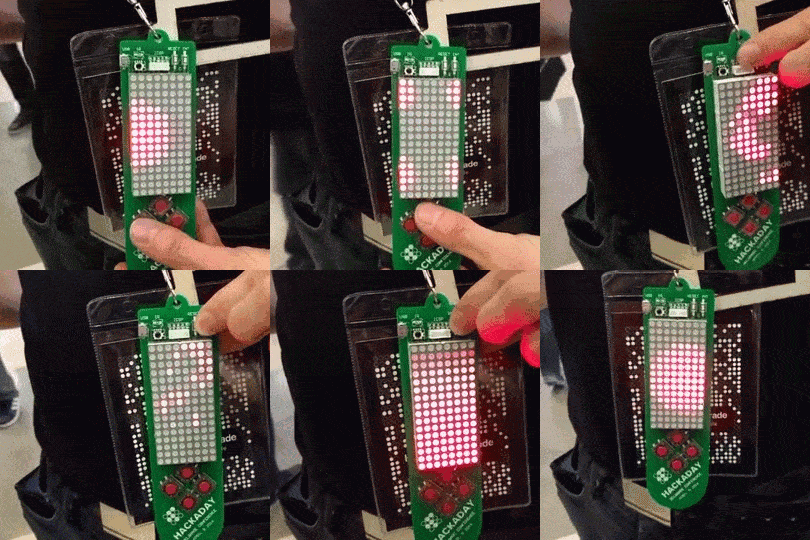
Mike Harrison, perhaps better known to us as the titular Mike of YouTube channel mikeselectricstuff, is a hardware hacking genius. He’s the man behind this year’s Superconference badge, and his hacks and teardowns have graced our pages many times. The best thing about Mike is that his day job is designing implausibly cool one-off hardware for large-scale art installations. His customers are largely artists, which means that they just don’t care about the tech as long as it works. So when he gets together with a bunch of like-minded hacker types, he’s got a lot of pent-up technical details that he just has to get out. Our gain.

He’s been doing a number of LCD installations lately. And he’s not using the standard LCD calculator displays that we all know and love, although the tech is exactly the same, but is instead using roughly 4″ square single pixels. His Superconference talk dives deep into the behind-the-scenes cleverness that made possible a work of art that required hundreds of these, suspended by thin wires in mid-air, working together to simulate a flock of birds. You really want to watch this talk.


Continue reading “Mike Harrison At The Superconference: Flying LCD Pixels”

Alan Yates: Introduction To Vacuum Technology

When we mention vacuum technology, it’s not impossible that many of you will instantly turn your minds to vacuum tubes, and think about triodes, or pentodes. But while there is a lot to interest the curious in the electronics of yesteryear, they are not the only facet of vacuum technology that should capture your attention.

When [Alan Yates] gave his talk at the 2017 Hackaday Superconference entitled “Introduction To Vacuum Technology”, he was speaking in a much more literal sense. Instead of a technology that happens to use a vacuum, his subject was the technologies surrounding working with vacuums; examining the equipment and terminology surrounding them while remaining within the bounds of what is possible for the experimenter. You can watch it yourself below the break, or read on for our precis.

In the first instance, he introduces us to the concept of a vacuum, starting with the work of [Evangelista Torricelli] on mercury barometers in the 17th century Italy, and continuing to explain how pressure, and thus vacuum, is quantified. Along the way, he informs us that a Pascal can be explained in layman’s terms as roughly the pressure exerted by an American dollar bill on the hand of someone holding it, and introduces us to a few legacy units of vacuum measurement.

In classifying the different types of vacuum he starts with weak vacuum sources such as a domestic vacuum cleaner and goes on to say that the vacuum he’s dealing with is classified as medium, between 3kPa and 100mPa. Higher vacuum is beyond the capabilities of the equipment available outside high-end laboratories.

Introduction over, he starts on the subject of equipment with a quick word about safety, before giving an overview of the components a typical small-scale vacuum experimenter’s set-up. We see the different types of vacuum gauges, we’re introduced to two different types of service pumps for air conditioning engineers, and we learn about vacuum manifolds. Tips such as smelling the oil in a vacuum pump to assess its quality are mentioned, and how to make a simple mist trap for a cheaper pump. There is a fascinating description of the more exotic pumps for higher vacuums, even though these will be out of reach of the experimenter it is still of great interest to have some exposure to them. He takes us through vacuum chambers, with a warning against cheap bell jars not intended for vacuum use, but suggests that some preserving jars can make an adequate chamber.

We are then introduced to home-made gas discharge tubes, showing us a home-made one that lights up simply by proximity to a high voltage source. Something as simple as one of the cheap Tesla coil kits to be found online can be enough to excite these tubes, giving a simple project for the vacuum experimenter that delivers quick results.

Finally, we’re taken through some of the tools and sundries of the vacuum experimenter, the different types of gas torches for glass work, and consumables such as vacuum grease. Some of them aren’t cheap, but notwithstanding those, he shows us that vacuum experiments can be made within a reasonable budget.

Continue reading “Alan Yates: Introduction To Vacuum Technology”

Sarah Petkus On Building A Cartoon To Go To Mars

Sarah Petkus is a robot mom (which means she’s the mother to a robot, not that Sarah herself is a robot, at least as far as we’re aware), whose child, Noodle Feet, is a character in Sarah’s graphic novel Gravity Road. Unlike every other robot on the planet, Noodle Feet is a content-based robot. Instead of robotic arms welding car panels together or 3D printers squiring out goo, Noodle Feet isn’t a robot built for a specific function. Noodle Feet’s design is derived from his personality in his graphic novel. In the graphic novel, Noodle Feet tastes with his feet, clambers over rocks, and explores his surroundings. That’s what the real-life version of Noodle Feet must do, and that means building the hardware to do just that.

Sarah has been working on Noodle Feet for about two years now, and last year she presented a talk about tasting feet and salivating toes. It’s odd, yes, but it is a fantastic exploration of what can be done with robotics.

This year, Sarah had the opportunity to be an artist in residence at ESA, where Noodle Feet could at least test out his dream of living on Mars. There, Noodle Feet played around in the ESA’s Mars yard, where he made friends with a copy of the ExoMars rover.

Continue reading “Sarah Petkus On Building A Cartoon To Go To Mars”

Kristin Paget Is Hacking Carrier Grade LTE ENodeB

Every once in a while you get lucky and a piece of cool gear lands on your bench to tear down and explore. On that measuring stick, Kristin Paget hit the jackpot when she acquired a fascinating piece of current generation cellphone infrastructure. She’s currently researching a carrier-grade LTE eNodeB and walked through some of the findings, along with security findings of two IoT products, during her talk on the Laws of IoT Security at the 2017 Hackaday Superconference.

Evolved Node B (eNodeB) is the meat and potatoes of the LTE cellular network. It connects the antenna to backhaul — this is not something you’d expect to see on the open market but Kristin managed to pick one up from a vendor at DEF CON. Hearing her walk through the process of testing the hardware is a real treat in her talk and we’ll get to that in just a minute. But first, check out our video interview with Kristin the morning after her talk. We get into the progress of her eNodeB research, and touch on the state of IoT security with advice for hardware developers moving forward.

Continue reading “Kristin Paget Is Hacking Carrier Grade LTE ENodeB”