Would You Like To Play A Game? WOPR Summit Is This Weekend

During the summer months it might be known as “America’s Playground”, but around this time of year, Atlantic City is generally the destination of choice for bus loads of seniors looking to burn up some of that fixed income. Of course, that was before the WOPR Summit came to town. From March 1st to the 3rd, it promises to transform Bally’s Hotel and Casino on the famous Atlantic City Boardwalk into a high-tech oasis in a sea of oxygen tanks and walkers. There might not be any fun in the sun to be had at this time of year, but a full schedule of talks and workshops covering everything from penetration testing to ham radio is more our speed anyway.

There’s still a couple days to register for WOPR online at a discount, but naturally they’ll be happy to take your money at the door if you miss the cutoff. As of this writing, there’s even still rooms left at Bally’s for the special WOPR rate, which you’ll probably want to take advantage of as the schedule has events running until well past our normal bedtime.

WOPR looks like it will be a nice mix between hardware and software, with a generous sprinkling of InfoSec. Presentations such as “Strategies for your projects: Concept to Prototype” and “Being Q. — Designing Hacking Gadgets” sound like classic Hackaday fare. But even if you aren’t normally into the security scene, talks such as “Ham Hacks: Breaking into Software Defined Radio” and “An Introduction to IoT Penetration Testing” seem like they’ll be an excellent way to cross the divide. In between the talks, they promise to have a hackerspace up and running for you to check out, complete with soldering classes and contests.

It’s not often that you get to witness the birth of a new hacking conference, especially one on the East Coast, so Hackaday will be shaking off the last bits of our long winters nap as I catch the next bus out of the Senior Center that’s headed towards the Boardwalk. Track me down and you might even be able to take some of our Jolly Wrencher stickers home along with your slot machine winnings. But even if you can’t make it to America’s rather chilled and blustery playground this weekend, I’ll be sure to report on all the highlights so you can live vicariously through the comforting flicker of your favorite screen.

Supercon: Ruth Grace Wong And Firmware From The Firehose

Firmware and software are both just code, right? How different could the code that runs Internet-scale distributed web stuff be from the code that runs a tiny microcontroller brain inside a personal hydroponics device? Night and day!

Ruth Grace Wong works in the former world, but moonlights as a manufacturing engineer with some friends. Their product had pre-existing firmware that contained (at least) one bug, and Ruth’s job was to find it. The code in question was written by the Chinese PCB engineer, who knew the electronics intimately but who had no software background, providing Ruth an opportunity to jump head-first into the rawest of raw embedded programming. Spoiler alert: she found the bug and learned a lot about firmware along the way. This talk follows her along the adventure.

“The code is very well documented, in Chinese” but the variable names are insanely non-descriptive. Similarly, while the PCB engineer knows full well what a 24C02 is, if you’re a software geek that might as well be Chinese. As you’d expect, web searches came to the rescue on both fronts.

The bug ended up hiding in a logical flaw in the PWM-setting code inside an interrupt service routine, and it kept the fan from ever coming full on. Once found, it was easily fixed. But getting to the point where you understand the codebase deeply enough to know where to look is four-fifths of the battle. Heck, setting up the toolchain alone can take a day or two.

If you’re a fellow software type, Ruth’s talk (embedded below) will give you a quick glimpse into the outer few layers of the onion that is embedded firmware development, from a familiar viewpoint. Give her quick and value-packed talk a watch! Grizzled hardware veterans will nod along, and maybe even gain a little insight into how our code looks to “them”.

Continue reading “Supercon: Ruth Grace Wong And Firmware From The Firehose” →

Badge.Team: Badges Get A Platform

Electronic conference badges are now an accepted part of the lifeblood of our community, with even the simplest of events now sporting a fully functional computer as an eye-catching PCB on a lanyard. Event schedules and applications are shipped on them, and the more sophisticated ones have app libraries and support development communities of their own.

The trouble is that so often those badges fail to live up to their promise, and one reason behind that stems from the enormity of the task facing a badge team when it comes to firmware for a modern badge. There is some fascinating news from the Netherlands  that might reduce some of those firmware woes though, badge.team is a freshly-launched project that provides a ready-made badge firmware with the promise of both stability and long-term support. If you’re making a badge, or even a one-off device using the ESP32, this is a project worth checking out.

Continue reading “Badge.Team: Badges Get A Platform” →

Electron Microscopes Are Awesome: Everything You Didn’t Know You Wanted To Know

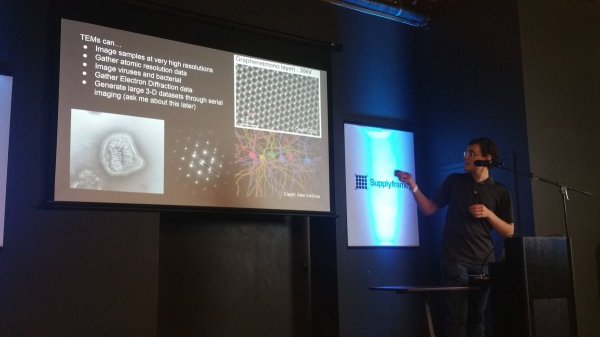
Electron microscopes were once the turf of research laboratories that could foot the hefty bill of procuring and maintaining such equipment. But old models have been finding their way into the hands of eager individuals who are giving us an inside look at the rare equipment. Before you start scouring Craigslist, go on a crash course of what you need to know with Adam McComb’s Hacker’s Guide to Electron Microscopy. He presented the talk at the 2018 Hackaday Superconference and the recording was just published, you’ll find it below.

Continue reading “Electron Microscopes Are Awesome: Everything You Didn’t Know You Wanted To Know” →

Understanding Math Rather Than Merely Learning It

There’s a line from the original Star Trek where Khan says, “Improve a mechanical device and you may double productivity, but improve man and you gain a thousandfold.” Joan Horvath and Rich Cameron have the same idea about improving education, particularly autodidacticism or self-learning. They share what they’ve learned about acquiring an intuitive understanding of difficult math at the Hackaday Superconference and you can watch the newly published video below.

The start of this was the pair’s collaboration on a book about 3D printing science projects. Joan has a traditional education from MIT and Rich is a self-taught guy. This gave them a unique perspective from both sides of the street. They started looking at calculus — a subject that scares a lot of people but is really integral (no pun intended) to a lot of serious science and engineering.

You probably know that Newton and Leibniz struck on the fundamentals of calculus about the same time. The original papers, however, were decidedly different. Newton’s approach was more physical and less mathematical. Leibniz used formal logic and algebra. Although both share credit, the Leibniz notation won out and is what we use today.

Continue reading “Understanding Math Rather Than Merely Learning It” →

Supercon 2018: Mike Szczys And The State Of The Hackaday

Every year at Superconference, Editor-in-Chief Mike Szczys gets the chance to talk about what we think are the biggest, most important themes in the Hackaday universe. This year’s talk was about science and technology, and more importantly who gets to be involved in building the future. Spoiler: all of us! Hackaday has always stood for the ideal that you, yes you, should be taking stuff apart, improving it, and finding innovative ways to use, make, and improve. To steal one of Mike’s lines: “Hackaday is an engine of engagement in engineering fields.”

Continue reading “Supercon 2018: Mike Szczys And The State Of The Hackaday” →

Chris Gammell Talks Circuit Toolboxes

Chris Gammell wants to know: What’s in your circuit toolbox?

Personally, mine is somewhat understocked. I do know that in one of my journals, probably from back in the 1980s, I scribbled down a schematic of a voltage multiplier I had just built, with the classic diode and capacitor ladder topology. I probably fed it from a small bell transformer, and I might have gotten a hundred volts or so out of it. I was so proud at the time that I wrote it down for posterity with the note, “I made this today!”

I think the whole point of Chris’ 2018 Hackaday Superconference talk is precisely what I was trying to get at when I made my “discovery” — we all have circuits that just work for us, and the more you have, the better. Most readers will recognize Chris from such venues as The Amp Hour, a weekly podcast he hosts with Dave Jones, and his KiCad tutorial videos. Chris has been in electrical engineering for nearly twenty years now, and he’s picked up a collection of go-to circuits that keep showing up in his designs and making life easier, which he graciously shared with the crowd.

As Chris points out, it’s the little circuits that can make the difference. Slide after slide of his talk had schematics with no more than a handful of components in them, covering applications from dead-simple LED power indicators and switch debouncing to IO expansion using a 74HC595. And as any sensible engineer might, Chris’ toolbox includes a good selection of power protection circuits, everything from polarity reversal protection with a MOSFET and a zener to a neat little high-side driver shutoff using a differential amp and an optoisolator.

My favorite part of the talk was the “Codeless” section — things you can do with discrete components that make microcontroller circuits better. We see the “You could have used a 555!” comments from readers all the time, and Chris agrees, at least to a point. He aptly notes that microcontrollers can wake up with their IO pins in unknown states, and offered several circuits to keep the potential for mischief at bay, such as Schmitt trigger power-on reset or the simple addition of a pull-down resistor to default a MOSFET to a safe state. There’s a lot that code can accomplish, but adding just a few parts can make a circuit much safer and useful.

Chris acknowledges that in any audience, everyone is always at different places with regard to their hardware learning curve, so what’s old hat to someone might be a fresh revelation to another. Still, everything is new to someone at some point, and that’s often the best time to write it down. That’s what I did all those years ago with that voltage multiplier, and it never left me as a result. It’s good advice, and if you haven’t started building your own circuit toolbox, now’s the time.

Continue reading “Chris Gammell Talks Circuit Toolboxes” →