Rubicon Gives The Makerbot Digitizer A Run For Its Money

rubicon

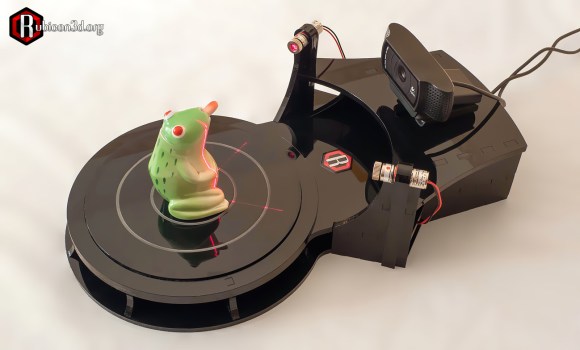
Look out MakerBot, there’s a new 3D scanner on the block and it’s about 10% of the cost of the Digitizer. Enter the Rubicon 3D Scanner which just hit Indiegogo, a device much closer to being worth its price $199.

Just like the pricey Makerbot Digitizer it’s a very simple design made up of a webcam, two laser lines, and a stepper motor controlled turn table. Still very easy to make yourself, but at $199, it’s not a bad price for an all-in-one kit, especially compared to the Digitizer. The newcomer claims a much faster scan time (3 minutes versus 12), and the same stepper rotation (800 steps or 0.45 degrees per step). There are no details about making the design open source, but after some digging in the RepRap forums we found some discussion on that topic from designer [Robert].

It scans objects up to 160mm in diameter and 250mm tall, however it has the ability to scan marginally larger objects if the camera is moved farther back. The funding for the Indiegogo campaign will go towards a custom arduino-esq PCB with a motor driver built in – personally we would be interested in just getting the PCB and 3D printing the rest of the scanner ourselves!

More information is found in the video after the break. Continue reading “Rubicon Gives The Makerbot Digitizer A Run For Its Money” →

Putting Every Game Console In The Palm Of Your Hand

SNES

Casemodders extraordinaire [Downing] and [Hailrazer] are known for their fabulous builds that put just about every gaming console into a portable hand-held format. Everything from a Game Cube to N64s and a Sega Genesis have been conquered by the two, and for the last year they’ve been putting their heads together to make the best solution to portabalizing console gaming forever. It’s called the Cross Plane, and puts just about everything with an HDMI connection in the palm of your hand.

The build began as one of [Downing]’s more ambitious projects. He imagined a system that could play nearly every retro game on a small handheld device. After finishing this build, he set up a Kickstarter and called up his friend [Hailrazer] to get some feedback. Just hours before the Kickstarter launched, [Hailrazer] suggested making a device for modern consoles. [Downing]’s pride and joy was scrapped, but out of its ashes arose the Cross Plane.

Inside the Cross Plane is a wireless HDMI receiver and a 7″ 720p display. This, along with a few buttons and analog controls, allow the Cross Plane to serve as a remote display and controller for an XBox 360, Playstation 3, and even a PC, for all that retro emulator goodness.

It’s a really, really cool project, and since the dream of an open Wii U controller seem to have died, we’re thinking this could be a great controller for an FPV quadcopter or other remotely operated vehicle.

The JavaScript Of Things

Espruino

There are a ton of people out there that can program in JavaScript, but give them an embedded device, and they’re up the creek without a paddle. Not anymore, that is, thanks to [Gordon]’s wonderful Espruino, a JavaScript interpreter for ARM microcontrollers. Oh, it’s also a very capable dev board that has more than enough power to turn just about any project you can imagine into reality.

On board the Espruino is an ARM Cortex M3 in the form of an STM32 chip, 256kB Flash, 48kB of RAM, and a ton of PWM and ADC pins to go along with 2 SPI ports, 2 I2C ports, and 2 DACs. It’s a very capable piece of hardware, and if you’re looking to build anything, it would be hard to pick a better general purpose dev board.

[Gordon] has put his board up on Kickstarter, and since it’s already been successfully funded, he’ll be releasing the hardware and software sources under an Open Source license. If you’ve ever wanted to run JavaScript on an ARM board, it looks like Espruino is just the ticket.

A Fast And Easy-to-use Vision Sensor

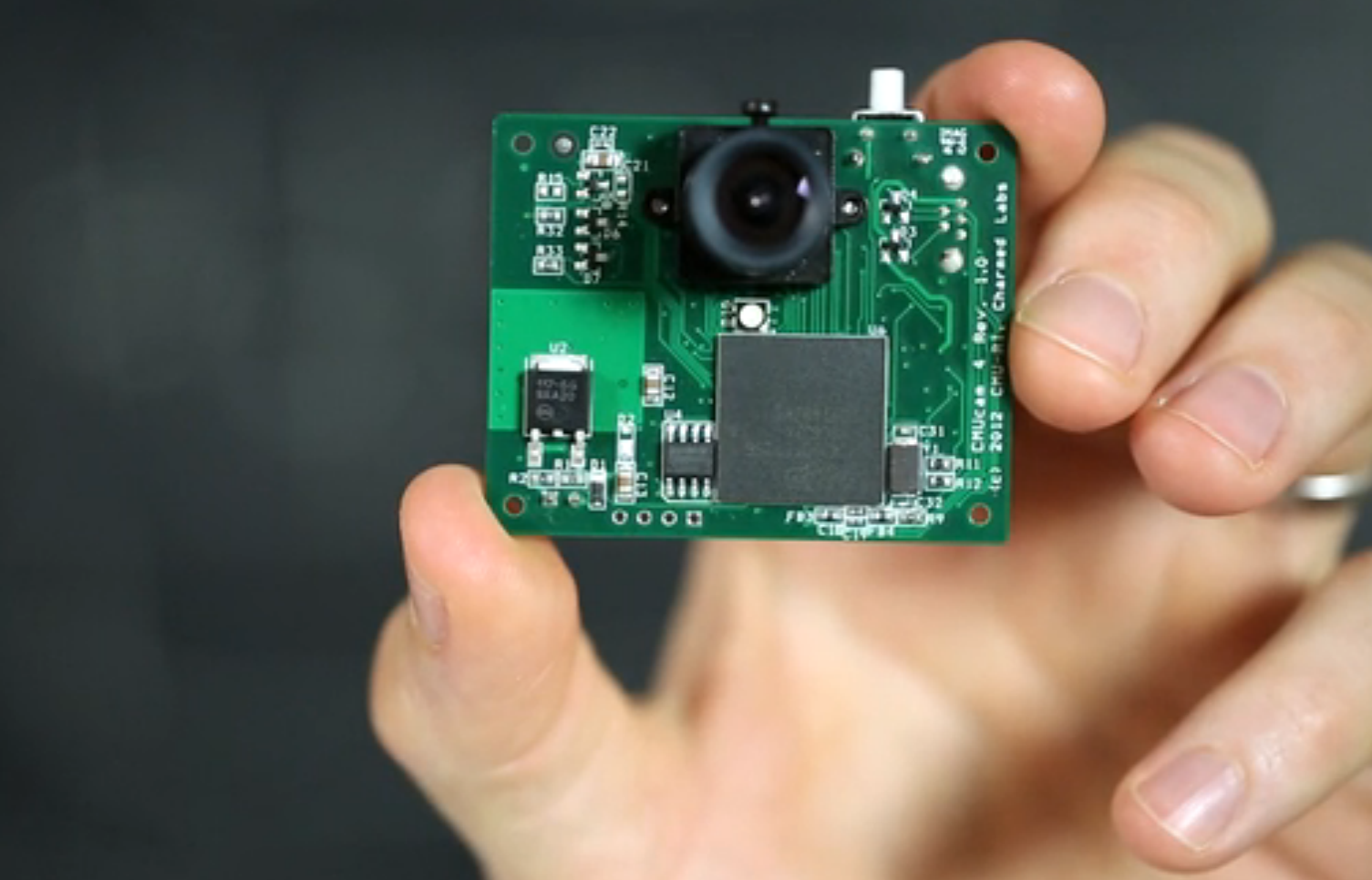
At Hackaday we don’t often feature kickstarter campaigns, but this one is worth noticing in our opinion. It is called Pixy, a small camera board about half the size of a business card that can detect objects that you “train” it to detect.

Training is accomplished by holding the object in front of Pixy’s lens and pressing a button. Pixy then finds objects with similar color signatures using a dedicated dual-core processor that can process images at 50 frames per second. Pixy can report its findings, which include the sizes and locations of all detected objects, through one of several interfaces: UART serial, SPI, I2C, digital or analog I/O.

The platform is open hardware, its firmware is open source and GPL licensed, making the project very interesting. It is based on a 204MHz dual core ARM cortex M4 & M0, uses a 1280×800 image sensor and can stream the processed camera output to your computer. You can get one Pixy in the kickstarter campaign for $59, which is not that expensive for what it is.

Dual Extruders In The Space Of One Stepper Motor

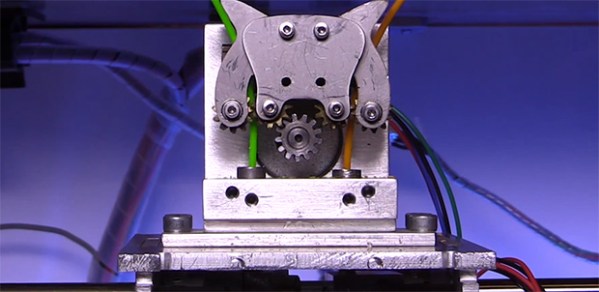
The new hotness in 3D printers is – and has been for a while – dual extrusion. With two extruders and the requisite filament supply, it’s possible to print objects in two colors or two different materials. There’s a problem with this setup, though: each extruder requires a separate motor, greatly reducing the print area should you want to print in two or more colors. [Carl] and [Brian] think they have the solution to this with their dual extruder that is powered by one stepper motor.

As you can see from the pic above, the idea is relatively simple. Two strands of filament are fed past one gear attached to a stepper motor. Each strand is moved into the hot end through two idler gears and side of the extruder feeds into the hot end is determined by the rotation of the motor. It’s really one of those, “why didn’t I think of that” ideas.

[Carl] and [Brian] are also offering a quad extruder, a dual-sized extruder able to pump four different filaments onto a printer bed. With this, we expect some people to experiment with CMYK (or CMYW) prints, truly turning any 3D printer into a machine that prints full color parts.

Continue reading “Dual Extruders In The Space Of One Stepper Motor” →

Six Years, A Giant Robot, And A Kickstarter

robot

Since 2007, [Jamie Mantzel] has been building a huge remote-controlled walking robot. If you’ve been following him on his YouTube channel and blog, you’ve seen the very beginnings of him building a lumber mill to create a workshop, making the legs for his robot, and improving his welding rig. This week, though, has been very special. [Jamie] has finally finished his giant robot project, bidding closed the fevered dream of a madman who awakes to a 10 foot robot in his yard.

The giant robot is constructed nearly entirely out of scrap aluminum. In the interest of simplicity, [Jamie] has come up with some interesting techniques to scale up conventional RC gear to power huge motors swinging giant legs: the steering motors are powered by manual switches, but these switches are activated by servos. A brilliantly simple solution to driving high-current loads if we do say so ourselves.

[Jamie]’s robot has garnered a lot of attention over the years, so much so that toy companies have licensed his designs for a line of battling combat spiderbots. [Jamie] believes his robots should be more educational, so he’s launched a Kickstarter for his own version as a kit. With this kit, getting the bug tank robot up and running isn’t simply a matter of pulling it out of the box and installing batteries; [Jamie]’s version is an actual kit with linkages that must be assembled. We know which version we’d want.

It’s an amazingly impressive project, and we’re glad to see such an awesome cat has finally realized his dream of a walking aluminum arachnid of death.

Centimeter-level Precision GPS For $900

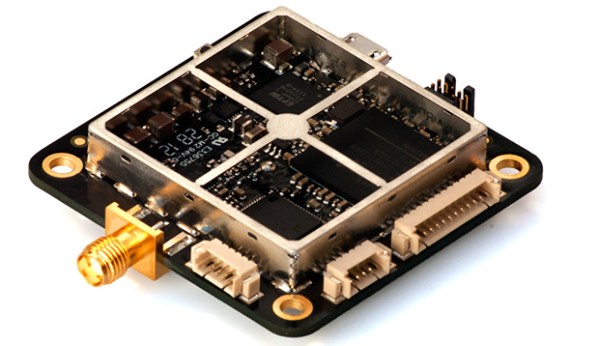
[Colin] and [Fergus] have been working with GPS for years now, and like most builders of really cool things, they’re often limited by the precision of off-the-shelf GPS units. While a GPS receiver is usually good for meters of accuracy,  this just isn’t good enough for a lot of projects. What you need is centimeter-level accuracy, something the guys have managed to do with their Piksi GPS receiver.

Where most GPS receivers only look at the data coming from the GPS satellites orbiting overhead, the Piksi uses another technique, real-time kinematics (RTK), to determine the receiver’s location with exacting precision. The basic idea behind RTK is to look at the carrier frequency of the GPS signals at 1575.42 MHz. This frequency has a wavelength of 19 cm, compared to the alternating 1s and 0s of the that are transmitted at around 1 MHz, or about 300 meters between each bit. While centimeter-level precision isn’t possible with only one receiver, two of these Piksi boards – one base station and one on a vehicle, connected via radio link – can make for a very exacting high-accuracy GPS receiver.

Previously, commercial RTK GPS systems have cost thousands of dollars – making a quadcopter or other homebrew project that relies on this level of precision nonsensical. [Colin] and [Fergus] have built hardware that can bring the price of this setup to under $1000. As a bonus, the Piksi board can also receive from other constellations such as Galileo and GLONASS. A very impressive piece of hardware, and we can’t wait to see the applications.