Once upon a time, bailing out of a plane involved popping open the roof or door, and hopping out with your parachute, hoping that you’d maintained enough altitude to slow down before you hit the ground. As flying speeds increased and aircraft designs changed, such escape became largely impossible.
Ejector seats were the solution to this problem, with the first models entering service in the late 1940s. Around this time, the United Kingdom began development of a new fleet of bombers, intended to deliver its nuclear deterrent threat over the coming decades. The Vickers Valiant, the Handley Page Victor, and the Avro Vulcan were all selected to make up the force, entering service in 1955 through 1957 respectively. Each bomber featured ejector seats for the pilot and co-pilot, who sat at the front of the aircraft. The remaining three crew members who sat further back in the fuselage were provided with an escape hatch in the rear section of the aircraft with which to bail out in the event of an emergency.
If you watched the original Star Trek series, you’d assume there was no way the Federation would ever work with the Klingons. But eventually the two became great allies despite their cultural differences. There was a time when it seemed like the United States and Russia would never be friends — as much as nations can be friends. Yet today, the two powers cooperate on a number of fronts.
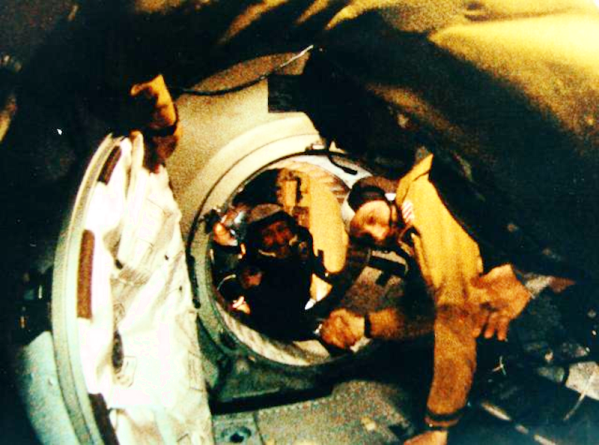
One notable area of cooperation is in spaceflight, and that also was one of the first areas where the two were able to get together in a cooperative fashion, meeting for the first time in orbit, 135 miles up. The mission also marks the ultimate voyage of the Apollo spacecraft, a return to space for the USSR’s luckiest astronauts, and the maiden flight of NASA’s oldest astronaut. The ability to link US and Soviet capsules in space would pave the way for the International Space Station. The Apollo-Soyuz mission was nothing if not historic, but also more relevant than ever as more nations become spacefaring. Continue reading “The Day The Russians And Americans Met 135 Miles Up”→
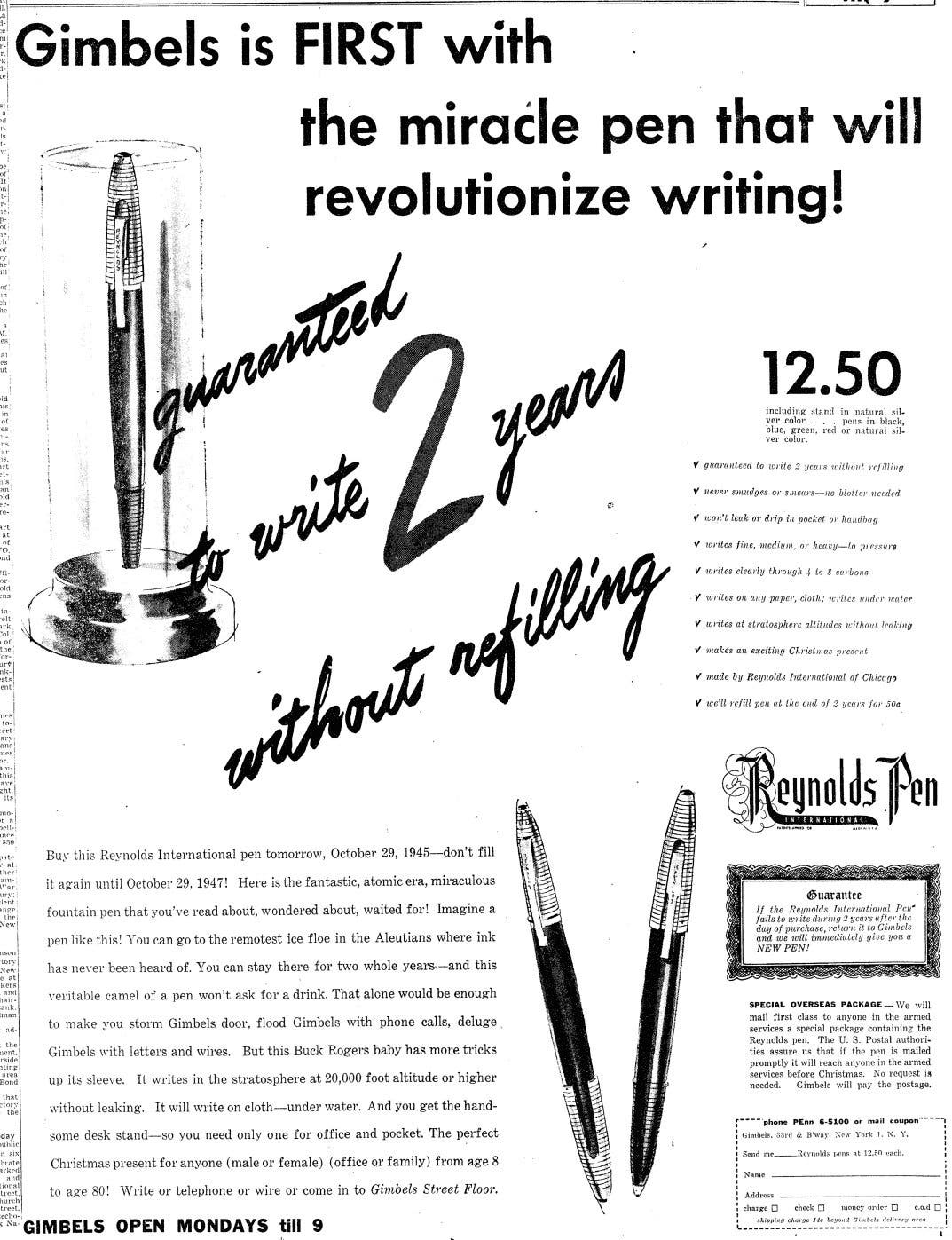
This new pen cost $12.50, which is about $180 today. For many people, the improved experience that the ballpoint promised over the fountain pen was well worth the price. You might laugh, but if you’ve ever used a fountain pen, you can understand the need for something more rugged and portable.
Ballpoint pens are everywhere these days, especially cheap ones. They’re so ubiquitous that we don’t have to carry one around or really think about them at all. Unless you’re into pens, you’ve probably never marveled at the sheer abundance of long-lasting, affordable, permanent writing instruments that are around today. Before the ballpoint, pens were a messy nuisance.
A Revolutionary Pen
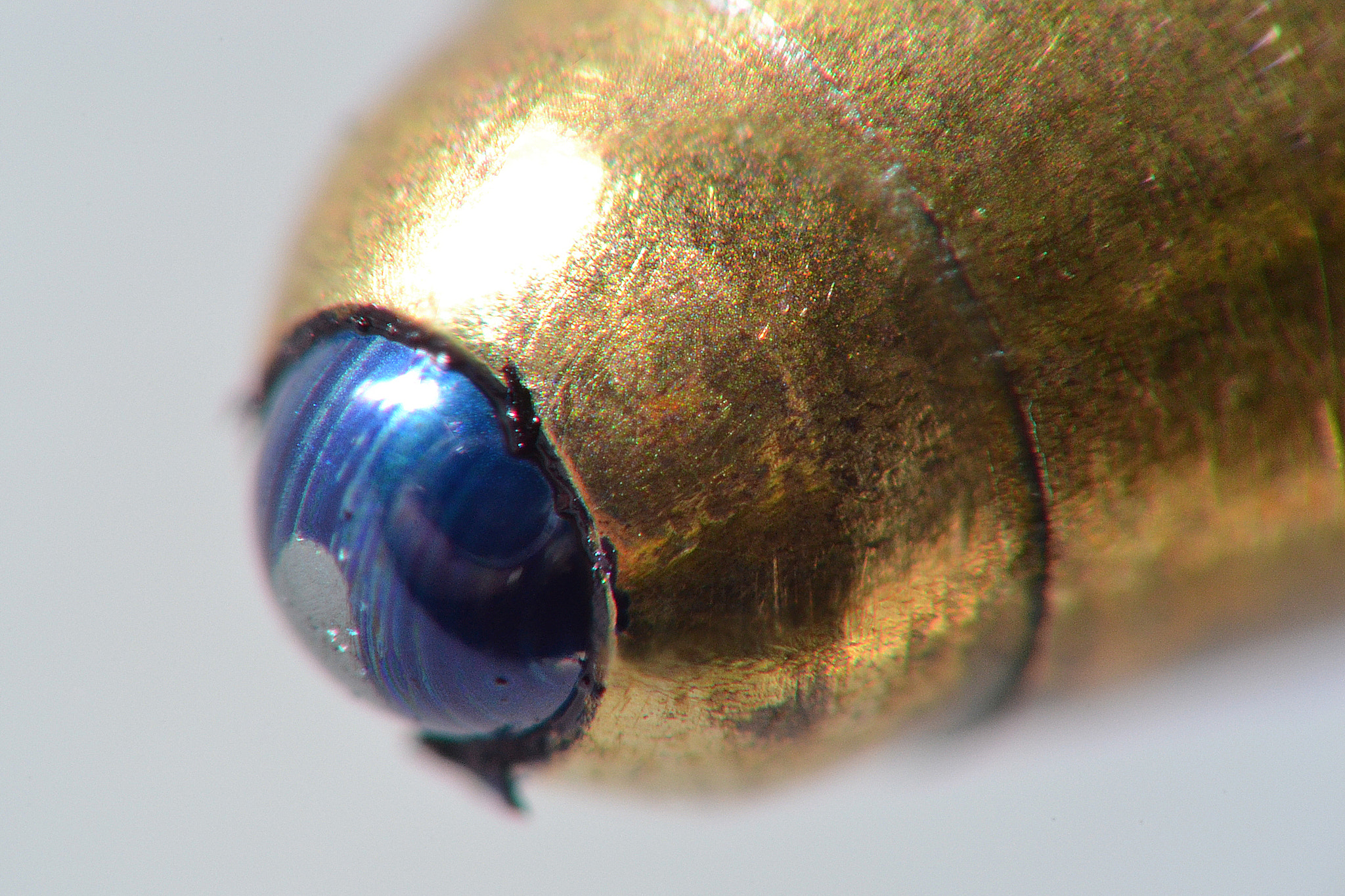
A ballpoint, up close and personal. Image via Wikipedia
Fountain pens use gravity and capillary action to evenly feed ink from a cartridge or reservoir down into the metal nib. The nib is split in two tines and allows ink to flow forth when pressed against paper. It’s not that fountain pens are that delicate. It’s just that they’re only about one step above dipping a nib or a feather directly into ink.
There’s no denying that fountain pens are classy, but you’re playing with fire if you put one in your pocket. They can be a bit messy on a good day, and the cheap ones are prone to leaking ink. No matter how nice of a fountain pen you have, it has to be refilled fairly frequently, either by drawing ink up from a bottle into the pen’s bladder or inserting a new cartridge. And you’re better off using it as often as possible, since a dormant fountain pen will get clogged with dried ink.
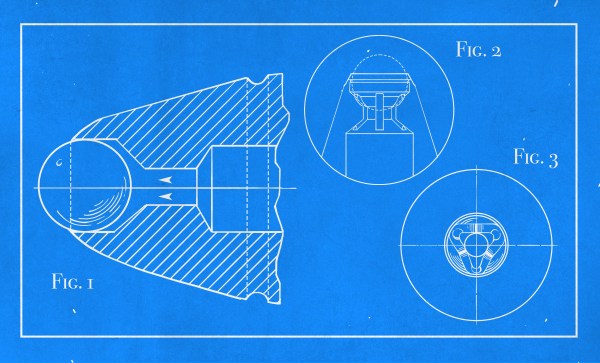
Early ballpoint pens were modeled after fountain pens, aesthetically speaking. They had metal bodies and refillable reservoirs that only needed a top-up every couple of years, compared to once a week or so for fountain pens. Instead of a nib, ballpoints have a tiny ball bearing made of steel, brass, or tungsten carbide. These pens rely on gravity to bathe the ball in ink, which allows it to glide around in the socket like a tiny roll-on deodorant.
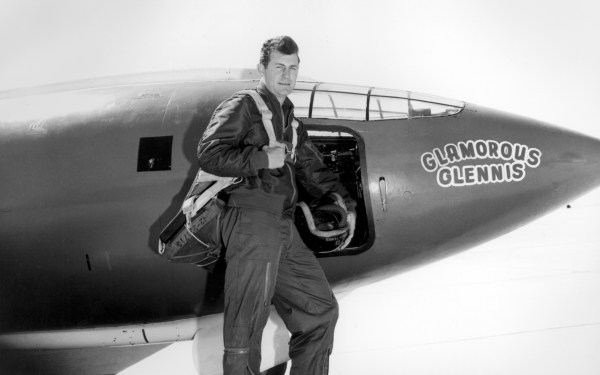
In history there are people whose legacy becomes larger than life. Ask anyone who built and flew the first airplane, and you’d be hard-pressed to find someone who isn’t at least aware of the accomplishments of the Wright brothers. In a similar vein, Chuck Yeager’s pioneering trip into supersonic territory with the Bell X-1 airplane made his name essentially synonymous with the whole concept of flying faster than the speed of sound. This wasn’t the sole thing he did, of course: he also fought in WWII and Vietnam and worked as an instructor and test pilot, flying hundreds of different airplanes during his career.
Yeager’s insistence on making that first supersonic flight, despite having broken two ribs days earlier, became emblematic of the man himself: someone who never let challenges keep him from exploring the limits of the countless aircraft he flew, while inspiring others to give it their best shot. Perhaps ironically, it could be said that the only thing that ever held Yeager back was only having a high school diploma.
On December 7, 2020, Chuck Yeager died at the age of 97, leaving behind a legacy that will continue to inspire many for decades to come.
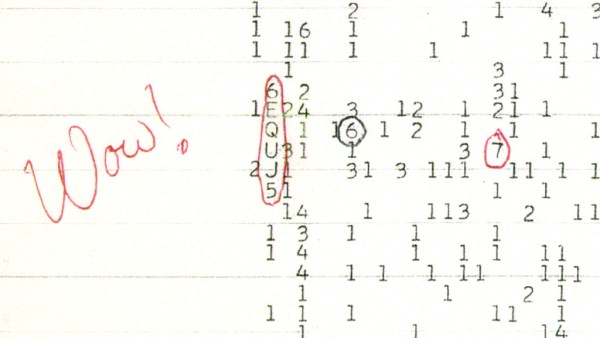
On a balmy August evening in 1977, an enormous radio telescope in a field in the middle of Ohio sat silently listening to the radio universe. Shortly after 10:00 PM, the Earth’s rotation slewed the telescope through a powerful radio signal whose passage was noted only by the slight change in tone in the song sung every twelve seconds by the line printer recording that evening’s data.
When the data was analyzed later, an astronomer’s marginal exclamation of the extraordinarily powerful but vanishingly brief blip would give the signal its forever name: the Wow! Signal. How we came to hear this signal, what it could possibly mean, and where it might have come from are all interesting details of an event that left a mystery in its wake, one that citizen scientists are now looking into with a fresh perspective. If it was sent from a region of space with habitable planets, it’s at least worth a listen.
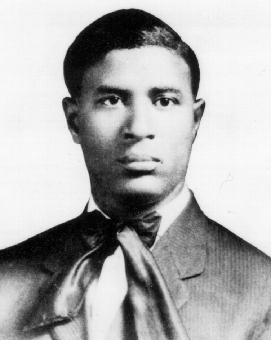
Some people invent with the intent of seeking fame and prestige. Few inventors seem to truly care about other people the way that Garrett Augustus Morgan did. His inventions saved many lives, including those of a few people who were rescued by Garrett himself after an explosion tore through a tunnel beneath Lake Erie.
Though he had little formal education, Garrett’s curiosity took him into many fields from sewing machine repair to gas masks to transportation problems. He achieved great success and improved many lives along the way.
Garrett Augustus Morgan was born March 4th, 1877 in Claysville, Kentucky. He was the seventh of eleven children born to Sydney and Elizabeth Morgan, who had both been slaves. His mother was part Native American.
Armed with a sixth grade education and ten cents in his pocket, Garrett left home at fourteen look for work, which was common for kids his age at the time. He first landed in Cincinnati and spent a few years working as a handyman.
In 1895 he moved to Cleveland and started repairing sewing machines. This is where he developed his taste for the way things work. After a decade or so, he opened his own sewing machine shop. He had gotten married in the meantime, and a few years later, he and his wife Mary Anne, a seamstress, opened a discount ladies clothing store and hired thirty-two employees to make all the suits, coats, and dresses in-house.
One day Garrett was sewing a woolen fabric that kept getting scorched by the extremely high speed of the sewing machine needle. He experimented with a few chemicals to coat the needle and keep it cool. As the story goes, he wiped his hands off on a piece of cloth and went to lunch. When he came back, the wavy fibers in the fabric had been completely straightened by the chemical.
Curious, he tried the solution on his neighbor’s dog’s fur, and it straightened that, too. Then he worked up the nerve to try it on his own hair, and discovered the hair relaxer. He turned the solution into a cream and established the G.A. Morgan Hair Refining Company to sell his hair relaxer to African Americans. The company was terrifically successful and Garrett earned enough money from sales to keep inventing.
It wouldn’t be October without Halloween, and it wouldn’t be Halloween without some spooky music. There’s no instrument spookier than a Theremin, which also happens to be one of the world’s first electronic instruments.
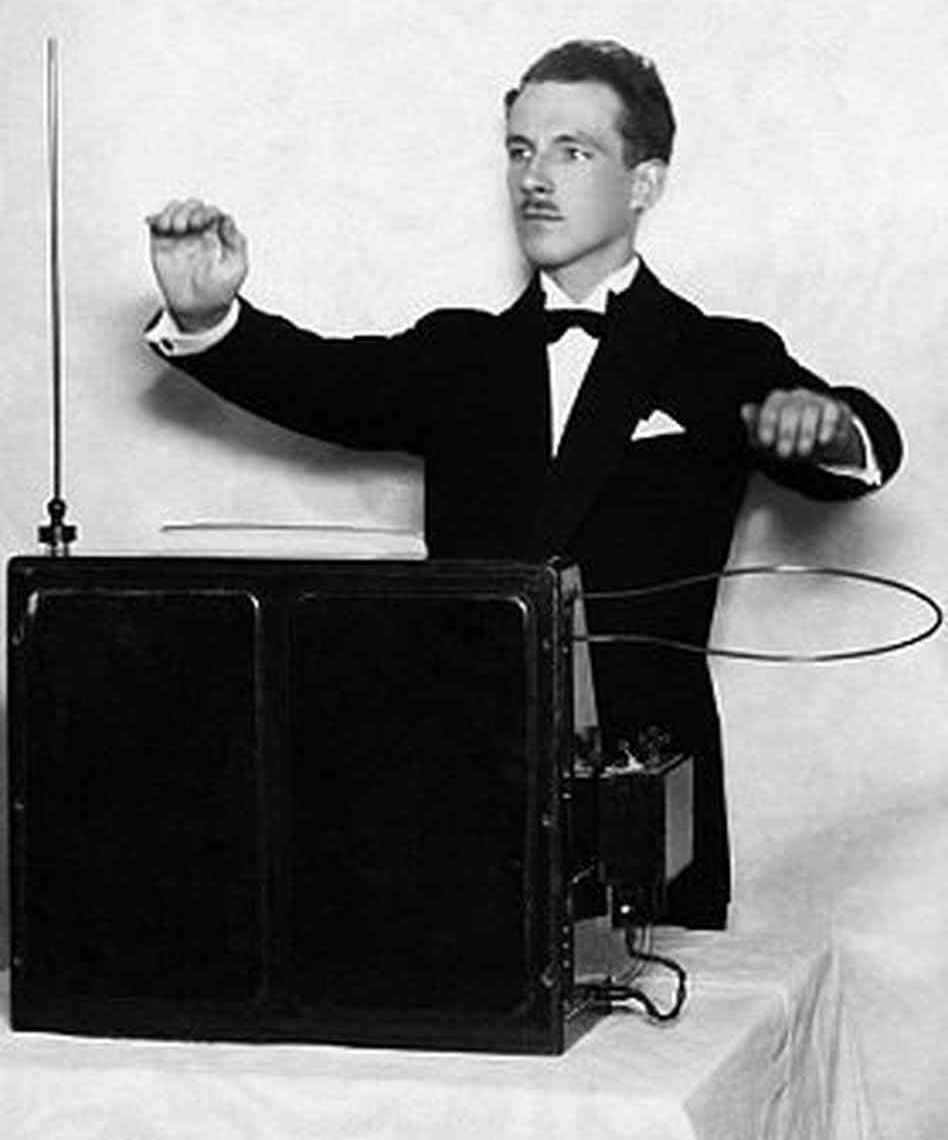
Leon Theremin plays his namesake instrument. Image via Linda Hall Library
You’ve no doubt heard the eerie, otherworldly tones of the Theremin in various 1950s sci-fi films, or heard the instrument’s one-of-a-kind cousin, the Electro-Theremin in “Good Vibrations” by the Beach Boys. The Theremin turns 100 years old this month, so we thought we’d take a look at this strange instrument.
One hundred years ago, a young Russian physicist named Lev Sergeyevich Termen, better known as Leon Theremin, was trying to invent a device to measure the density of various gases. In addition to the standard analog needle readout, he wanted another way to indicate the density, so he devised an oscillator whistle that would change pitch based on the density.
He discovered by accident that having his hand in the field of the antenna changed the pitch of the whistle, too. Then he did what any of us would do — played around until he made a melody, then called everyone else in the lab over to check it out.
Theremin soon showed his device to Lenin, who loved it so much that he sent Lev on a world tour to show it off. While in New York, he played it for Rachmaninoff and Toscanini. In fact you can see a video recording of Leon playing the instrument, a performance that’s more hauntingly beautiful than spooky. In 1928, he patented the Theremin in the United States and worked with RCA to produce them.