Static Radio For The Chumby One

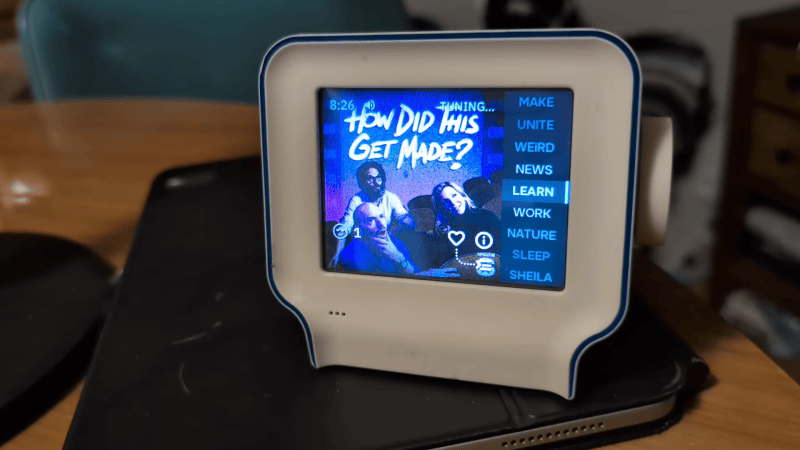
If you haven’t heard of Static Radio, it’s basically an online radio station made up of podcast content. [Brendan Fitzpatrick] decided to take an old 2009 Chumby One and turn it into an appliance for tuning in to Static.

This was achieved by creating a native C Static Radio client that could run on the Chumby’s 454 MHz ARM9 CPU. It’s got no FPU, only 60 MB of RAM, and runs Linux 2.6.28, so it’s not exactly the most up to date platform out there. But nevertheless, [Brendan] was able to make it work.

The client starts from a USB stick, without touching the original firmware on the Chumby itself. [Brendan] bundled in mbedTLS, since the stock Chumby OS shipped with OpenSSL 0.9.7 from 2004, which simply doesn’t cut it today. He also threw in a fixed-point Helix MP3 decoder along with HE-AAC and a polyphase resampler to handle sound, with the audio stream piped out to the kernel’s ALSA PCM device. The client is set up to buffer not only the current station, but the two neighbouring stations on the dial as well, so that turning the knob to switch stations comes with a clean crossfade transition.

If you’ve got a Chumby sitting around doing nothing, this could be the perfect way to put it back to work. We’ve examined other hacks for this venerable piece of hardware, too.
Continue reading “Static Radio For The Chumby One” →

The Sounds Of The World, One Random Album At A Time

In the streaming era it’s easy to forget that there’s still a lot of stuff being broadcast over the radio for anyone who cares enough to dial in their receiver. Give me an antenna big enough and a tower on which to place it, and I shall listen to the world.

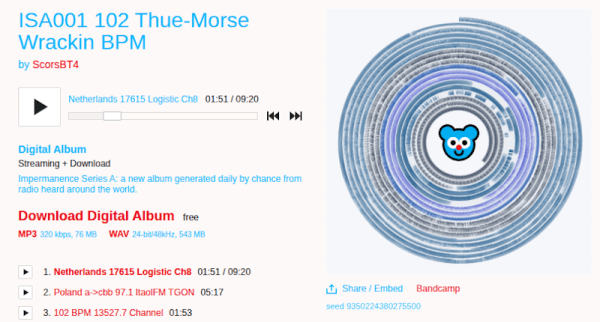
Of course, so you can’t actually listen to everything being blasted out all over the planet yourself. But if you’d like to at least have a little taste, check out Impermanence Series A — a project by [Sam Scorsby] that randomly combines bits and pieces of audio pulled down from shortwave and FM broadcasts with some web streams, live microphones, and even a bit of the Internet Archive each day into a one of a kind album. We’re not sure we’d call it music, exactly. But it’s certainly fascinating to listen to, a bit like randomly spinning the dial on a planet-wide radio receiver.

[Sam] has shared the Python scripts that pull together each day’s album, and he’s not shy about the fact that the project was created with the help of artificial intelligence tools. In fact, that’s sort of the point. [Sam] puts himself somewhere in the middle when it comes to the current debate over AI, and acknowledges that while computers are good at processing raw data, it still takes a human touch to put it all into context.

So each day [Sam] will listen to the latest computer-generated album and pick his favorite tracks, and once the project has run its course, he’ll put together a human-curated “Best Of” collection. Man and machine working together, each doing what they do best.

We know something of opinionated folks on the Internet, and our experience tells us that Impermanence Series A is unlikely to change anyone’s minds when it comes to AI. But we do appreciate the thoughtful approach [Sam] has taken with the project, and look forward to hearing what he comes up with in the end.

Building A Simple Internet Radio

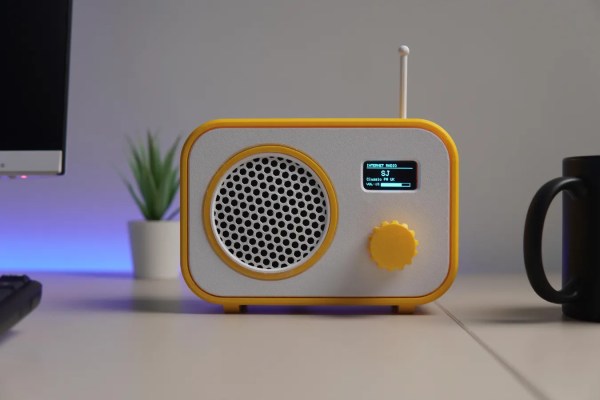
Broadcast radio isn’t as popular as it once was, its popularity suffering in turn due to technologies like MP3 players and music streaming services. If you don’t fancy either of those, you might like to listen to some internet radio stations, using a rig like the one [CodersCafeTech] built.

It’s a simple desktop radio set, but instead of tuning in to AM or FM broadcast bands, it has an antenna for 2.4 GHz instead. That’s because inside this radio is an ESP32-S3 development board, which is equipped with onboard WiFi hardware that lets it connect to the internet. It’s hooked up to a 1.3-inch OLED display over I2C, which acts as a user interface in concert with a rotary encoder. Sound is handled with a MAX98357 I2S audio amplifier, hooked up to a small 3 W speaker. Once programmed appropriately, all the unit needs is a WiFi SSID and password, and the URL for the internet radio station you’d like to listen to.

We’ve featured a few internet radio builds over the years, as well as a rather fun build that saw a Macintosh SE/30 hooked up to Spotify. If you’re tinkering with something along those lines, don’t hesitate to let us know on the tipsline!

Super Mario 64 Comes To The Microsoft Zune

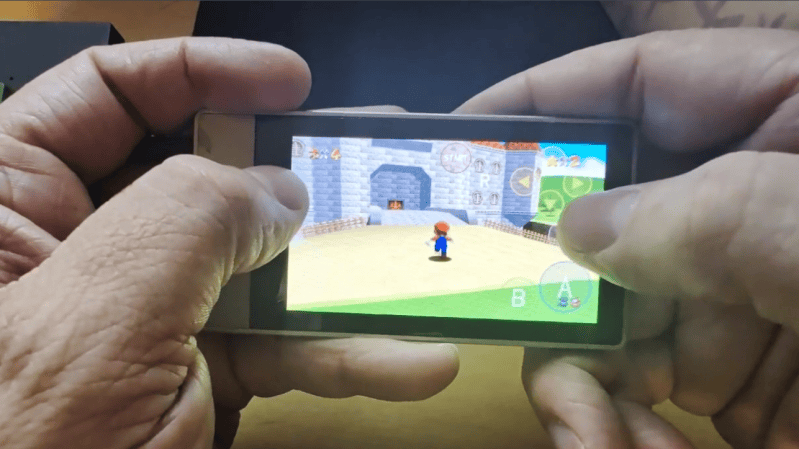
As a portable media player, Microsoft’s Zune simply couldn’t compete with Apple’s juggernaut iPod — the latter essentially becoming the de facto personal media player until smartphones took over. But in 2026 it might be Microsoft that gets the last laugh, as thanks to [rsheldiii] the Zune can now play Super Mario 64.

The software is based on sm64ex, and notably doesn’t include the ROM file necessary to actually run the game. But presuming a legal dump of a cartridge has been done, building and loading it onto a Zune HD is straightforward enough. From there the player is presented with a controller interface on the device’s touchscreen overlaid with the video output from the game. Some interesting things are happening in the background here as well, like using NVIDIA’s Tegra tools to pre-compile shaders so the 2009-era processor can handle the rest of the gameplay.

Although it didn’t enjoy the mainstream success of the iPod, the Zune was actually a pretty solid device, and even though the last of them rolled off the assembly line back in 2012, there’s still a fairly active userbase for it. Modern improvements have added Bluetooth and solid-state drive upgrades for them have been available almost since they were first released.

With Latest Update, Alexa Refuses To Pass The Aux

Although the feature has been deleted from newer models, there was a time when Amazon’s Echo devices included a 3.5 mm “aux” input jack that let you connect other audio sources to the smart speaker. Alexa would even let you switch over to an external source with a voice command — or at least, it used to.

As first reported by Reddit user [n8-sd], Amazon has started informing users that voice control over the 3.5 mm jack is no longer supported. While the physical input will still function on models equipped with it, if you want to mute the audio coming from an external device you’ll have to wade through the Alexa smartphone application to do it.

In a statement to Ars Technica, an Amazon rep confirmed that voice control over the auxiliary input has been removed as of the latest software version, and that their analytics showed not many people were using the feature in the first place. They also pointed out that no changes have been made to voice control of Bluetooth devices. While we don’t doubt that the total number of users that were physically plugging an audio source into their Echos was probably low in the grand scheme of things, that doesn’t really explain why such a simple feature needed to be actively removed.

Some commenters have theorized that the real reason behind the change is the fact that Amazon has no way of monitoring what users are playing over the auxiliary input. Since cataloging and selling the media consumption habits of users is big business these days, that’s a problem. While they might prefer to disable the feature entirely, they know that would stir up some bad press, so they’re opting to simply make it more annoying to use. We’re not saying we entirely buy this explanation, but it’s not the craziest thing we’ve ever heard either.

Although the Echo devices have never been particularly hackable, they have enjoyed a certain amount of success with tech-savvy users, making it all the more disappointing to see the ecosystem seemingly becoming less capable over time.

Is This The Smallest Internet Radio?

Internet radios have been a thing in some form for the last quarter century, and the advent of cheap networked microcontrollers has made them easier than ever to build. But just how small can one be made? [Milen] has made one that’s about as small as we’ve seen, and put it up on Instructables.

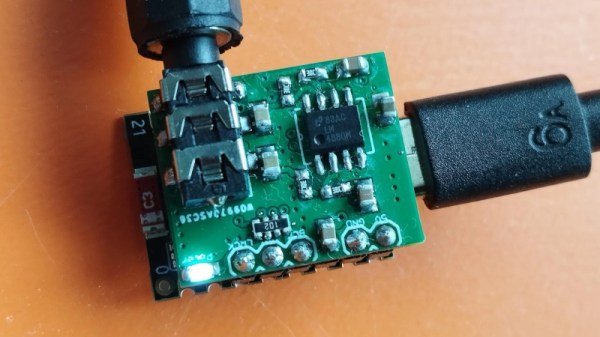
The hardware recipe is straightforward enough; take a microcontroller, connect it to the internet, and have your internet radio software squirt its output to a DAC. In this case the microcontroller is an ESP32-C£ on a very small dev board, and clipped to that is a custom PCB with a PCM5102A I2S DAC and an amplifier. The whole thing is tiny, small enough in fact that the two connectors are significant in size compared to it.

Whether or not it’s a practical device for listening remains to be seen, but it’s certainly tiny. But the question is, could it be made smaller? Perhaps eschewing the connectors would be an easy win, and in return for a loss in quality the ESP has a built-in DAC that’s not intended for audio but can be used. If you have any bright ideas, we’d be interested to hear them.

We’ve seen plenty of internet radios over the years, and for some reason this cassette-shaped one appeals to us.

Making A Digital Music Player For Cassette Decks

In the cross-over between the era of tapes into that of MP3s, you’d see quite a few of those special cassette tapes that were actually digital music players inside. Some simply provided a 3.5 mm input, while others were complete MP3 players or Bluetooth receivers that just happened to also output to the magnetic read head of a cassette player. Recently [Jonathan Rowny] decided to make his own version of the latter.

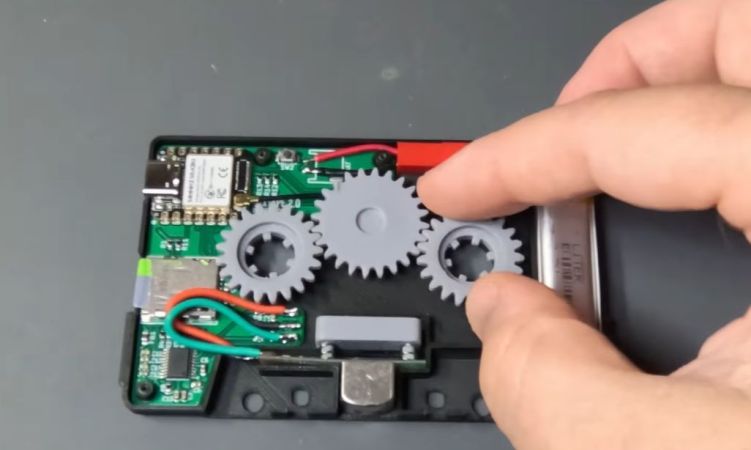
Although getting the actual audio signal into the read head is easy enough – requiring little more than its equivalent being used as a write head on the cassette side – actually interfacing with the player’s mechanisms like auto-stop, reverse and so on requires the use of some gearing that detect motion on what would be the tape spools, as well as transfer the motion from the take-up spool to the other spool so that features like the auto-stop mechanism don’t get triggered.

A lot of inspiration here can be found in e.g. the videos made by [Clint] of [Lazy Game Reviews] who looked at a number of examples – including their internals – over the years, with various levels of functionality. For this particular implementation an ESP32-S3 module is used for the brains, along with a microSD card reader for music and a PCM5102 I2S audio codec to create the analog audio signal.

The gears were printed using an SLA printer and seem to work all right. Unfortunately he didn’t realize the importance of the capstan as the mechanism that actually transports the tape, so its motion was not measured as is done in the better cassette adapters. This will likely be corrected in a future iteration, however.

Continue reading “Making A Digital Music Player For Cassette Decks” →