Seeing The World Through Animal Eyes

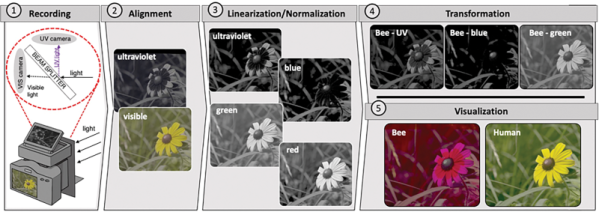
If you think about it, you can’t be sure that what you see for the color red, for example, is what anyone else in the world actually sees. All you can be sure of is that we’ve all been trained to identify whatever we do see as red just like everyone else. Now, think about animal vision. Most people know that dogs don’t see as many colors as we do. On the other hand, the birds and the bees can see into ultraviolet. What would the world look like with extra colors? That’s the question researchers want to answer with this system for duplicating different animals’ views of the world.

Of course, this would be easy if you were thinking about dogs or cats. They can’t see the difference between red and green, making them effectively colorblind by human standards. Researchers are using modified commercial cameras and sophisticated video processing to produce images that sense blue, green, red, and UV light. Then they modify the image based on knowledge of different animal photoreceptors.

We were somewhat surprised that the system didn’t pick up IR. As we know snakes, for example, can sense IR. You’d think more sophisticated animals would have better color vision, but that seems to be untrue. The mantis shrimp, for example, has 12-16 types of photoreceptors. Even male and female humans have different vision systems that make them see colors differently.

Maybe you need a photospectrometer. You wonder if animals dream in color, too.
Experiment With The Pi Camera The Modular Way

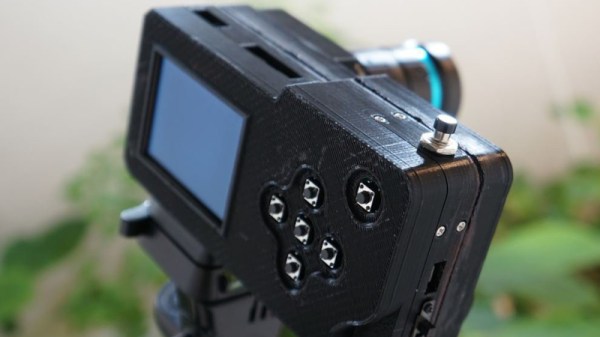
The various Raspberry Pi camera modules have become the default digital camera hacker’s tool, and have appeared in a huge number of designs over the past decade. They’re versatile and affordable, and while the software can sometimes be a little slow, they’re also of decent enough quality for the investment. Making a Pi camera can be annoying though, because different screens, lenses, and modules have their own mounting requirements. [Jacob David C Cunningham] has a solution here, with a modular Raspberry Pi camera, as an experimentation platform for different screens and lenses.

It takes the form of a central unit that holds the Pi and its support components, and front and rear modules for the screens or displays. Examples are given using the HQ and non-HQ modules, as well as with round or rectangular displays.

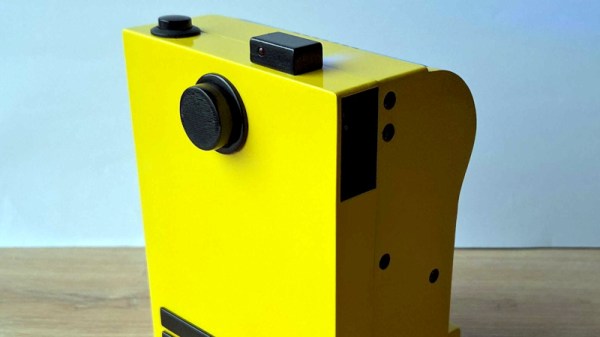
When designing a camera for 3D printing it’s a very difficult task, to replicate or exceed the industrial design of commercial cameras. Few succeed, and we’d include ourselves among that number. But this one comes close; it looks like a camera we’d like to use. We like it.

The Tragic Demise Of The Technirama Prism-Based Anamorphic Lens

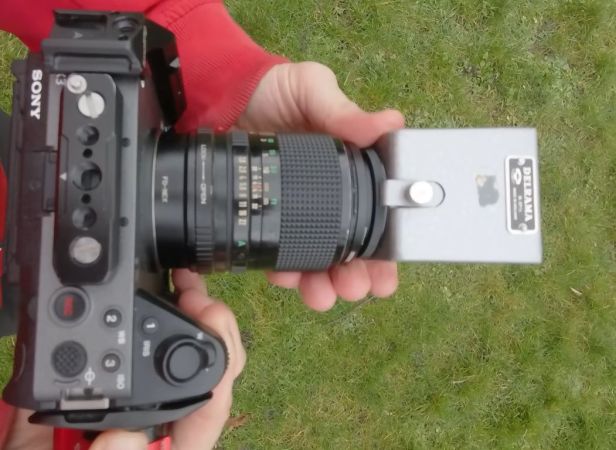
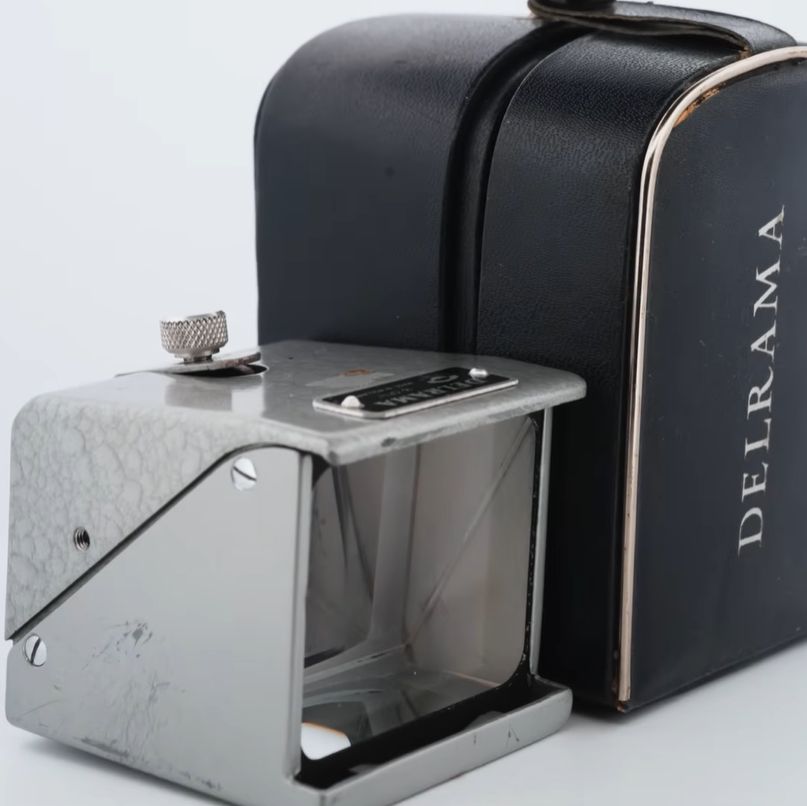
A commercial Delrama prism-based anamorphic lens for large cameras. (Source: Mathieu Stern, YouTube)

Although to the average person a camera lens is just that bit of glass you stick on the front of the camera to make stuff appear in focus, there’s a whole wide world out there of lens designs and modifications with enough variety to make your head spin. Some of these designs make a big impact, while others fade away again, sometimes at the whims of film makers and photographers. Prism-based anamorphic lenses are an oddity that recently [Mathieu Stern] got his hands on. (Video, embedded below.)

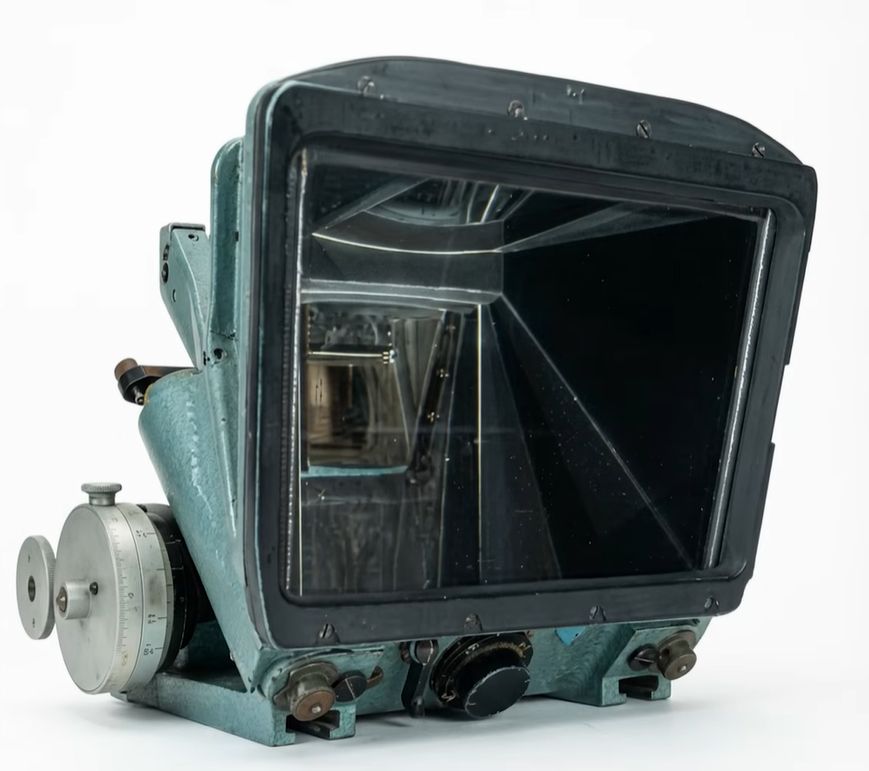
During the 1950s and 1960s there was a bit of a competition between anamorphic formats, which use special lenses that ‘squeeze’ a larger image so that widescreen movies could be recorded on standard 35 mm film. By using the same lens for recording and playback, the result was a mostly distortion-free image. Here the Technirama format by Technicolor who teamed up with Dutch company De Oude Delft (‘Old Delft’) to produce the prism-based Delrama lenses that fit on existing lenses for cameras and projectors.

The last gasp of the Delrama anamorphic lenses. (Credit: Mathieu Stern, YouTube)a

Despite having a clearly superior, distortion-free image than the cylindrical lenses of the competition, Technirama got pushed out of the commercial market, leaving De Oude Delft to try and interest the consumer market for Delrama with 8 and 16 mm adapters. These latter are the ones that [Mathieu] got his hands on and tried out with a DSLR camera.

Troublesome with these Delrama adapters is that their silver mirrors tend to degrade over time, and they also turned out to be rather fragile, which are both things that made consumers sour on them. Another challenge was the fixed four meter focus that’s great when you’re using it with a projector, but terrible for up-close shots. All of these issues resulted in Delrama fading from the market by the 1970s until all that remains are these remnants of a format that once was used to film some of the biggest Hollywood movies.

Continue reading “The Tragic Demise Of The Technirama Prism-Based Anamorphic Lens”

Instant Photography For The Maker

Instant photography is a miracle of the analog age, chemical photographs that develop in your hands moments after the shutter has been pressed. You can buy instant cameras and film from Fuji and the successor company to Polaroid, the originator of the technology, but they’re expensive. Fortunately [BoxArt] is here for those seeking a cheaper alternative, with an instant camera featuring a Raspberry Pi and a printer (Lithuanian language, Google Translate link).

It’s a fairly straightforward arrangement, with the Pi Zero and camera driving a receipt printer. There’s a nicely engineered 3D printed case, and the guts of a power bank to provide the volts for the thing. There are a set of status lights on top, and that’s it. Press the button, get a not-very-good grayscale image on curly paper.

You can of course buy off-the-shelf grayscale printing cameras from your favorite import site for much less than the cost of this camera, but we think this would probably take better pictures. Meanwhile if the original instant photography interests you, we’ve got you covered.

Pan-Tilt Head For Camera Motion Control

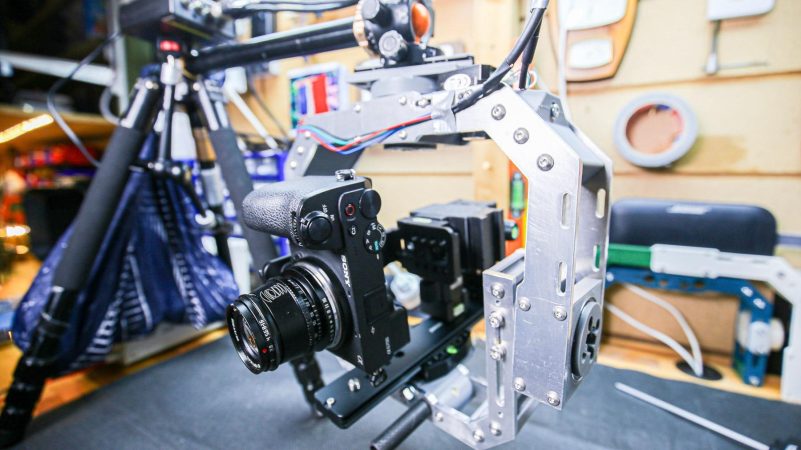
Historically, moving and pointing a camera while filming was the job of a highly-skilled individual. However, there are machines that can do that, enabling all kinds of fancy movement that is difficult or impossible for a human to recreate. A great example is this pan-tilt build from [immofoto3d.]

The build uses a hefty cradle to mount DSLR-size cameras or similar. It’s controlled in the tilt axis by a chunky NEMA 17 stepper motor hooked up to a belt drive for smooth, accurate movement. Similarly, another stepper motor handles the pan axis, with an option for upgrade if you have a heavier camera rig that needs more torque to spin easily. Named Gantry Bot, it’s an open-source design with source files available, so you can make any necessary tweaks on your own. You will have to bring your own control mechanism, though—telling the stepper motors what to do and how fast to do it is up to you.

It’s a heavy-duty build, this one, and you’ll really want a decent metal-capable CNC to get it done, along with a 3D printer for all the plastic pieces. With that said, we’ve featured some other similar builds that might be more accessible if you don’t have a hardcore machine shop in the basement. If you’ve got your own impressive motion rig in the works, be sure to notify the tipsline!

Random Number Generator Uses Camera Noise

Random numbers are very important to us in this computer age, being used for all sorts of security and cryptographic tasks. [Theory to Thing] recently built a device to generate random numbers using nothing more complicated than simple camera noise.

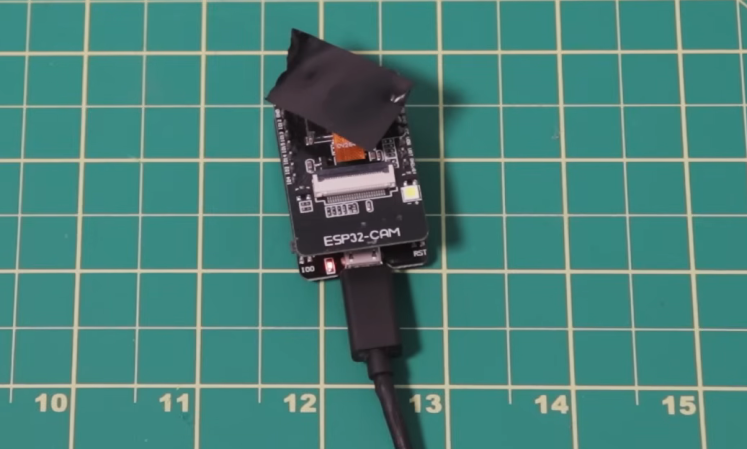
The heart of the build is an ESP32 microcontroller, which [Theory to Thing] first paired with a temperature sensor as a source of randomness. However, it was quickly obvious that a thermocouple in a cup of tea wasn’t going to produce nice, jittery, noisy data that would make for good random numbers. Then, inspiration struck, when looking at vision from a camera with the lens cap on. Particularly at higher temperatures, speckles of noise were visible in the blackness—thermal noise, which was just what the doctor ordered.

Thus, the ESP32 was hooked up to an OV3660 camera, which was then covered up with a piece of black electrical tape. By looking at the least significant bits of the pixels in the image, it was possible to pick up noise when the camera should have been reporting all black pixels. [Theory to Thing] then had the ESP32 collate the noisy data and report it via a web app that offers up randomly-generated answers to yes-or-no questions.

[Theory to Thing] offers up a basic statistical exploration of bias in the system, and shows how it can be mitigated to some degree, but we’d love a deeper dive into the maths to truly quantify how good this system is when it comes to randomness. We’ve featured deep dives on the topic before.

Continue reading “Random Number Generator Uses Camera Noise”

Panoramic Film Camera Made From 3D Printed Parts

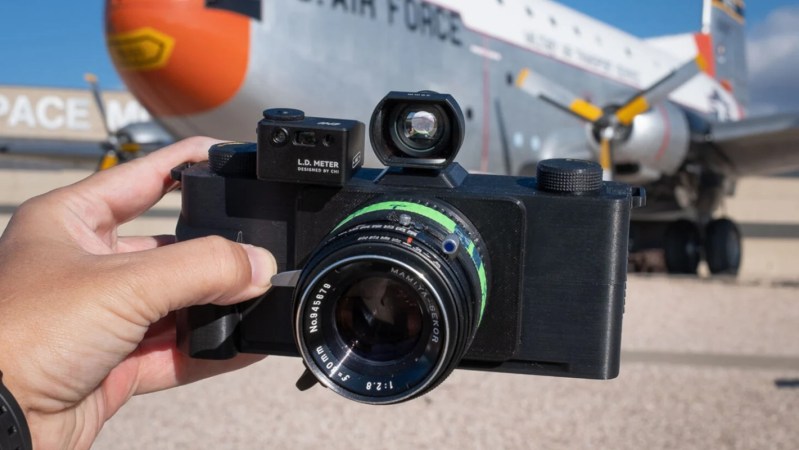
Even though digital cameras have lowered the barrier of entry to photography dramatically, as well as made it much easier for professionals and amateurs alike to capture stunning images without the burden of developing film, the technology behind them is considerably more complex than their analog counterparts. In fact, an analog film camera (not counting the lens) can be as simple as a lightproof box and a way to activate a shutter. Knowing that, any kind of film camera could be built for any number of applications, like this 3D-printed panoramic camera from [Denis Aminev].

The custom-built camera works by taking a standard roll of 35mm film, which is standardized to take 36 pictures, and exposing a wider section of the film to create a panorama. This reduces the number of pictures on the roll to 19. This is the fifth version of this camera, called the Infidex 176 V, and has everything a standard film camera would have, from an exposure counter, pressure plate for the film, a winder, interchangable lenses, a viewfinder, and a tripod mounting point. It does take a bit of work to assemble, as shown in the video linked below, but the final result is impressive and delivers a custom finished product not easily found or reproducible in off-the-shelf cameras.

The path to creating this camera was interesting as well, as [Denis]’s first custom film camera was a pinhole camera. From there he moved on to disassembling an SLR camera and attempting to reproduce all of its parts with 3D printed ones. With that in hand, he was able to modify this design into this panoramic camera which he likes because it reproduces the feel of widescreen movies. Although this camera reproduces all of the bells and whistles of a high quality analog camera, not all of these features are strictly necessary for taking pictures on film. Have a look at this minimum viable camera as well.

Continue reading “Panoramic Film Camera Made From 3D Printed Parts”