Manned Electric Helicopter With 7 Tail Rotors

One of the best things to come from the growing drone industry is the development of compact and powerful brushless motors. We’ve seen several multi-rotors capable of carrying a human, but electric helicopters are rare. [OskarRDA] decided to experiment with this, converting his single-seat ultralight helicopter to electric power and giving it seven tail rotors in the process. Flight footage after the break.

The helicopter in question started life as a Mosquito Air, a bare-bones kit helicopter originally powered by a two-stroke engine. The engine and gearbox were replaced with an EMRAX 228 109 kW brushless motor. Initially, he used the conventional drive-shaft powered tail rotor but wanted to experiment with multiple smaller rotors powered by separate motors, which has several advantages. He only really needed four of the 5008 or 5010 size motors with 18″ props to get comparable thrust, but he added more for redundancy. The new setup was also lighter, even with its independent batteries, at 7.5 kg compared to the 8.1 kg of the old tail rotor assembly.

One of the major advantages of a conventional helicopter over a multirotor is the ability to autorotate safely to the ground if the engine fails. A coupled tail rotor bleeds some energy from the main rotor while autorotating, but since the tail rotor has independent power in this case, it allows all the energy to be used by the main rotor, theoretically decreasing decent speed by 120 feet per second. [OskarRDA] did some engine failure and autorotation test flights, and the results were positive. He likes his new tail rotors enough that he doesn’t plan on going back to a single large rotor.

Power for the main motor is provided by a 7.8 kWh, 40 kg LiPo battery pack mounted beneath the seat. Theoretically, this would allow flight times of up to 27 minutes, but [OskarRDA] has kept most of his flights to 10 minutes or less. He didn’t add any electronic gyro for stabilization, but he did add some electronic coupling between the main motor and tail motors, to reduce the torque correction required by the pilot. Even so, it is clear from the flight footage that [OskarRDA] is a skilled helicopter pilot. Continue reading “Manned Electric Helicopter With 7 Tail Rotors”

DRehmFlight: Customizable Flight Stabilisation For Your Weird Flying Contraptions

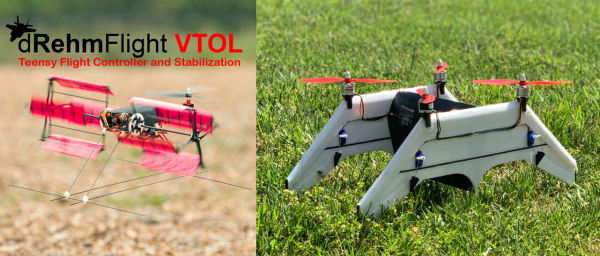
The availability of cheap and powerful RC motors and electronics has made it possible for almost anyone to build an RC flying machine. Software is usually the bigger challenge, which has led to the development of open-source packages like BetaFlight and Ardupilot. These packages are very powerful, but not easy to modify if you have unconventional requirements. [Nicholas Rehm] faced this challenge while doing his master’s degree, so he created dRehmFlight, a customizable flight controller for VTOL aircraft. Overview video after the break.

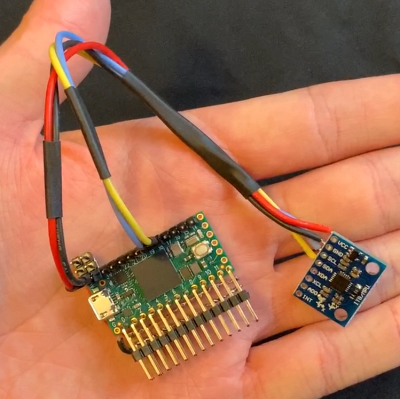
dRehmFlight runs on Teensy 4.0 with a MPU6050 or MPU9250 IMU

[Nicholas] has been building unique VTOL aircraft for close to a decade, and he specifically wanted flight stabilization software that is easy to modify and experiment with. Looking at the dRehmFlight code, we think he was successful. The main flight controller package is a single file of fewer than 1600 lines. It’s well commented and easy to figure out, even for an inexperienced programmer. A detailed PDF manual is also available, with full descriptions for all the functions and important variables, and a couple of tutorials to get you started. Libraries for interfacing with accelerometers and RC gear is also included. It runs on a 600 Mhz Teensy 4.0, and all the programming can be done from the Arduino IDE.

[Nicholas] has repeatedly demonstrated the capabilities of dRehmFlight with several unique aircraft, like the belly floppingĀ RC Starship we covered a while ago, a VTOL quad rotor biplane, VTOL F35, and the cyclocopter seen in the header image. dRehmFlight might not have the racing drone performance of BetaFlight, or advanced autopilot features of Ardupilot, but it’s perfect for getting unconventional aircraft off the ground. Continue reading “DRehmFlight: Customizable Flight Stabilisation For Your Weird Flying Contraptions”

Orphaned Gimbal Gets Second Chance To Fly

A reality of flying RC aircraft is that at some point, one of your birds is going to fall in the line of duty. It could get lost in the clouds never to be seen again, or perhaps it will become suddenly reacquainted with terra firma. Whatever the reason, your overall enjoyment of the hobby depends greatly on how well you can adapt to the occasional loss.

Based on what we’ve seen so far, we’d say [Rural Flyer] has the right temperament for the job. After losing one of his quadcopters in an unfortunate FPV incident, he decided to repurpose the proprietary gimbal it left behind. If he still had the drone he could have slipped a logic analyzer in between its connection with the motorized camera to sniff out the communication protocol, but since that was no longer an option, he had to get a little creative.

Figuring out the power side of things was easy enough thanks to the silkscreen on the camera’s board, and a common 5 V battery eliminator circuit (BEC) connected to the drone’s 7.4 V battery pack got it online. A cobbled together adapter allowed him to mount it to one of his other quads, but unfortunately the angle wasn’t quite right.

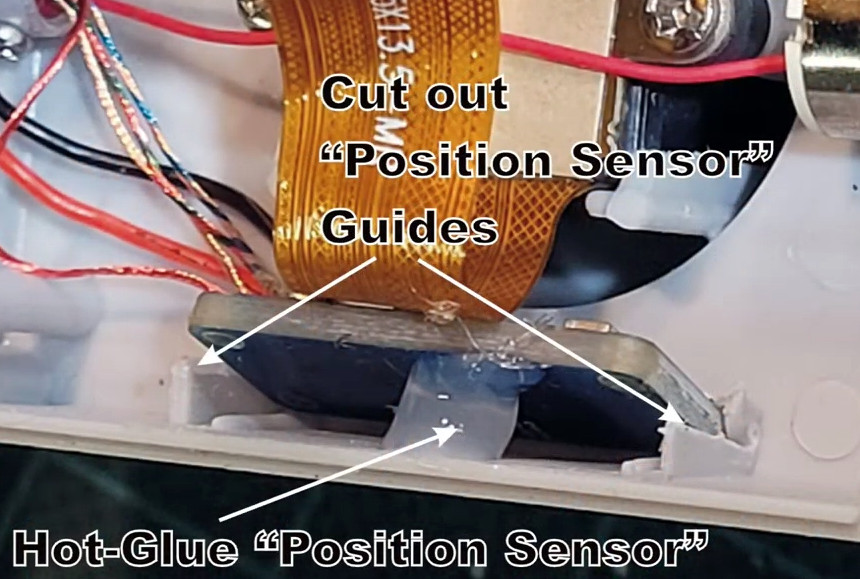
[Rural Flyer] wanted the camera tilted down about 15 degrees, but since he didn’t know how to talk to it, he employed a clever brute force solution. After identifying the accelerometer board responsible for determining the camera’s position, he use a glob of hot glue to push the sensor off of the horizontal. Providing this physical offset to the sensor data caused the camera to automatically move itself to exactly where he wanted it.

Continue reading “Orphaned Gimbal Gets Second Chance To Fly”

Controlling A Quadcopter With One Dead Motor

Quadcopters have incredible flying abilities, but if one loses just a single motor, it drops like a rock. Researchers from the University of Zurich’s Robotics and Perception Group have proven that this does not need to be the case by keeping a quadcopter flying with only three motors.

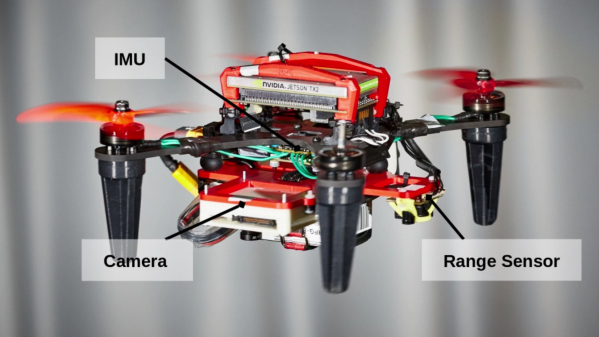
A quadcopter usually has enough thrust to stay aloft with only three motors, but it will spin uncontrollably in the yaw axis. It is impossible to stop a quadcopter from spinning, so the focus for researchers was on keeping the drone controllable while it’s spinning. To achieve this, accurate position and motion estimation is required, so they attached a pair of cameras to the bottom of the craft for visual-inertial odometry (VIO). One is a normal optical camera, while the other is an event camera, which has pixels that can independently respond to changes in light as they occur. This means that it has better low light performance and does not suffer from motion blur.

The feeds from the cameras are analyzed in real-time by an onboard Nvidia Jetson TX2 for state estimation, which is then used with an optical range sensor and onboard IMU to maintain controlled flight, as demonstrated in the video after the break. The research paper is free to read, and all the code is available on GitHub.

New developments in drone control schemes are always fascinating, like this hexacopter with an innovative motor layout to achieve six degrees of freedom, or a conventional helicopter with a virtual swash plate.
Continue reading “Controlling A Quadcopter With One Dead Motor”

How To Run Alternative Batteries On The DJI Mavic Mini

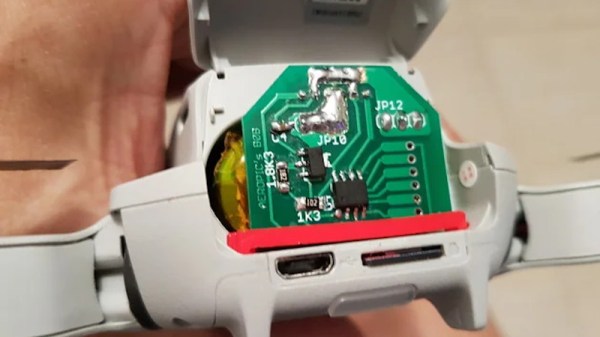
Rechargeable batteries are ubiquitous these days, freeing us from the expense and hassle of using disposable cells. However, this has come with the caveat that many manufacturers demand their equipment only be used with their own official batteries. [aeropic] wasn’t a fan of this, so built a circuit to allow his DJI Mavic Mini to fly with any batteries he pleased.

The Mavic Mini uses I2C to communicate with official packs, making the hack relatively straightforward. [aeropic] built a board nicknamed B0B, which tells the drone what it wants to hear and lets it boot up with unofficial batteries installed. The circuit uses a PIC12F1840 to speak to the drone, including reporting voltage on the cells installed. Notably, it only monitors the whole pack, before dividing the voltage to represent the value of individual cells, but it shouldn’t be a major problem in typical use. Combined with a few 3D printed components to hold everything together, it allows you to build your own cheap pack for the Mavic Mini with little more than a PCB and a few 18650 cells.

It’s always good to see hackers getting out and doing the bread and butter work to get around restrictive factory DRM measures, whether its on music, printer cartridges, or drone batteries. We’ve even seen the scourge appear on litter boxes, too. Video after the break.

Continue reading “How To Run Alternative Batteries On The DJI Mavic Mini”

ExpressLRS: Open Source, Low Latency, Long Range RC Protocol

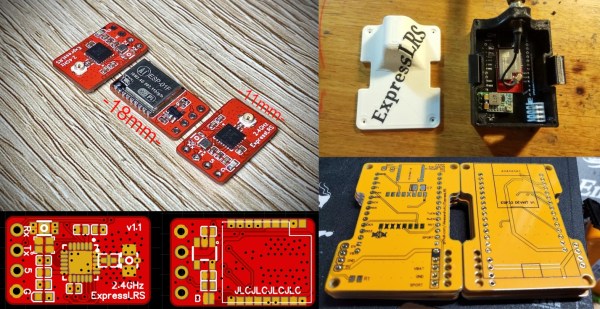
One of the major choices a newcomer to the RC flying hobby must make is on the RC link protocol. To add the list of choices (or confusion) there is now a new open-source, low latency, and long-range protocol named ExpressLRS.

ExpressLRS’s claim to fame is high packet rates of up to 500 Hz, with plans for 1000 Hz, and latency as low as 5 ms. Long-range testing has pushed it out to 30 km with a flying wing (video below), but this is not unheard of for other protocols. Most modern RC protocols run either in the 2.4 GHz or 915/868 MHz bands, with the latter having a definite advantage in terms of range.

ExpressLRS has options to run on either band, using Semtech SX127x (915/868 MHz) or SX1280 (2.4 GHz) LoRa transceivers, connected to STM32, ESP32, or ESP8285 microcontrollers. The ESP microcontrollers also allow software updates over Wi-Fi.

We’re excited to see an open-source competitor to the proprietary protocols currently dominating the market, but several open-source protocols have come and gone over the years. Hardware availability and compatibility is a deciding factor for a new protocol’s success, and ExpressLRS already has an advantage in this regard. Existing Frsky R9 transmitters and receivers, and Immersion RC Ghost receivers are compatible with the firmware. There are also DIY options available, and the GitHub page claims that several manufacturers are working on official ExpressLRS hardware.

If you’re already into the RC hobby, and you have compatible hardware lying around, be sure to give it a try and give some feedback to the developers! One scenario we would like to see tested is high interference and congested band conditions, like at RC flying events.

All the source code and hardware designs are available on GitHub, and there are active community discussions on Discord. Continue reading “ExpressLRS: Open Source, Low Latency, Long Range RC Protocol”

Mavic Mini Gets Custom Clear Case

Apparently, in the drone scene, sticker wraps are popular for a custom aesthetic. [Useless Mod] wanted to go a little further, however, and decided to build a full crystal enclosure for his Mavic Mini, facing some hurdles along the way. (Video, embedded below.)

The first stage of the build was disassembly, with the compact 249 gram drone requiring a deft touch to avoid damaging the delicate ribbon cables and mechanisms inside. With the drone stripped down to its bare components, a silicone mould was made of each individual piece of the case, with new parts being cast in clear epoxy. It’s not a job for the faint of heart, with many undercuts and complex features to contend with. However, [Useless Mod] managed to produce the parts and get it all back together.

An initial test flight ended poorly, when the drone entered an uncontrollable wobble due to the case not being fully assembled. However, with fresh internals and with everything properly put together, everything worked! It’s not a build we’d suggest for the inexperienced, as the moulds required are complex and the electronics quite fragile. The final result is a good one though, and it even weighs 10 grams less than the original casing!

For those in the US, the world of drones is set to change drastically in short order.

Continue reading “Mavic Mini Gets Custom Clear Case”