Last Monday we held our very first Hackaday Projects Meetup at the Congregation Ale House in Pasadena, CA. We knew there were a lot of Hackaday.io members in the area and figured a meetup is a great excuse for them to meet each other.
The turn out was surprisingly good, with a wide variety of makers and hackers. People I met included aerospace engineers, embedded device developers, 3d printer inventors, and web developers. About thirty Hackaday readers turned up along with some newbies and a merry few hours of drinking beer, exchanging tales, poking at blinky things and admiring 3d printers ensued.
Despite being full of techies and people doing interesting things with portable devices, you don’t want to have an active radio on you within a quarter-mile of DEFCON. The apps on your phone leak personal data onto the Internet all the time, and the folks at DEFCON’s Wall Of Sheep were very successful in getting a few thousand usernames and passwords for email accounts.
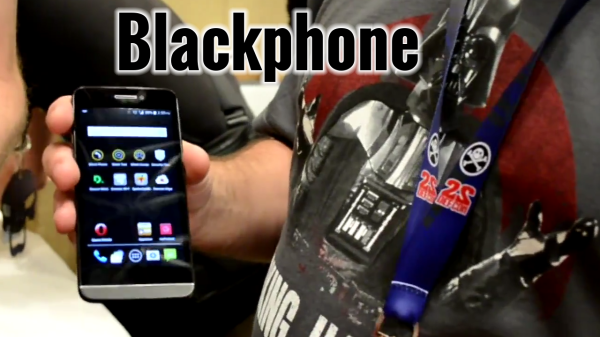
Blackphone is designed to be the solution to this problem, so when we ran into a few members of the Blackphone crew at DEFCON, we were pretty interested to take a quick peek at their device.
The core functionality for the Blackphone comes from its operating system called PrivatOS. It’s a fork of Android 4.4.2 that is supposed to seal up the backdoors found in other mobile phones. There’s also a bundle of apps from Silent Circle that give the Blackphone the ability to make encrypted phone calls, texts (with file sharing), and encrypted and password protected contact lists.
The hardware for the Blackphone is pretty impressive; a quad-core Nvidia Tegra provides all the power you need for your apps, video, and playing 2048, a 2000mAh battery should provide enough juice to get you through a day or two (especially since you can turn off cores), and the usual front/rear cameras, GPS, 802.11bgn and GSM and HSPA+/WCDA radios means this phone will be useable on most networks.
A little over a year ago I had a semi-gruesome accident; I stepped off of a ladder and I caught my wedding ring on a nail head. It literally stripped the finger off the bone. This was in spite of me being a safety-freak and having lived a whole second life doing emergency medicine and working in trauma centers and the like. I do have trauma center mentality which means, among other things, that I know you can’t wind the clock back.
A few seconds make an incredible differences in people’s lives. Knowing that it couldn’t be undone, I stayed relaxed and in the end I have to say I had a good time that day as I worked my way through the system (I ended up in a Philadelphia trauma center with a nearby hand specialist) as I was usually the funniest guy in the room. Truth be told they ask incredibly straight questions like”are you right handed?” “Well I am NOW”.
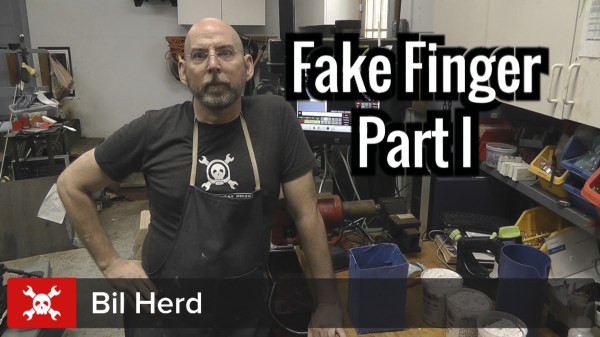
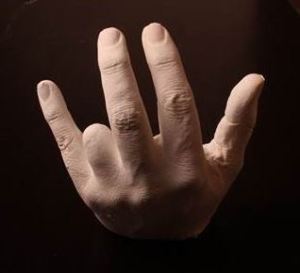
So now I could really use a bit of a body hack, having seen the X-Finger on Hackaday long before I knew that I would one day work with them, I was hoping that we could get one to work for me. In speaking with a couple of the mechanical engineers on the Hackaday staff we decided to get [James Hobson] and [Rich Bremer] involved and that the best way to do it was to get a casting of my injured hand out to them.
Who cares about Open Design and building the next generation of Connected Devices? It turns out a lot of people do!
The Hackaday Prize put out the call for Open, Connected design ideas and around 800 projects were posted over the last few months to answer that call. The cutoff for documenting your concept and making entry to the contest was just before midnight last Wednesday. Since then our crew has been going through the entries to select 50 to move on as Semifinalists. Here’s who made the cut:
Nothing says “Welcome to Vegas” like a massive turbulence on a plane full of drunk people who, instead of holding on to their seats, frantically laugh and shout “we’re all going to die!” At 105 Fahrenheit outside, the heat was getting into everyone’s head. After a bumpy touchdown, the in-flight entertainment system rebooted, and a black terminal screen flashed onto everyone’s face:
RedBoot(tm) bootstrap and debug environment [RAM]
(MAS eFX) release, version ("540060-212" v "0.1.02") - built 12:00:35,
Nov 19 2004
Now, that was a beautiful sight – an IFE system that hadn’t been updated for almost a decade. For people who didn’t come here to participate in a big zero-sum game that is Vegas, this was a sign.
DEFCON was waiting for us right outside of that front cabin door.
You probably remember that for DEFCON I built a hat that was turned into a game. In addition to scrolling messages on an LED marquee there was a WiFi router hidden inside the hat. Get on the AP, load any webpage, and you would be confronted with a scoreboard, as well as a list of usernames and their accompanying password hashes. Crack a hash and you can put yourself on the scoreboard as well as push custom messages to the hat itself.
Choosing the complexity of these password hashes was quite a challenge. How do you make them hackable without being so simple that they would be immediately cracked? I suppose I did okay with this because one hacker (who prefers not to be named) caught me literally on my way out of the conference for the last time. He had snagged the hashes earlier in the weekend and worked feverishly to crack the code. More details on the process are available after the jump.
My introduction to electronic manufacturing was as a production technician at Pennsylvania Scale Company in Leola PA in the early 1980’s. I learned that to work on what I wanted to work on I had to get my assigned duties done by noon or thereabouts. The most important lesson I had learned as a TV repairman, other than not to chew on the high voltage cable, was to use your eyes first. I would take a box of bad PCB’s that were essentially 6502 based computers that could count and weigh, and first go through inspecting them; usually the contents were reduced 50% right off by doing this. Then it was a race to identify and fix the remaining units and to keep my pace up I had to do my own desoldering.
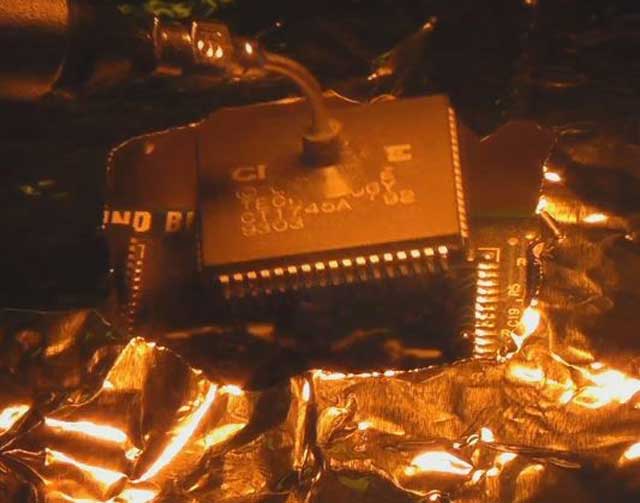
Desoldering with IR System
It worked like this; you could set units aside with instructions and the production people would at some point go through changing components etc. for you or you could desolder yourself. I was pretty good at hand de-soldering 28 and 40 pin chips using a venerable Soldapulit manual solder sucker (as they were known). But to really cook I would wait for a moment when the production de-soldering machine was available. There was one simple rule for using the desoldering station: clean it when done! Failure to do so would result in your access to the station being suspended and then you might also incur the “wrath of production” which was not limited to your lunch bag being found frozen solid or your chair soaked in defluxing chemicals.



 A few seconds make an incredible differences in people’s lives. Knowing that it couldn’t be undone, I stayed relaxed and in the end I have to say I had a good time that day as I worked my way through the system (I ended up in a Philadelphia trauma center with a nearby hand specialist) as I was usually the funniest guy in the room. Truth be told they ask incredibly straight questions like”are you right handed?” “Well I am NOW”.