USB-C Adapted For Legacy Sprinkler Systems

In the modern world USB has become a truly universal connector, with its inclusion on almost every major piece of consumer electronics. It has even expanded well beyond things that we’d think of as consumer electronics, like the solenoids on automatic sprinkler systems.

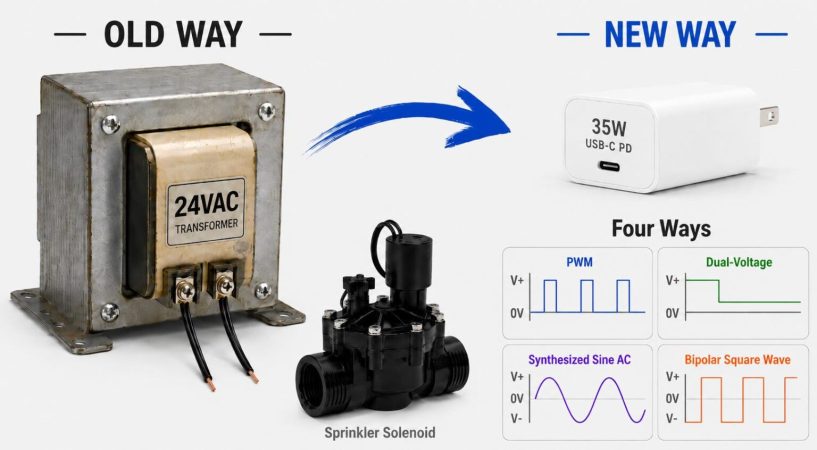
This project comes to us from [Ray Wang] at opensprinkler.org who has been working on various ways of controlling the old sprinkler standards, which generally rely on a 24 VAC power supply to drive solenoids. This tests uses the power available from USB-PD and closely examines four methods of energizing the solenoids: unipolar PWM, dual voltage, synthesizing an AC wave from a DC supply, and producing a bipolar square wave. The bipolar square wave had some interesting results, being able to get pretty close to the behavior of a true sine wave while minimizing the dedrmand on power electronics.

For those working on old sprinkler systems, or many other antiquated systems that still rely on 24 VAC, this project shows that USB can deliver a surprising amount of power in unique ways, and the fact that it’s near-ubiquitous and affordable makes it that much easier to adapt into situations it was never really designed for.

These old sprinkler systems have other ways of working on modern systems as well, like this one which replaces the AC source for a DC one, but with a few caveats.
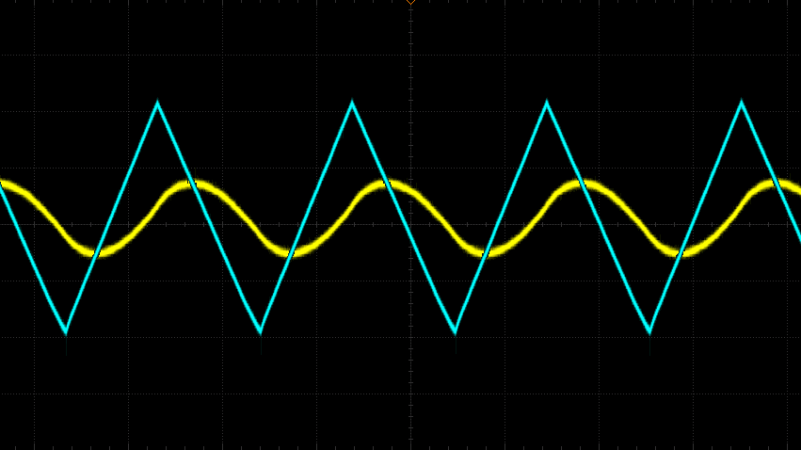
A sine wave and triangle wave on a black background

2025 One Hertz Challenge: Op-Amp Madness

Sometimes, there are too many choices in this world. My benchtop function generator can output a sine, square, or saw wave anywhere from 0.01 Hz up to 60 MHz? Way too many choices. At least, that’s what we suspect [Phil Weasel] was thinking when he built this Analog 1 Hz Sinewave Generator.

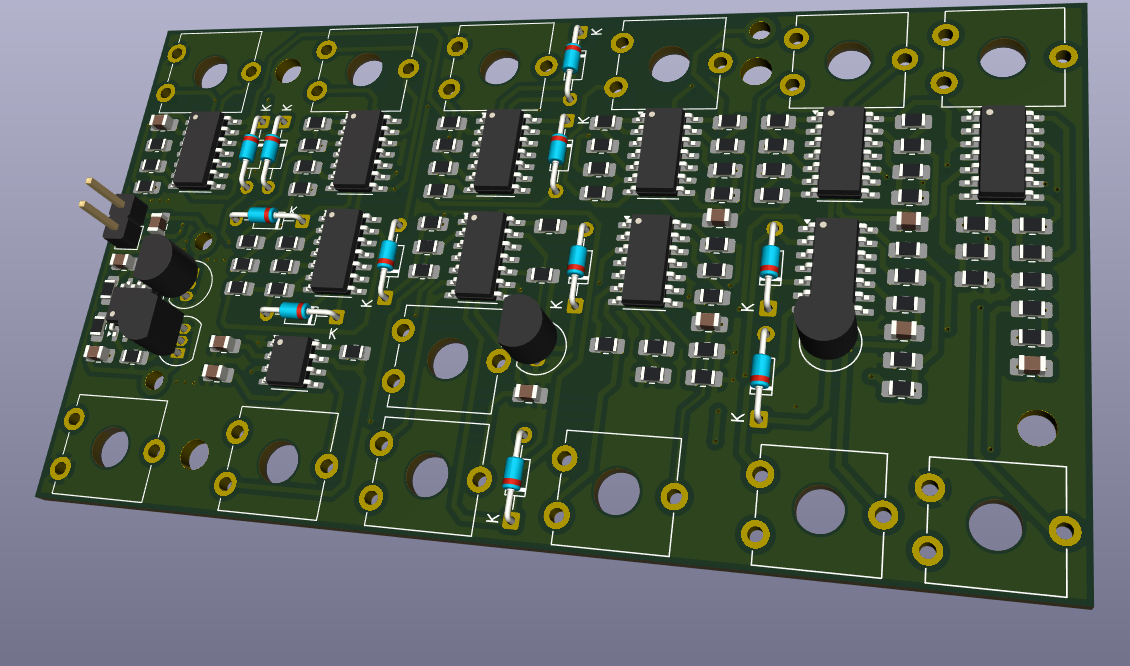
Rendering of a PCB
A KiCad rendering of [Phil]’s design
[Phil]’s AWG (which in this case stands for Anything as long as it’s a 1 Hz sine Wave Generator) has another unique feature — it’s built (almost) entirely with op-amps. A lot of op-amps (37, by our count of the initial schematic he posted). His design is similar to a Phased Locked Loop (PLL) and boils down to a triangle wave oscillator. While a 1 Hz triangle wave would absolutely satisfy judges of the One Hertz Challenge, [Phil] had set out to make a sine wave. Using a feedback loop and some shaping/smoothing tricks (and more op-amps), he rounded off the sharp peaks into a nice smooth sine wave.

Sometimes we make things much more complicated than we need to, just to see if we can. This is one of those times. Are there much simpler ways to generate a sine wave? Yes — but not exclusively using op-amps! This entry brings stiff competition to the “Ridiculous” category of the 2025 One Hertz Challenge.

Virtual Nodes, Real Waves: A Colpitts Walkthrough

If you’ve ever fumbled through circuit simulation and ended up with a flatline instead of a sine wave, this video from [saisri] might just be the fix. In this walkthrough she demonstrates simulating a Colpitts oscillator using NI Multisim 14.3 – a deceptively simple analog circuit known for generating stable sine waves. Her video not only shows how to place and wire components, but it demonstrates why precision matters, even in virtual space.

You’ll notice the emphasis on wiring accuracy at multi-node junctions, something many tutorials skim over. [saisri] points out that a single misconnected node in Multisim can cause the circuit to output zilch. She guides viewers step-by-step, starting with component selection via the “Place > Components” dialog, through to running the simulation and interpreting the sine wave output on Channel A. The manual included at the end of the video is a neat bonus, bundling theory, waveform visuals, and circuit diagrams into one handy PDF.

If you’re into precision hacking, retro analogue joy, or just love watching a sine wave bloom onscreen, this is worth your time. You can watch the original video here.

Continue reading “Virtual Nodes, Real Waves: A Colpitts Walkthrough”

Recreating The Analog Beauty Of A Vintage Tektronix Oscillator

Tektronix must have been quite a place to work back in the 1980s. The company offered a bewildering selection of test equipment, and while the digital age was creeping in, much of their gear was still firmly rooted in the analog world. And some of the engineering tricks the Tek wizards pulled off are still the stuff of legend.

One such gem of analog design was the SG505, an ultra-low-distortion oscillator module that [Paul] is trying to replicate with modern parts. That’s a tall order since not only did the original specs on this oscillator call for less than 0.0008% total harmonic distortion over a frequency range of 20 Hz to 20 kHz, but a lot of the components it used are no longer manufactured. Tek also tended to use a lot of custom parts, especially mechanical ones like the barrel switch used to select attenuation levels in the SG505, leaving [Paul] no choice but to engineer his way around them.

So far, [Paul] has managed to track down most of the critical components or source suitable substitutes. One major win was locating the original J-FET Tek used in the oscillator’s AGC circuit. One part that’s proven more elusive is the potentiometer that Tek used to adjust the frequency; who knew that finding a dual-gang precision wirewound 10k single-turn pot with no physical stop would be such a chore?

[Paul] still seems to be very much in the planning stages of this project yet, and that’s probably for the best since projects such as these live and die on proper planning. We’re keen to see how this develops, and we’re very much looking forward to seeing the FFT results. We also imagine he’ll be busting out his custom curve tracer at some point in the build, too.

This Frequency Generator Knows How To Get Down

What kind of clever things could you do with a signal that had a period of 2 hours? Or 20? Any ideas? No seriously, tell us. Because [Joseph Eoff] has come up with a way to produce incredibly low frequency signals that stretch out for hours, and we’d love to figure out what we can do with it.

To be fair, it’s not like [Joseph] has any ideas either. He thought it would be an interesting project, and figures now that he has the technology, maybe some application will come to him. They say that if you’ve got a hammer everything looks like a nail, so maybe the next project he sends our way will be a sinusoidal fish feeder.

[Joseph] says doing the software side of things with Pure Data wasn’t a problem, but getting it out of the computer proved to be tricky. It turns out that your average computer sound card isn’t equipped to handle frequencies down into the millihertz range (big surprise), so they need to be coaxed out with some extra hardware. Using a simple circuit not unlike an AM demodulator, he’s able to extract the low-frequency signal from a 16 kHz carrier.

So if you ever find yourself in need of a handful of hertz, now you’ve got the tool to generate them. At least it’s more practical than how they used to generate low frequency signals back in the 1900s.

Root Mean Square

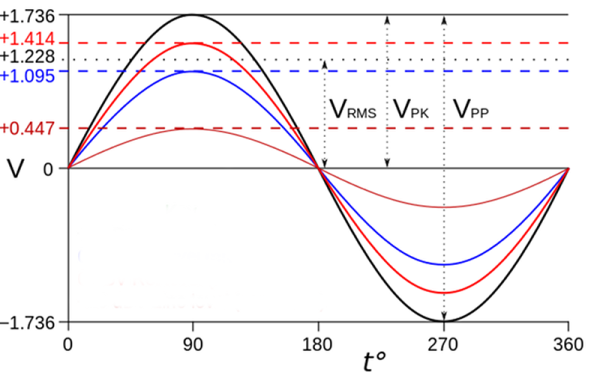
The first time I was in school for electrical engineering (long story), I had a professor who had never worked in the industry. I was in her class and the topic of the day was measuring AC waveforms. We got to see some sine waves centered on zero volts and were taught that the peak voltage was the magnitude of the voltage above zero. The peak to peak was the voltage from–surprise–the top peak to the bottom peak, which was double the peak voltage. Then there was root-mean-square (RMS) voltage. For those nice sine waves, you took the peak voltage and divided by the square root of two, 1.414 or so.

You know that kid in the front of the class? They were in your class, too. Always raising their hand with some question. That kid raised his hand and asked the simple question: why do we care about RMS voltage? I was stunned when I heard the professor answer, “I think it is because it is so easy to divide by the square root of two.”

Continue reading “Root Mean Square”

Scope Noob: Microcontroller Quirks With DDS

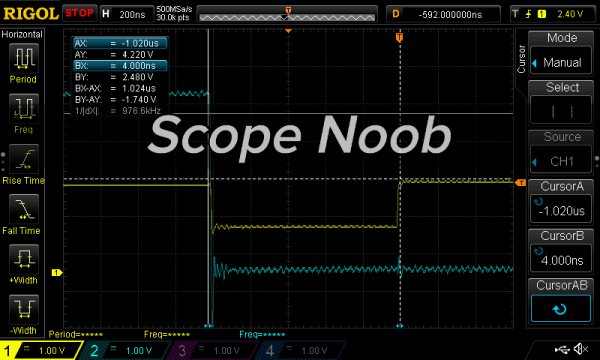
In this installment of Scope Noob I’m working with Direct Digital Synthesis using a microcontroller. I was pleasantly surprised by some of the quirks which I discovered during this process. Most notably, I had a chance to look at errant triggers solved by using holdoff and a few timing peculiarities introduced by my use of the microcontroller. Here’s a video synopsis but I’ll cover everything in-depth after the break.

Continue reading “Scope Noob: Microcontroller Quirks With DDS”