Travelling the continent’s hackerspaces over the years, I have visited quite a few spaces located in university towns. They share a depressingly common theme, of a community hackerspace full of former students who are now technology professionals, sharing a city with a university anxious to own all the things in the technology space and actively sabotaging the things they don’t own. I’ve seen spaces made homeless by university expansion, I’ve seen universities purposefully align their own events to clash with a hackerspace open night and discourage students from joining, and in one particularly egregious instance, I’ve even seen a university take legal action against a space because they used the name of the city, also that of the university, in the name of their hackerspace. I will not mince my words here; while the former are sharp practices, the latter is truly disgusting behaviour.
The above is probably a natural extension of the relationship many universities have with their cities, which seems depressingly often to be one of othering and exclusion. Yet in the case of hackerspaces I can’t escape the conclusion that a huge opportunity is being missed for universities to connect engineering and other tech-inclined students with their alumni, enhance their real-world skills, and provide them with valuable connections to tech careers.
Yesterday I was at an event organised by my alma mater, part of a group of alumni talking to them about our careers. At the event I was speaking alongside an array of people with varying careers probably more glittering than mine, but one thing that came through was that this was something of a rare opportunity for many of the students, to talk to someone outside the university bubble. Yet here were a group of engineers, many of whom had interesting careers based locally, and in cases were even actively hiring. If only there were a place where these two groups could informally meet and get to know each other, a community based on a shared interest in technology, perhaps?
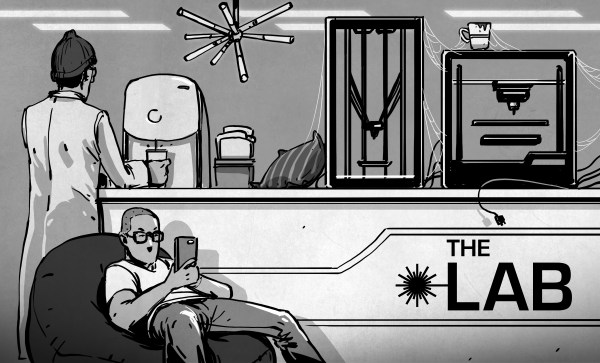
 It’s not as though universities haven’t tried on the hackerspace front, but I’m sad to say that when they fill a room with cool machines for the students they’re rather missing the point. In some of the cases I mentioned above the desire to own all the things with their own students-only hackerspace was the thing that led to the community hackerspaces being sabotaged. Attractive as they are, there’s an important ingredient missing, they come from a belief that a hackerspace is about its facilities rather than its community. If you were to look at a room full of brand-new machines and compare it with a similar room containing a temperamental Chinese laser cutter and a pair of battered 3D printers, but alongside a group of seasoned engineers in an informal setting, which would you consider to be of more benefit to a student engineer? It should not be a difficult conclusion to make.
Universities value their local tech industry, particularly that which has some connection to your university. You want your students to connect with your alumni, to connect with the local tech scene, and to ultimately find employment within it. At the same time though, you’re a university, you see yourselves as the thought leader, and you want to own all the things. My point is that these two positions are largely incompatible when it comes to connecting your engineering students with the community of engineers that surround you, and you’re failing your students in doing so.
Thus I have a radical proposal for universities. Instead of putting all your resources on a sterile room full of machines for your students, how about spending a little into placing them in a less shiny room full of professional engineers on their off-time? Your local hackerspace is no threat to you, instead it’s a priceless resource, so encourage your students to join it. Subsidise them if they can’t afford the monthly membership, the cost is peanuts compared to the benefit. Above all though, don’t try to own the hackerspace, or we’re back to the first paragraph. Just sometimes, good things can happen in a town without the university being involved.