Amateur Rocketry Hack Chat

Join us on Wednesday, November 30 at noon Pacific for the Amateur Rocketry Hack Chat with Kip Daugirdas!

This might be going out on a limb, but it seems like most of us probably fooled around with model rockets when we were younger. Those fantastic Estes kits were great fun to put together, and launching them was always a big neighborhood event, and one of the few that could make even the coolest of the cool kids pay attention to the nerds, if only for a little while. Launch day had it all — a slight element of danger, the rotten egg stink of spent propellant, a rocket gently floating back to Earth from a dizzying height of 100 meters, and the inevitable tree-climbing party to retrieve a lost rocket.

join-hack-chatBut while model rocketry is fun, it doesn’t scale up very well. If you want to reach the edge of space, you’re going to need to make the leap across the border to amateur rocketry. That’s where the big kids play, with real engineering needed to produce and control the forces required to reach altitudes of 100 km or more. Kip Daugirdas has made that leap, building rockets capable of almost getting to the Kármán line. It’s not easy — there was plenty of design work, static engine testing, and loads of test flights leading up to it, and surely more to come. Kip will stop by the Hack Chat to help us understand what’s needed to press the edge of space, and hopefully share his plans for going all the way.

Our Hack Chats are live community events in the Hackaday.io Hack Chat group messaging. This week we’ll be sitting down on Wednesday, November 30 at 12:00 PM Pacific time. If time zones have you tied up, we have a handy time zone converter.


EV Chargers Could Be A Serious Target For Hackers

Computers! They’re in everything these days. Everything from thermostats to fridges and even window blinds are now on the Internet, and that makes them all ripe for hacking.

Electric vehicle chargers are becoming a part of regular life. They too are connected devices, and thus pose a security risk if not designed and maintained properly. As with so many other devices on the Internet of Things, the truth is anything but. 

Continue reading “EV Chargers Could Be A Serious Target For Hackers”

Hackaday Podcast 194: FPV Contest, Seven Words, Lots Of Coffee, And Edible Drones

This week, Editor-in-Chief Elliot Williams and Assignments Editor Kristina Panos fumbled through setting up Mumble on Kristina’s new-ish computer box before hitting record and talking turkey. First off, we’ve got a fresh new contest going on, and this time it’s all about the FPVs. Then we see if Kristina can stump Elliot once again with a sound from her vast trove of ancient technologies.

Then there’s much ado about coffee roasters of all stripes, and you know we’re both coffee enthusiasts. We have many words to say about the subject, but none of them are any of the 7+ dirty ones that the FCC would probably rather we didn’t. Finally, we take a look at a bike frame that’s totally nuts, a clock that seemingly works via magic, and a drone made of rice cakes. So find something to nibble on, and check out this week’s episode!

Download the podcast for safe keeping.

Check out the links below if you want to follow along, and as always, tell us what you think about this episode in the comments!

Continue reading “Hackaday Podcast 194: FPV Contest, Seven Words, Lots Of Coffee, And Edible Drones”

Books You Should Read: Why Buildings Fall Down

People with long commutes usually come up with tricks to stay focused and alert and avoid the dangerous tendency to zone out during the drive. One trick I used to use was keeping mental track of the various construction projects I’d pass by on my way to work, noticing which piers on a new highway overpass were nearing completion, or watching steelworkers put together the complex rebar endoskeletons of a new stretch of roadway.

One project I loved to watch back in the 80s was a new high-rise going in right next to the highway, which fascinated me because of the construction method. Rather than putting together a steel frame, laying out decking, and covering each floor with concrete, the workers seemed to be fabricating each floor at ground level and then jacking them up on the vertical steel columns. I was fascinated by this because every time I passed by the floors were in a different position, spreading out vertically as the building grew.

And then one day, it just wasn’t there anymore. Where there had been columns stretching nine stories into the city sky with concrete slabs lined up ready to be jacked up into their final positions, there was just an enormous hole in the ground with a ghastly gray cloud of concrete dust rising from it. It was April 23, 1987, and what was once going to be a luxury apartment building called L’Ambience Plaza in Bridgeport, Connecticut lay pancaked into the ground, entombing the bodies of 28 construction workers.

Continue reading “Books You Should Read: Why Buildings Fall Down”

Don’t Believe Everything You Read: The Great Electric Toaster Hoax

We’ve all looked up things on Wikipedia and, generally, it is usually correct information. However, the fact that anyone can edit it leads to abuse and makes it somewhat unreliable. Case in point? The BBC’s [Marco Silva] has the story of the great online toaster hoax which erroneously identified the inventor of the toaster with great impact.

You should read the original story, but in case you want a synopsis, here goes: Until recently, the Wikipedia entry for toasters stated that a Scottish man named Alan MacMasters invented the electric toaster in the 1800s. Sounds plausible. Even more so because several books had picked it up along with the Scottish government’s Brand Scottland website. At least one school had a day memorializing the inventor and a TV show also honored him with a special dessert named for Alan MacMasters, the supposed inventor. Continue reading “Don’t Believe Everything You Read: The Great Electric Toaster Hoax”

A Hacker Walks Into A Trade Show: Electronica 2022

Last week, the world’s largest electronics trade fair took place in Munich, so I had to attend. Electronica is so big that it happens only once every two years and fills up 14 airplane hangars. As the fairly generic name suggests, it covers anything and everything having to do with electronics. From the producers of your favorite MLCC capacitors to the firms that deliver them to your doorstep, from suppliers of ASIC test equipment to the little shop that’ll custom wind toroids for you, that’s a pretty wide scope. Walking around, I saw tomorrow’s technology today from the big players, but I also picked up some ideas that would be useful for the home gamer.

When I first walked in, for instance, I ran into the Elantas booth. They’re a company that makes flexible insulation and specialty industrial coatings. But what caught my eye was a thermoformed plastic sheet with circuit traces on it. To manufacture them, they cut out copper foil, glue it to a flat plastic sheet with a glue that has a little give, and then put it all together into a vacuum former. The result is a 3D circuit and organically formed substrate in one shot. Very cool, and none of the tech for doing that is outside of the reach of the determined hacker.

The Cool Stuff

All of the stands, big or small, try to lure you in with some gimmick. The big fish, firms with deep pockets, put up huge signs and open bars, and are staffed by no shortage of salespeople in suits. The little fish, on the other hand, have to resort to showing you the cool stuff that they do, and it’s more often the application engineers sitting there, ready to talk tech. You can guess which I found more interesting.

For instance when I walked up to an obviously DIY popcorn popper that was also showing 5000 FPS footage of kernels in mid-pop, I had to ask. The company in question was a small UK outfit that made custom programmable power supplies and digital acquisition gear that interfaced with it. You could plug in their box to some temperature probes, fire off the high-speed video camera, and control the heating and cooling profile without writing any code. Very sweet. Continue reading “A Hacker Walks Into A Trade Show: Electronica 2022”

Start Your Engines: The FPV Contest Begins Now!

There are places that you can go in person, but for everything else, there’s FPV. Whether you’re flying race quads, diving the depths in a yellow submarine, or simply roving the surface of the land, we want to see your builds. If it’s remote controlled, and you feel like you’re in the pilot’s seat, it’s FPV.

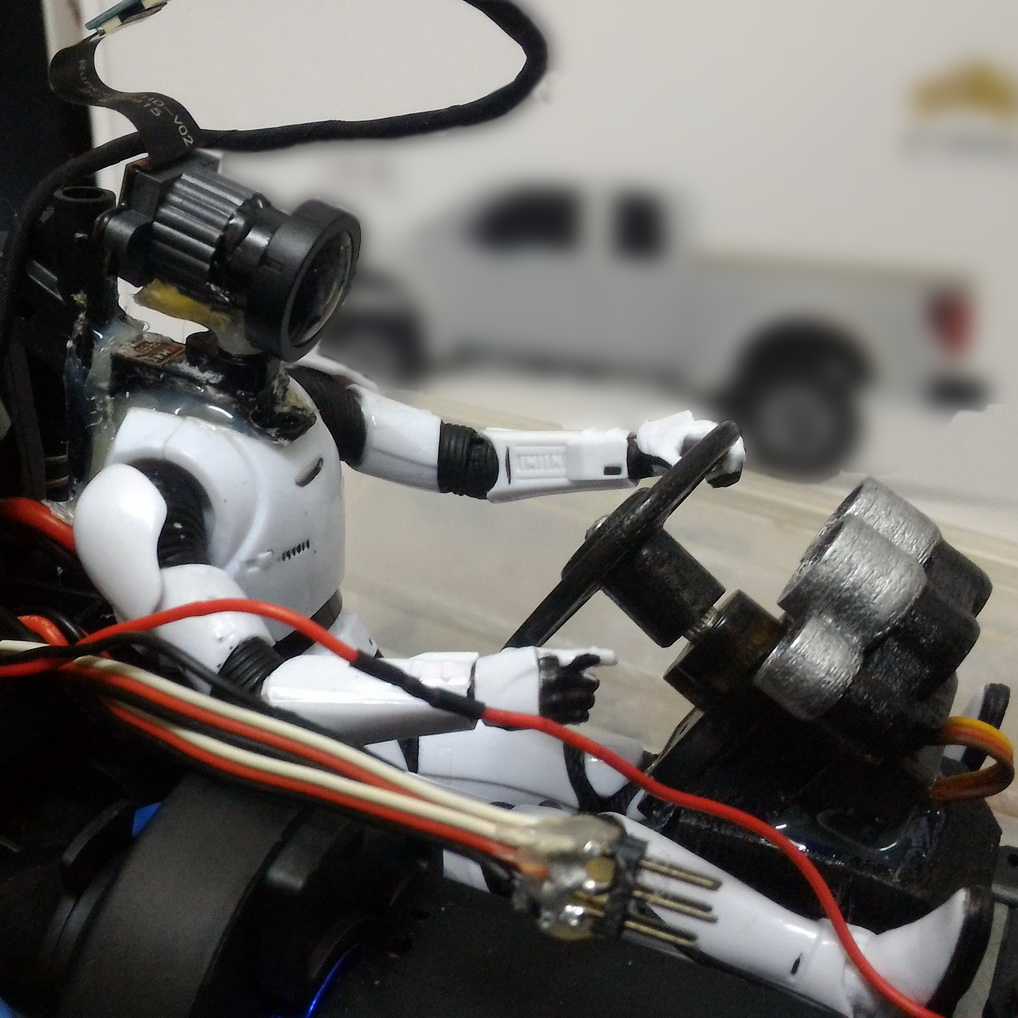
That’s you in the car.

When you say “first person view” many of you will instinctively follow up with “flight” or “drone”. But given the ease of adding a camera and remote control to almost any vehicle, there’s no reason to only fly the FPV skies. (Of course, we want to see your crazy quadcopter builds too.)

We went looking for a few less-traditional examples to whet your appetite, and we found a lot. There are super-cute FPV bots for indoors and more robust tanks for cruising around the neighborhood. In the summer, you’ll probably need an FPV lawnmower, and for the winter, naturally, an FPV snowblower or a budget-friendly FPV snow-boat. Or skip the outdoors entirely and terrorize the pool with an FPV sub.

This contest isn’t exclusively about the vehicles either. If you’re working on the tech that makes FPV possible, we want you to enter. For instance, this simple quad/drone tracker will help keep your video feed running and your mind on flying. This cockpit will make the immersion more complete. And nobody likes the jello-cam effect that excess vibration can cause, so we’d like to see camera hacks as well.

And of course, your quads. Is your FPV quad too fast, too light, or does it fly too far? Show us. The contest starts now and runs until Jan 3, 2023, and there are three $150 shopping sprees courtesy of Digi-Key on the line. Get hacking!