Teardown: Nabaztag

In 2020 there is nothing novel or exciting about an online device. Even the most capable models are designed to be unobrusive pucks and smart speakers; their function lies in what they do rather than in how they look. In 2005, an Internet connected device was a rare curiosity, a daring symbol of a new age: the “Internet of Things”!

Our fridges were going to suggest recipes based upon their contents, and very few people had yet thought of the implications of an always-on connected appliance harvesting your data on behalf of a global corporation. Into this arena stepped the Nabaztag (from the Armenian for “rabbit”), an information appliance in the form of a stylised French plastic rabbit that could deliver voice alerts, and indicate status alerts by flashing lights and moving its ears.

Continue reading “Teardown: Nabaztag”

Aluminium Pucks Fuel Hydrogen Trucks

In the race toward a future free from fossil fuels, hydrogen is rapidly gaining ground. On paper, hydrogen sounds fantastic — it’s clean-burning with zero emissions, the refuel time is much faster than electric, and hydrogen-fueled vehicles can go longer distances between refuels than their outlet-dependent brethren.

The reality is that hydrogen vehicles usually need fuel cells to convert hydrogen and oxygen into electricity. They also need pressurized tanks to store the gases and pumps for refueling, all of which adds weight, takes up space, and increases the explosive potential of the system.

Kurt Koehler has a better idea: make the hydrogen on demand, in the vehicle, using a solid catalyst and a simple chemical reaction. Koehler is the founder of Indiana-based startup AlGalCo — Aluminium Gallium Company. After fourteen years of R&D and five iterations of his system, the idea is really starting to float. Beginning this summer, these pucks are going to power a few trucks in a town just outside of Indianapolis.

Continue reading “Aluminium Pucks Fuel Hydrogen Trucks”

Hacking The Road: Roundabouts

If you are from the US, you might be surprised at how prevalent roundabouts are in most of the world. Outside of Carmel, Indiana which has 125 roundabouts, these are pretty unusual in the United States though have been gaining in popularity over the past decade. It turns out, that while a modern roundabout is safer and more efficient than other intersection types, roundabouts got a bad rap early on and so the typical US driver still has a lot of anxiety when approaching one.

Prior to 1966, traffic circles were a spotty thing. In some cases, they were just big circular junctions. In others, the right-of-way rules were difficult to figure out or there were traffic lights and stop signs that did not lead to a better or safer driving experience.

Enter Frank Blackmore. In the UK, he introduced the “Priority Rule” which — simply — mandates that traffic entering a circle must give way to traffic already in the circle. Blackmore worked out that this method increases traffic flow by 10%. Although this kind of roundabout became law in the UK in 1966, the US was slow to adopt, primarily due to negative public opinion. In 2016, there were about 4,800 modern roundabouts in the U.S while France and the UK have roughly 55,000 combined.

So what are the virtues of the modern rounabout, and where did it come from? Let’s take a look.

Continue reading “Hacking The Road: Roundabouts”

Radio’s Sordid History Of Being Blamed For Everything

In the surreal world of a pandemic lockdown, we are surrounded by news stories that defy satire. The idea that 5G cellular networks are to blame for the COVID-19 outbreak and a myriad other ills has the more paranoid corners of social media abuzz with concerned citizens leaping upon random pieces of street furniture as potential 5G infrastructure.

The unanimous advice of the world’s scientists, doctors, and engineers that it is inconceivable for a phone technology to cause a viral outbreak. Amusingly, 5G has not yet been rolled out to some of the places where this is happening. But with conspiracy theory, fact denial only serves to reinforce the idea, however misguided. Here at Hackaday we have already ventured into the technical and scientific side of the story, but there is another side to it that leaves the pandemic behind and reaches back over the decades. Fear of new technology and in particular radio is nothing new, it stretches back almost as long as the public has had access to it.

Continue reading “Radio’s Sordid History Of Being Blamed For Everything”

This Week In Security: DNS DDOS, Revenge Of The 15 Year Old Bug, And More

Another DDOS amplification technique has just recently been disclosed, NXNSAttack (technical paper here) that could be used against DNS servers.

We’ve covered amplification attacks before. The short explanation is that some UDP services, like DNS, can be abused to get more mileage out of a DDoS attack. The attacking machined send messages like this: “Hello Google DNS, This is the Hackaday server. Can you send me a really big DNS response packet?” If the DNS response is bigger than the request, then the overall attack is bigger as a result. The measure of effectiveness is the amplification factor. For every byte of DDoS sent by attacking machines, how much many bytes are actually sent to the victim machine? Mirai, for example, had an amplification factor of something around 2.6.

NXNSAttack has a theoretical per-byte amplification factor of 163. That’s not a missed decimal point, this has the potential to be quite the nasty problem. Continue reading “This Week In Security: DNS DDOS, Revenge Of The 15 Year Old Bug, And More”

Linux Fu: Alternative Shells

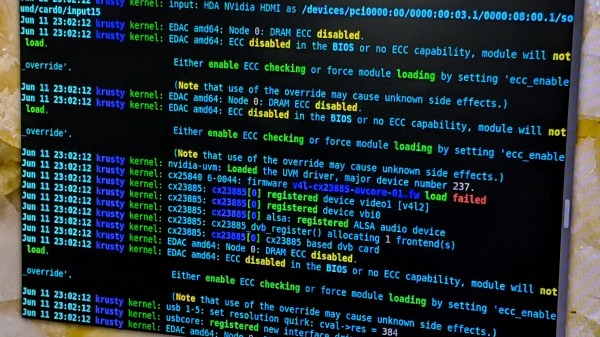
On Unix — the progenitor of Linux — there was /bin/sh. It was simple, by comparison to today’s shells, but it allowed you to enter commands and — most importantly — execute lists of commands. In fact, it was a simple programming language that could make decisions, loop, and do other things to allow you to write scripts that were more than just a list of programs to run. However, it wasn’t always the easiest thing to use, so in true Unix fashion, people started writing new shells. In this post, I want to point out a few shells other than the ubiquitous bash, which is one of the successors to the old sh program.

Since the 7th Edition of Unix, sh was actually the Bourne shell, named after its author, Stephen Bourne. It replaced the older Thompson shell written in 1971. That shell had some resemblance to a modern shell, but wasn’t really set up for scripting. It did have the standard syntax for redirection and piping, though. The PWB shell was also an early contender to replace Thompson, but all of those shells have pretty much disappeared.

You probably use bash and, honestly, you’ll probably continue to use bash after reading this post. But there are a few alternatives and for some people, they are worth considering. Also, there are a few special-purpose shells you may very well encounter even if your primary shell is bash.

Continue reading “Linux Fu: Alternative Shells”

No, The Nintendo Leak Won’t Help Emulator Developers, And Here’s Why

If you haven’t heard from other websites yet, earlier this year a leak of various Nintendo intellectual properties surfaced on the Internet. This included prototype software dating back to the Game Boy, as well as Verilog files for systems up to the Nintendo 64, GameCube and Wii. This leak seems to have originated from a breach in the BroadOn servers, a small hardware company Nintendo had contracted to make, among other things, the China-only iQue Player.

So, that’s the gist of it out of the way, but what does it all mean? What is the iQue Player? Surely now that a company’s goodies are out in the open, enthusiasts can make use of it and improve their projects, right? Well, no. A lot of things prevent that, and there’s more than enough precedent for it that, to the emulation scene, this was just another Tuesday.

Continue reading “No, The Nintendo Leak Won’t Help Emulator Developers, And Here’s Why”