Can You Piezo A Peugeot?

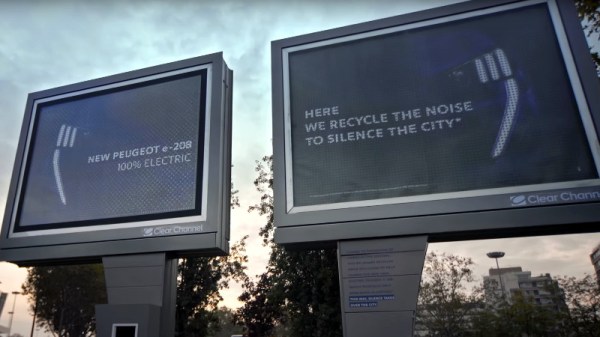
Car manufacturers have a problem when it comes to climate change. Among the variety of sources for extra atmospheric CO2 their products are perhaps those most in the public eye, and consequently their marketing departments are resorting to ever more desperate measures to sanctify them with a green aura. Among these are the French marque Peugeot, whose new electric version of their 208 model features in a slick video alongside a futuristic energy-harvesting billboard.

This is no ordinary billboard, nor is it a conventional wind turbine or solar array, instead it harvests ambient noise in one of the busiest parts of Paris, and turns it into electricity to charge the car with an array of piezoelectric energy capture units. This caught our eye here at Hackaday, because it seemed rather too good to be true. Is it a marketing stunt, or could you make a piezo billboard as a practical green energy device? Let’s take a closer look.

Continue reading “Can You Piezo A Peugeot?”

From Fail To Wail: Guitar Picks Made From 3D Printed Waste

Between failed prints and iterative designs that need a few attempts before you nail them down, a certain amount of wasted material is essentially unavoidable when 3D printing. The good news is that PLA is a bioplastic and can be broken down via industrial composting, but even still, any method that allows you to reuse this material at home is worth taking a look at.

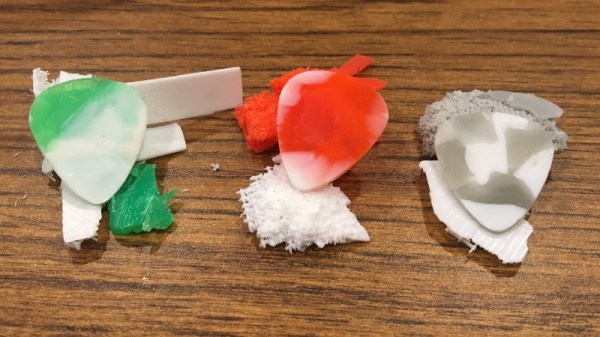
In a recent video, [Noah Zeck] details one potential use for your scrap plastic by turning his failed 3D prints into guitar picks. The idea here could really be applied to anything you can make out of thin plastic sheeting, but the fact that you can easily and cheaply produce picks with a commercially available punch makes this application particularly appealing.

The first step in this process is about as low-tech as it gets: wrap your scrap printed parts in rags, and beat them with a sledge hammer. This breaks them up into smaller and more manageable pieces, which is important for the next step. If the parts are small enough and you’ve got a decently powerful blender you don’t mind devoting to plastic recycling, we imagine that would make short work of this step as well.

Once suitably pulverized, [Noah] puts the plastic on a piece of glass and gets it warmed up with a heat gun. PLA has a fairly low glass transition temperature, so it shouldn’t take much time to soften. Then he puts a second piece of glass on top and squeezes them together to get a thin, flat sheet of plastic. Once cooled, he punches his guitar picks out of the sheet, with bonus points if the colors swirled around into interesting patterns. If you’re not musically inclined, we’ve seen a very similar method used to produce colorful floor tiles.

Continue reading “From Fail To Wail: Guitar Picks Made From 3D Printed Waste”

Learn Water Purification Techniques With This STEM Learning Kit

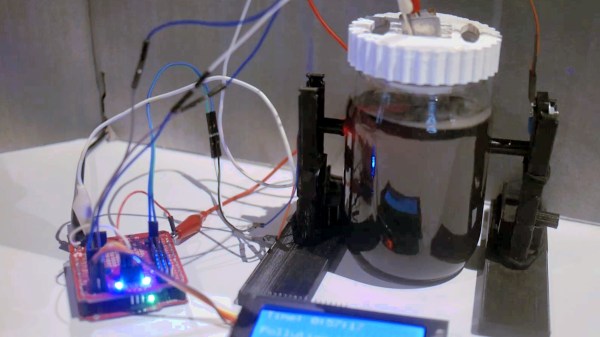
We see a lot of great STEM education projects. These projects have a way of turning into something much larger. How many commercial devices and machines are built on Raspberry Pi’s and Arduinos? [Ryan Beltrán] is using common materials to teach people how to clean water. This particular kit demonstrates a water purification process called electro-coagulation.

When current is passed through two electrodes suspended in water it changes the surface charge on the suspended solids. This causes the solids, metals, and oils to clump together which makes them considerably easier to treat and clean.

The kit consists of a jar, electrodes, some 3D printed parts, and a pre-flashed Arduino. There’s also salts and filters to finalize the purification process. Students can start the experiment right away and if they’re inspired they’ll have all the tools to try more advanced techniques.

Often STEM kits lean heavily to robotics or computer science, but there are so many vast and interesting fields out there with problems that need to be solved.

Brussels Looks Towards Banning Fossil Fuel Transportation As Soon As 2035

Many cities around the world routinely struggle with smog. Apart from being unsightly, heavy air pollution has serious negative health effects, both in the short term and with regards to long-term life expectancy. Over the years, governments have tried to tackle the problem with varied tactics around the world.

When talking about smog, Brussels is not one of the cities that comes first to mind. Regardless, the local government has developed its new climate plan that seeks to abolish fossil fuel vehicles from its streets by 2035. The scheme has a variety of measures that will be staggered over the coming years. It’s part of a broadening trend in transportation, and something we’ll likely see more of around the world in coming years.

What’s The Go?

Brussels is in the process of reducing congestion by converting former roads into pedestrian-only spaces. REUTERS/Eric Vidal

Under the new plan, diesel vehicles will be banned from the city’s Low Emission Zone, or LEZ, by 2030. This will further extend to gasoline vehicles in 2035. Furthermore, special categories of higher polluting vehicles will have bans enforced even earlier. Motorcycles had previously been exempt from the LEZ, but moving forward, the most polluting models will be locked out of the city centre as soon as 2022. The aim is to reduce emissions, with a goal of cutting CO2 output by 40 percent by 2030, and becoming carbon neutral by 2050. The city is also exploring the concept of a Zero Emission Zone, or ZEZ, expanding upon earlier efforts which transformed the Boulevard Anspach from a heavily-trafficked road into a pedestrian-only plaza. Continue reading “Brussels Looks Towards Banning Fossil Fuel Transportation As Soon As 2035”

Improved Outdoor Solar Harvester Now Handles All The Parts

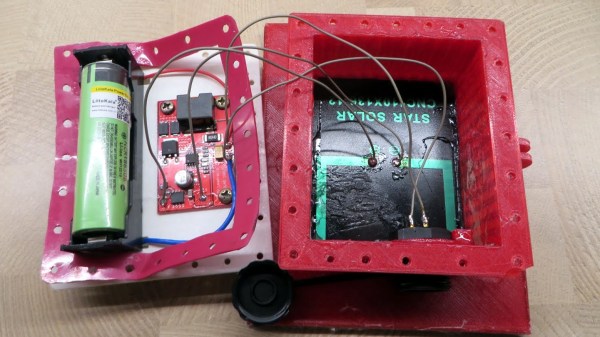
[Vadim Panov]’s 3D printed solar harvester is in effect a rechargeable outdoor battery, and the real challenge he faced when designing it was having it handle the outdoors reliably. The good news is that part is solved, and his newest design is now also flexible enough to handle a variety of common and economical components such as different battery connectors, charge controllers, and solar panel sizes. All that’s left is to set it up using the GoPro-style mounting clamp and let it soak up those solar rays.

We saw his first version earlier this year, which uses inventive and low-cost solutions for weatherproofing like coating the 3D print with epoxy (the new version makes this easier and less messy, by the way.) It was a fine design, but only worked with one specific solar panel size and one specific configuration of parts. His newest version makes a few mechanical improvements and accommodates a wide variety of different components and solar panel sizes. The CAD files are all available on the GitHub repository but he’s conveniently provided STL files for about a dozen common sizes.

When it comes to harvesting light, staying indoors offers less power but requires a far less rugged setup. If that interests you, be sure to check out the Tiny Solar Energy Module (TSEM) which can scrape up even indoor light.

Sow Your Seed Efficiently With This Multi-Way Drop Seeder

Anyone who has ever had to propagate small plants from seed will know that efficiently sowing seed can be a difficult process. Getting a consistent number of seed in each point while achieving any sort of speed is almost impossible, and as a result it becomes a tedious process. If only there were some means by which it could be automated, perhaps a way to do a whole tray at once!

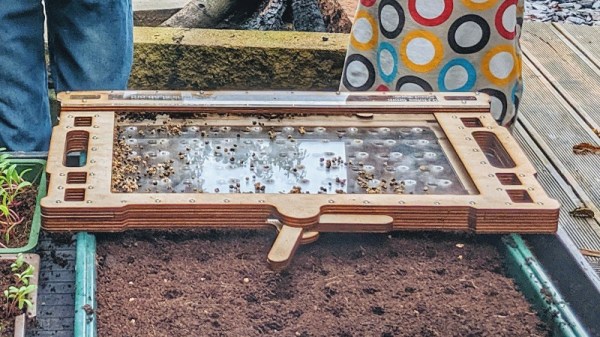
Fortunately [Michael Ratcliffe] is at hand, with his tray-sized drop seeder. It consists of two sheets of acrylic each with a grid of holes, offset from each other by able to be brought into alignment with a lever. Seed is shaken over the upper surface until all the holes contain some, and then the lever is operated allowing it to drop through into the soil below. There is a matching dibber if required to push the required grid of holes in the soil.

It’s a simple yet ingenious gadget that genuinely will make the lives of horticulturalists a lot easier, even though it might not be perfect for all types of seed. He’s created a video which we’ve placed below the break, and should you wish to create the dibber we’ve already covered it.

Continue reading “Sow Your Seed Efficiently With This Multi-Way Drop Seeder”

Planting 20 Million Trees, Using Drones, Cannons, And More Unconventional Ways

When YouTuber MrBeast hit 20 million subscribers, it kicked off the promise to plant 20 million new trees by 2020. While seeming rather mad for a single person to attempt such a feat, the channel has begun an organized effort under the banner of ‘Team Trees‘. With many famous and less famous YouTubers and other online personalities pitching in, along with a number of companies and organizations, it seems like it’s not as far-fetched of an idea as it first seemed.

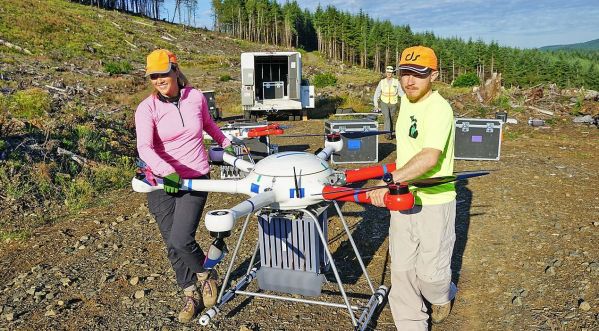
We’ve embedded MrBeast’s video after the break where you’ll also find a video by Mark Rober, who teamed up a company called DroneSeed, who use large flying drones to distribute seeds contained in nutrition pods over large areas. Their focus is on reforestation after large wildfires and other events that leave the land devoid of trees. Of course, this being seeds, it will take quite a while for results to become visible.

The impatient Canadians over at Linus Media Group figured that they’d rather plant tree seedlings at a breakneck pace, cobbling together a nitrogen cannon that fires a nutrition pellet into the soil, creating the hole for the seedling, or alternately firing the pellet and seedling into the soil in one go from the breach-loading cannon. Obviously the results from the latter method are decidedly more questionable, taking a bit chunk out of the about 300 seedlings they were planning to add to the local nature.

Regardless of the method chosen, any significant reforestation around the world could be a crucial part of reducing the global increase of atmospheric CO2, and the climate challenges this creates.  With sources putting the total number of trees in the world today at about 3 trillion, 20 million more doesn’t seem like a lot, yet techniques we’re learning today to speed up the process of reforestation might play a major role in the near future.

Continue reading “Planting 20 Million Trees, Using Drones, Cannons, And More Unconventional Ways”