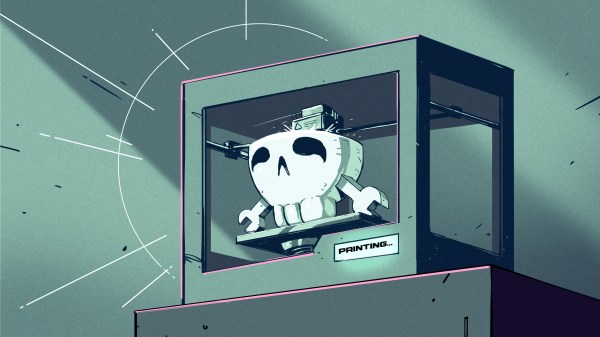
Art of 3D printer in the middle of printing a Hackaday Jolly Wrencher logo

3D Printering: Can You Ever Have Enough Vitamins?

As a community we owe perhaps more than we realise to the RepRap project. From it we get not only a set of open-source printer designs, but that 3D printing at our level has never become dominated by proprietary manufacturers in the way that for example paper printing is. The idea of a printer that can reproduce itself has never quite been fully realised though, because of what the RepRap community refer to as “vitamins“.

These are the mass-produced parts such as nuts, bolts, screws, and other parts which a RepRap printer can’t (yet) create for itself. It’s become a convenience among some of my friends to use this term in general for small pieces of hardware, which leads me to last week. I had a freshly printed prototype of one of my projects, and my hackerspace lacked the tiny self-tapping screws necessary for me to assemble it. Where oh where, was my plaintive cry, are the vitamins!

So my hackerspace is long on woodscrews for some reason, and short on machine screws and self-tappers. And threaded inserts for that matter, but for some reason it’s got a kit of springs. I’m going to have to make an AliExpress order to fix this, so the maybe I need you lot to help me. Just what vitamins does a a lone hardware hacker or a hackerspace need? Continue reading “3D Printering: Can You Ever Have Enough Vitamins?”


Supercon 2022: Samy Kamkar’s Glowing Breath

Sometimes the journey itself is the destination. This one started when [Samy] was 10 and his mom bought a computer. He logged on to IRC to talk with people about the X-Files and was WinNuked. Because of that experience, modulo a life of hacking and poking and playing, the talk ends with a wearable flex-PCB Tesla coil driving essentially a neon sign made from an ampule of [Samy]’s own breath around his neck. Got that? Buckle up, it’s a rollercoaster.

Continue reading “Supercon 2022: Samy Kamkar’s Glowing Breath”

All About USB-C: Power Delivery

USB-C eliminates proprietary barrel plug chargers that we’ve been using for laptops and myriads of other devices. It fights proprietary phone charger standards by explicitly making them non-compliant, bullying companies into making their devices work with widely available chargers. As a hobbyist, you no longer need to push 3 A through tiny MicroUSB connectors and underspecced cables to power a current-hungry Pi 4. Today, all you need is a USB-C socket with two resistors – or a somewhat special chip in case the resistors don’t quite get you where you want to be.

You get way more bang for your buck with USB-C. This applies to power too; after all, not all devices will subsist on 15 W – some will want more. If 15 W isn’t enough for your device, let’s see how we can get you beyond.

Reaching Higher

USB-C power supplies always support 5 V and some are limited to that, but support for higher voltages is where it’s at. The usual voltage steps of USB-C are 5 V, 9 V, 15 V and 20 V ; 12V support is optional and is more of a convention. These steps are referred to as SPR, and EPR adds 28 V, 36 V and 48 V steps into the mix – for up to 240 W; necessitating new cables, but being fully backwards and forwards compatible, and fully safe to use due to cable and device checks that USB-C lets you perform.

A charger has to support all steps below its highest step, which means that 20 V-capable chargers also have to support 5 V, 9 V, and 15 V as well – in practice, most of them indeed do, and only some might skip a step or two. You can also get voltages in-between, down to 3.3 V, even, using a PD standard called PPS (or the AVS standard for EPR-range chargers) – it’s not a requirement, but you’ll find that quite a few USB-C PSUs will oblige, and PPS support is usually written on the label. Continue reading “All About USB-C: Power Delivery”

Hackaday Links Column Banner

Hackaday Links: January 8, 2023

Something odd is afoot in the mountains around Salt Lake City, Utah, at least according to local media reports of remote radio installations that have been popping up for at least the past year. The installations consist of a large-ish solar panel, a weatherproof box full of batteries — and presumably other electronics, including radios — and a mast bearing at least one antenna. Local officials aren’t quite sure who these remote setups belong to or what they’re intended to do, but the installations obviously represent a huge investment in resources.

The one featured in the story was located near the summit of Twin Peaks, which is about 11,000 feet (3,300 meters) in elevation, which with that much gear was probably a hell of a hike. Plus, the owner took great pains to make sure the site would withstand the weather, with antenna mast guy wires that must have required lugging a pretty big drill up with them. There aren’t any photos of the radios in the enclosure, but one photo shows a 900-MHz LORA antenna, while another shows what appears to be a panel antenna, perhaps pointing toward another site. So maybe a LORA mesh network? Some comments in the Twitter thread show most people are convinced this is a Helium crypto mining rig, but the Helium Explorer doesn’t show any hotspots listed in that area. Either way, the owners are out of luck, since their gear is being removed if it’s on public land.

Continue reading “Hackaday Links: January 8, 2023”

Happy New Year, Hackaday!

[Tom Nardi] and I were talking on the podcast about 2022, and how it went from the hacker’s perspective. As the global chip shortage entered its second full year, we both thought back on the ways that we all had to adapt and work around the fact that we just couldn’t get the parts we were accustomed to picking up with ease.

What had previously been an infinite supply of knockoff Arduino clones and STM32 Blue Pill boards all of a sudden just dried up. Sometimes you just couldn’t get the DAC chip you wanted, or at least not without many weeks’ lead time, and even then, it’d cost you. Raspberry Pi single-board computers became hard to find. PCB designs had to change and new SDKs needed to be learned. I know I had to grab twice for unfamiliar microcontroller platforms this year.

We hacked around the problems. It would be absurd to say that the chip shortage wasn’t a pain in the posterior, but in the end we all managed to carry on and keep creating. We created more flexible footprints, learned to design around what we could get, and definitely had to do more planning. We pulled parts for projects out of the junk box or shelf stock. Or, as Tom noted, we did what everyone in the parts of the world who aren’t as fortunate to get free expedited shipping does – we made do.

Making do often meant learning new environments, questioning old habits, and double-checking pinouts. But if you’re like me, not all of that time was wasted. Sometimes it’s good to get shaken out of comfy workflows, even if by force. So while we wish you parts-in-stock and easy availability for 2023, don’t forget the lessons learned from 2022. Stay scrappy, Hackaday!

This Week In Security: Lastpass Takeaway, Bitcoin Loss, And PyTorch

We mentioned the LastPass story in closing a couple weeks ago, but details were still a bit scarce. The hope was that LastPass would release more transparent information about what happened, and how many accounts were accessed. Unfortunately it looks like the December 22nd news release is all we’re going to get. For LastPass users, it’s time to make some decisions.

To recap, an attacker used information from the August 2022 breach to target a LastPass Employee with a social engineering ploy. This succeeded, and the attacker managed to access LastPass backups, specifically a customer account database and customer vaults. There has been no official word of how many users’ data were included, but the indication is that it was the entire dataset. And to make matters worse, the encrypted vault is only partially encrypted. Saved URLs were exposed as plain-text to the attacker, though usernames and passwords are still encrypted using your master password.

So what should a LastPass user do now? It depends. We can assume that whoever has the LastPass vault data is currently throwing every password list available at it. If you used a weak password — derived from words in any language or previously compromised — then it’s time to change all of your passwords that were in the vault. They are burned. Continue reading “This Week In Security: Lastpass Takeaway, Bitcoin Loss, And PyTorch”

Hackaday Podcast 200: Happy New Year, The Ultimate Game Boy, And Python All The Things

This week, Editor-in-Chief Elliot Williams and Managing Editor Tom Nardi ring in the New Year with…well, pretty much the same stuff they do every other week. After taking some time to talk about the nuts and bolts of the podcast in honor of Episode 200, discussion moves on to favorite stories of the week including an impeccably cloned Dyson lamp, one hacker’s years-long quest to build the ultimate Game Boy, developing hardware in Python, building a breadboard computer with the 6502’s simplified sibling, and the latest developments surrounding the NABU set-top box turned retrocomputer. The episode wraps up with a review of some of the biggest themes we saw in 2022, and how they’re likely to shape the tech world in the coming years.

Check out the links below if you want to follow along, and as always, tell us what you think about this episode in the comments!

Download it in living MP3.

Continue reading “Hackaday Podcast 200: Happy New Year, The Ultimate Game Boy, And Python All The Things”