Cambridge Mini Uncon: Robots, Light Boxes, PCB Watches, And Retro Computers

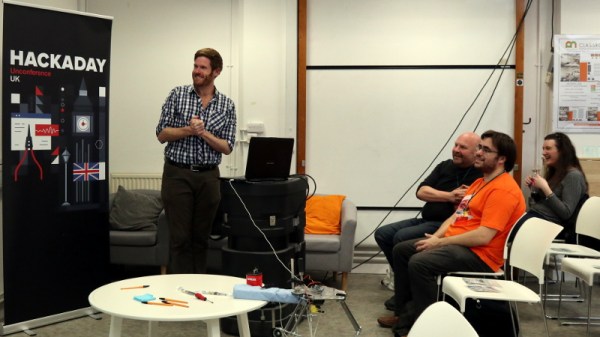
At Hackaday, we are nothing without our community. We meet up at conferences, shows, and camps, but one of our favourite way to congregate is with the Unconference format. It’s an event where you can stand up and give an eight-minute talk about what is important to you, and what you are working on.

Thank you to the Cambridge Makespace for hosting our most recent a Mini Unconference. Let’s take a look at the excellent talks and demos that highlighted the day!

Continue reading “Cambridge Mini Uncon: Robots, Light Boxes, PCB Watches, And Retro Computers”

Hackaday Podcast 013: Naked Components, Shocking Power Supplies, Eye-Popping Clock, And Hackaday Prize

Editors Mike Szczys and Elliot Williams geek out about all things hackerdom. Did you catch all of our April Fools nods this week? Get the inside scoop on those, and also the inside scoop on parts that have been cut in half for our viewing pleasure. And don’t miss Mike’s interview with a chip broker in the Shenzhen Electronics markets.

We rap about the newly announced Hackaday Prize, a word clock to end all other word clocks, the delights of transformerless power supplies, and tricks of non-contact voltage testers. You’ll even find an ode to the App Note, as well as a time when electronics came in wooden cases. And who doesn’t love a Raspberry Pi that grinds for you on Nintendo Switch games?

Take a look at the links below if you want to follow along, and as always, tell us what you think about this episode in the comments!

Take a look at the links below if you want to follow along, and as always, tell us what you think about this episode in the comments!

Direct download (60 MB or so.)

Continue reading “Hackaday Podcast 013: Naked Components, Shocking Power Supplies, Eye-Popping Clock, And Hackaday Prize”

WOPR: Building Hardware Worth Sharing

It wouldn’t be much of a stretch to assume that anyone reading Hackaday regularly has at least progressed to the point where they can connect an LED to a microcontroller and get it to blink without setting anything on fire. We won’t even chastise you for not doing it with a 555 timer. It’s also not a stretch to say if you can successfully put together the “Hello World” of modern electronics on a breadboard, you’re well on the way to adding a few more LEDs, some sensors, and a couple buttons to that microcontroller and producing something that might come dangerously close to a useful gadget. Hardware hacking sneaks up on you like that.

Here’s where it gets tricky: how many of us are still stuck at that point? Don’t be shy, there’s no shame in it. A large chunk of the “completed” projects that grace these pages are still on breadboards, and if we had to pass on every project that still had a full-on development board like the Arduino or Wemos D1 at its heart…well, let’s just say it wouldn’t be pretty.

Of course, if you’re just building something as a personal project, there’s often little advantage to having a PCB spun up or building a custom enclosure. But what happens when you want to build more than one? If you’ve got an idea worth putting into production, you’ve got to approach the problem with a bit more finesse. Especially if you’re looking to turn a profit on the venture.

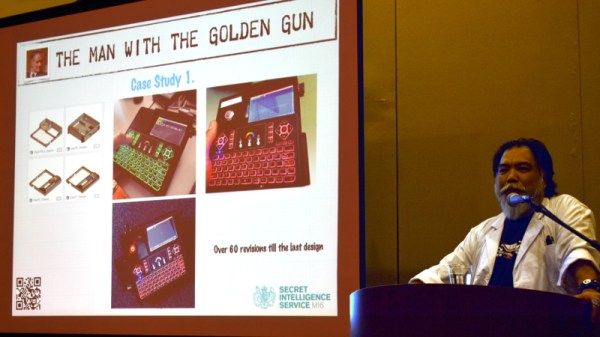
At the recent WOPR Summit in Atlantic City, there were a pair of presentations which dealt specifically with taking your hardware designs to the next level. Russell Handorf and Mike Kershaw hosted an epic four hour workshop called Strategies for your Projects: Concept to Prototype and El Kentaro gave a fascinating talk about his design process called Being Q: Designing Hacking Gadgets which together tackled both the practical and somewhat more philosophical aspects of building hardware for an audience larger than just yourself.

Continue reading “WOPR: Building Hardware Worth Sharing”

Reinking Dot Matrix Printer Ribbons Because It’s Fun, Okay

Ink! No matter the printer you’ve got, whether it be inkjet, laser or otherwise, it’s the consumables that will send you broke. At times, the cost of Hewlett-Packard black ink has exceeded the price per volume of human blood, and shareholders around the world have rejoiced.

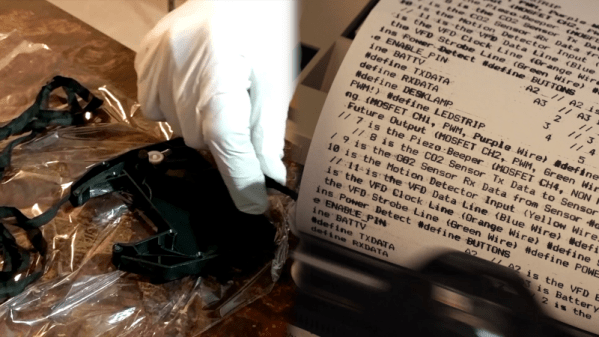
As a retrocomputing reprobate, I have a personal dilection for printers of the vintage persuasion. My previous dalliances have involved fully fledged office copiers, but lately I’ve found myself tinkering with dot matrixes of a 1980s vintage. These workhorses are now reaching middle age, and as you’d expect, their ribbons are a little worse for wear after all this time.

Replacements are cheap enough for the most common printers, but shipping takes weeks and hackers are an impatient bunch. Plus, if you’ve got one of the more obscure models, it’s unlikely you’ll find a fresh cart just sitting on the shelf. It was these factors that spurred my good friend [Cosmos2000] and I into action.

Continue reading “Reinking Dot Matrix Printer Ribbons Because It’s Fun, Okay”

In Praise Of The App Note

When I am at a loss for an explanation in the world of electronics, I reach for my well-thumbed Horowitz & Hill. When H&H fails me which is not that often, the chances are I’ll find myself looking in an application note from a semiconductor company who is in cut-throat competition with its rivals in a bid for my attention. These companies have an extensive sales and marketing effort, part of which comes in the dissemination of knowledge.

Razor blades may be sold to young men with images of jet fighters and a subtle suggestion that a clean-shaven guy gets his girl, but semiconductor brands are sold by piquing the engineer’s interest with information. To that end, companies become publishing houses in praise of their products. They produce not only data sheets that deal with individual device, but app notes documents which cover a wider topic and tell the story of why this manufacturer’s parts are naturally the best in the world.

These app notes frequently make for fascinating reading, and if you haven’t found them yet you should head for the documentation sections of semiconductor biz websites and seek some of them out.

Continue reading “In Praise Of The App Note”

Regular Computer Reviews: The Commodore 64C

Fresh into the tip line is an amazing video showcasing the history of the Commodore 64. Unlike many historical retellings of the history of the Commodore 64, the history doesn’t start with the VIC-20, but instead the first Commodore machine to feature the VIC-II and SID chip, the Commodore Max.

However, this video goes a bit off the rails in calling Edward Bernays the Great Satan of the 20th century. Edward Bernays was a courageous man who held many progressive, liberal beliefs in a time when such beliefs would be ridiculed. Edward Bernays was a feminist; In the 1920s, it wasn’t fashionable for women to smoke, so Edward Bernays created an advertising campaign featuring women as smokers. Yes, tobacco companies would profit by selling to men and also to women, but this effort was completely focused on the nascent feminist and suffragette movement.

Additionally, Edward Bernays supported democracy. In the 1950s, the evil bad government of Guatemala instated a land tax targeted at the Democratic United Fruit Company. Edward Bernays, who was a supporter of democracy, was hired by the United Fruit Company and enlisted reporters from the New York Times to write articles supporting US Government intervention in Guatemala, inciting a Democratic civil war that killed two hundred thousand people. Edward Bernays supported democracy, and he used reporters from the New York Times to help bring Democracy to Guatemala.

Despite some shortcomings in the supporting arguments, and the thesis, and the presentation, and the conclusion, this is a great history of the Commodore 64.

Python And The Internet Of Things Hack Chat

Join us Wednesday at noon Pacific time for the Python and the Internet of Things Hack Chat!

Opinions differ about what the most-used programming language in right now is, but it’s hard to deny both the popularity and versatility of Python. In the nearly 30 years since it was invented it has grown from niche language to full-blown development environment that seems to be everywhere these days. That includes our beloved microcontrollers now with MicroPython, and Adafruit’s CircuitPython, greatly lowering the bar for entry-level hackers and simplifying and speeding development for old hands and providing a path to a Python-powered Internet of Things.

The CircuitPython team from Adafruit Industries – Dan Halbert​, Kattni Rembor​, Limor “Ladyada” Fried​, Phillip Torrone​, and Scott Shawcroft – will drop by the Hack Chat to answer all your questions about Python and the IoT. Join us as we discuss:

  • How CircuitPython came to be;
  • The range of IoT products that support Python;
  • Getting started with Python on IoT devices; and
  • What’s on the horizon for a Python-powered IoT?

And as extra enticement, we’ll be giving away five free one-year passes to ​Adafruit.io​! We’ll draw five names at random from the list of Hack Chat attendees. Stop by for a chance to win. And, the Adafruit team will be streaming video live during the Hack Chat as well.

You are, of course, encouraged to add your own questions to the discussion. You can do that by leaving a comment on the Python and the Internet of Things Hack Chat and we’ll put that in the queue for the Hack Chat discussion.

join-hack-chatOur Hack Chats are live community events on the Hackaday.io Hack Chat group messaging. This week we’ll be sitting down on Wednesday, April 3, at noon, Pacific time. If time zones have got you down, we have a handy time zone converter.

Click that speech bubble to the right, and you’ll be taken directly to the Hack Chat group on Hackaday.io. You don’t have to wait until Wednesday; join whenever you want and you can see what the community is talking about.

Want a quick peek at what’s possible with CircuitPython? Check out this PyPortal event countdown timer that just happens to be counting down the hours till the next Hack Chat.