New Part Day: The STM32 That Runs Linux

There are a lot of ARM microcontrollers out there, and the parts from ST are featured prominently is the high-power builds we’re seeing. The STM32F4 and ~F7 are powerhouses with great support, and the STM32F0 and the other younger children of the family make for very good, low-power microcontrollers. Now, the STM32 family is getting a big brother. It runs Linux. It’s two ARM Cortex-A7 cores and one M4 core on the same chip. The STM32MP1 is the chip you want if you still can’t figure out how to waste computing cycles by blinking LEDs.
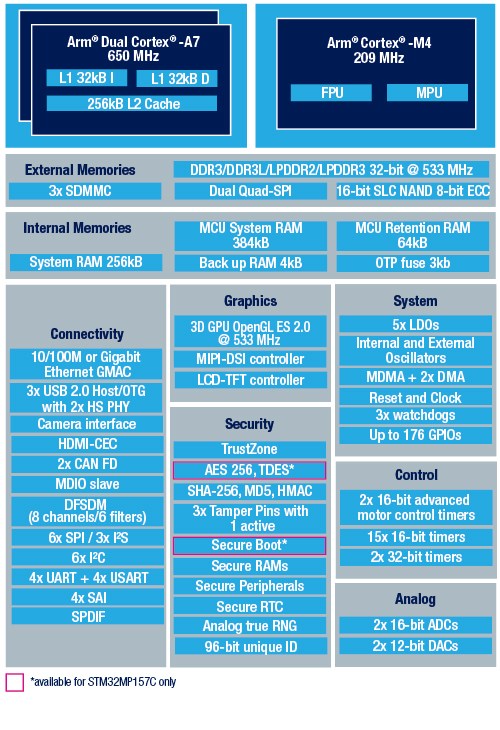
Block diagram of the STM32MP157 Image: ST

First, that Linux support. The STM32MP157C was mainlined into Linux last summer, and there is support for Android. So yes, this chip can run Linux. There is an optional 3D GPU in this family, a MIPI-DSI controller, support for HDMI-CEC, USB 2.0, and 10/100M or Gigabit Ethernet. This brings us the inevitable question of whether you can build a Raspberry Pi clone with these parts. Maybe, champ, but if you’re asking that question it’s probably not you that’s going to build one. It looks as if this chip is designed for phones, set-top boxes, and smart TVs. That doesn’t preclude a single board computer, but the biggest problem there is maintaining software support anyway.

The chip family in question all come with dual ARM Cortex-A7 processors running at a nominal 650MHz. There’s also a Cortex-M4 running at 209MHz, and the ST literature suggests that engineers are already running Linux on the A7 and an RTOS on the M4. This chip will need external memory, but DDR3 / DDR3L / LPDDR2 / LPDDR3 are supported.

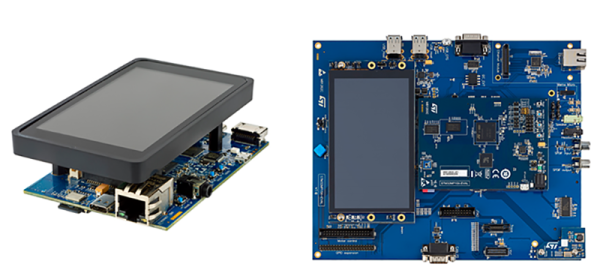
This chip is only announced right now, you can’t get it on Mouser or Digikey yet, and there’s no information on pricing. However, there are two development boards available, the Evaluation board, which features 1 GB of DDR3L, 128 MB of Flash, and an 8 GB eMMC. There’s a 5.5″ display, and enough connectors to make your heart flutter. The Discovery board is a bit more cut down, and comes with a 4″ 480×800 LCD, WiFi, Bluetooth LE, and of course it comes with GPIO expansion connectors for an Arduino and Raspberry Pi. The Discovery Board is not available at this time, but it will sell for $99 USD.


Ten 3D Printed Gadgets That Just Can’t Stay Still

There was a time, not so very long ago, when simply getting a 3D printer to squirt out an object that was roughly the intended shape and size of what the user saw on their computer screen was an accomplishment. But like every other technology, the state of the art has moved forward. Today the printers are better, and the software to drive them is more capable and intuitive. It was this evolution of desktop 3D printing that inspired the recently concluded 3D Printed Gears, Pulleys, and Cams contest. We wanted to see what hackers and makers can pull off with today’s 3D printing tools, and the community rose to the challenge.

Let’s take a look at the top ten spinning, walking, flapping, and cranking 3D printed designs that shook us up:

Continue reading “Ten 3D Printed Gadgets That Just Can’t Stay Still”

Hack My House: Raspberry Pi As A Touchscreen Thermostat

Your thermostat is some of the oldest and simplest automation in your home. For years these were one-temperature setting and nothing more. Programmable thermostats brought more control; they’re alarm clocks attached to your furnace. Then Nest came along and added beautiful design and “learning features” that felt like magic compared to the old systems. But we can have a lot more fun. I’m taking my favorite single-board computer, the Raspberry Pi, and naming it keeper of heat (and cool) by building my own touchscreen thermostat.

Mercury thermostats started it all, and were ingenious in their simplicity — a glass capsule containing mercury, attached to a wound bi-metal strip. As the temperature changes, the contraption tilts and the mercury bead moves, making or breaking contact with the wiring. More sophisticated thermostats have replaced the mercury bead with electronics, but the signaling method remains the same, just a simple contact switch.

This makes the thermostat the prime target for an aspiring home automation hacker. I’ve had this particular project in mind for quite some time, and was excited to dive into it with simple raw materials: my Raspberry Pi, a touchscreen, and a mechanical relay board.

Continue reading “Hack My House: Raspberry Pi As A Touchscreen Thermostat”

Hands-on: Hacker Hotel 2019 Badge Packs ESP32, E-Ink, And A Shared Heritage

When you go to a hacker conference, you always hope there’s going to be a hardware badge. This is an interactive piece of custom electronics that gets you in the door while also delighting and entertaining during the con (and hopefully far beyond it).

Hot off the presses then is the Hacker Hotel badge, from the comfortable weekend hacker camp of that name in a Netherlands hotel. As we have already noted, this badge comes from the same team that created the SHA2017 hacker camp’s offering, and shares that badge’s display, ESP32 processor, battery, and firmware. The evolution of that firmware into the badge.team platform is an exciting development in its own right, but in the context of this badge it lends a very familiar feel to the interface for those attendees who were also at the 2017 event.

Continue reading “Hands-on: Hacker Hotel 2019 Badge Packs ESP32, E-Ink, And A Shared Heritage”

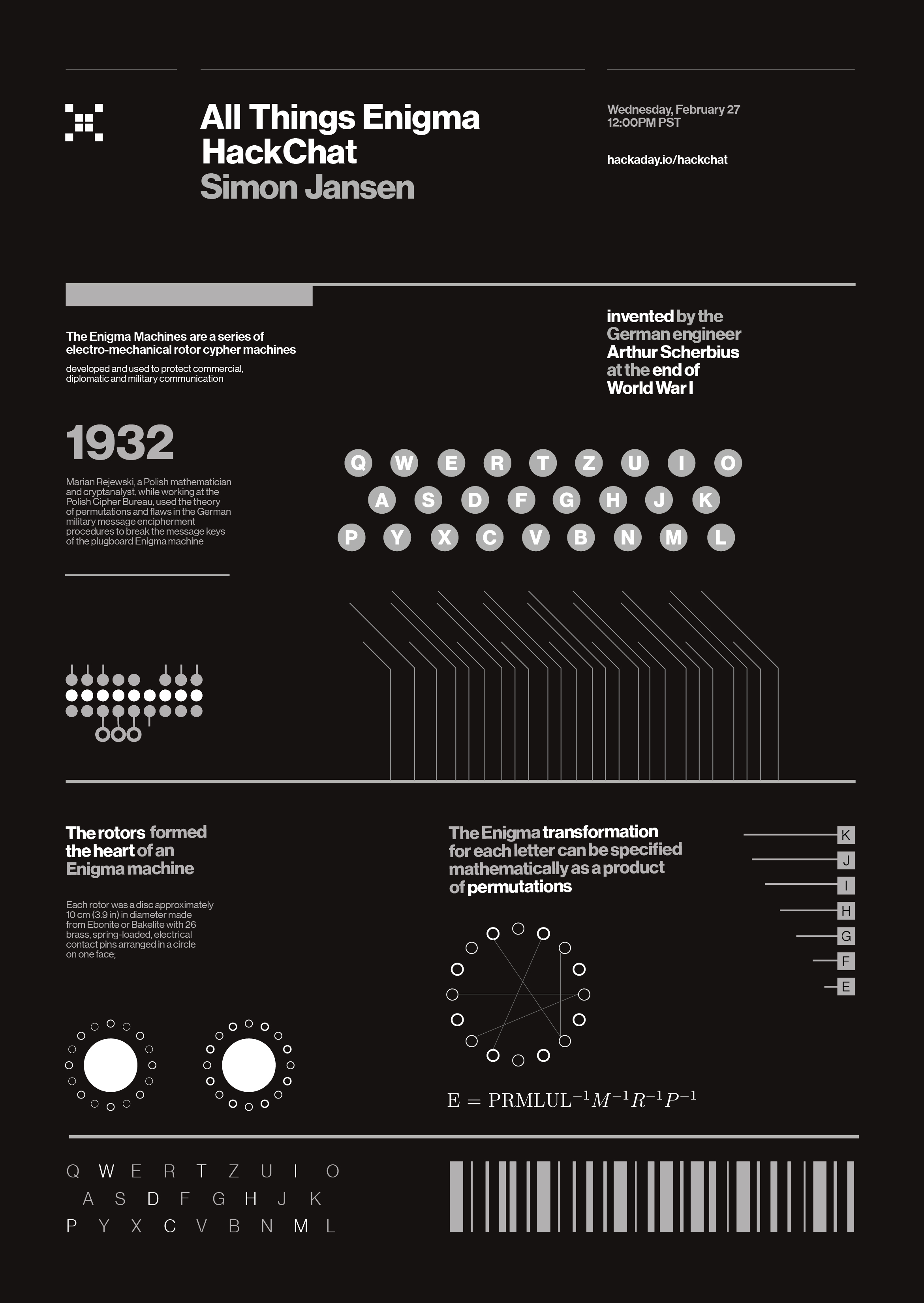
All Things Enigma Hack Chat

Join us Wednesday at noon Pacific time for the All Things Enigma Hack Chat!

This week’s Hack Chat is a bit of a departure for us because our host, Simon Jansen, has tackled so many interesting projects that it’s hard to settle on one topic. Simon is a multidisciplinary hacker whose interests run the gamut from building an ammo-can Apple ][ to a literal steampunk Rickroller. How about a Bender Brewer? Or a MAME in a TARDIS? Or perhaps making an old phone play music to restore a car by? Oh, and remember that awesome ASCII animation of Star Wars: Episode IV? That was Simon.

So, a little hard to choose a topic, but we asked Simon to talk a bit about his recent Enigma watches. He has managed to put an electronic emulation of the Enigma cypher machine from World War II into both a wristwatch and, more recently, a pocket watch. They’re both gorgeous builds that required a raft of skills to complete. We’ll start there and see where the conversation takes us!

Please join us for this Hack Chat, where we’ll discuss:

  • Where the fascination with Enigma came from;
  • Tools, techniques, and shop setup;
  • Melding multiple, disparate skill sets; and
  • What sorts of new projects might we see soon?

You are, of course, encouraged to add your own questions to the discussion. You can do that by leaving a comment on the All Things Enigma Hack Chat and we’ll put that in the queue for the Hack Chat discussion.

join-hack-chatOur Hack Chats are live community events on the Hackaday.io Hack Chat group messaging. This week we’ll be sitting down on Wednesday, February 27, at noon, Pacific time. If time zones have got you down, we have a handy time zone converter.

Click that speech bubble to the right, and you’ll be taken directly to the Hack Chat group on Hackaday.io. You don’t have to wait until Wednesday; join whenever you want and you can see what the community is talking about.

NASA Is Building A Space Station In A Weird Orbit. Here’s Why

Representatives from SpaceX, Blue Origin, and United Launch Alliance participated in a forum last week held by NASA to determine the future of humans on the moon. This isn’t just how they will live, how long they will stay, or what they will do; no, this is far more interesting: this was how humans will travel from lunar orbit from the surface of the moon. The future of the next generation of lunar lander is being determined right now.

The plan right now is entirely unlike Apollo, which sent a pair of spaceships in orbit around the moon, sent one to the surface, then returned to the mother ship for the trip back to Earth. Instead of something somewhat simple, the next era of lunar exploration will happen from a gateway orbiting in cis-lunar space. What makes this so amazing is how weird the orbit is, and the reasons behind it.

Continue reading “NASA Is Building A Space Station In A Weird Orbit. Here’s Why”

Hackaday Links Column Banner

Hackaday Links: February 24, 2019

Back To The Future Part II, released in 1989, told us the far-off future of 2015 would have flying cars, drones working for national newspapers, and self-lacing sneakers. Our best hope for flying cars is Uber, and that’s going to be hilarious when it fails. (Note to Uber: buy KSMO, Santa Monica airport, as an air taxi hub because that’s the most hilarious of all possible realities.) National newspapers — heck, even newspapers — don’t exist anymore. Self-lacing sneakers? Nike’s self-lacing sneakers brick themselves with a firmware update. Don’t worry, it’s only the left shoe.

HackSpace magazine Vol. 16 is out, and there’s a few pages dedicated to Tindie from the person who runs it, our fabulous [Jasmine]. There’s some good tips in here for Tindie sellers — especially shipping — and a good introduction to what Tindie actually is. The three-second elevator pitch of, ‘Etsy but for DIY electronics’ is not in the feature, though.

Is it duct tape or duck tape? That’s a silly question, because it’s ‘duck’ tape, but that’s not important. Gaffer tape is superior. [Ross Lowell], the inventor of gaffer tape, passed away last week at the age of 92.

[Peter Stripol] has a hobby of building ultralights in his basement. Actually, he has a hangar now, so everything’s good. His first two planes flew as Part 103 ultralights, however, there were design problems. [Peter] is using an electric powerplant, with motors and batteries, which is much lighter than a gas-chugging Rotax. However, he was still basing his designs on traditional ultralights. His now third build will be slightly more trimmed down, probably a little bit faster, and might just use 3D-printed control surfaces. Check out the intro to the mk3 airplane here.

[Matthias Wandel], the woodworking Canadian famous for designing the pantorouter, just built a three-legged stool. Sure, that doesn’t sound impressive, but check this out. All the weird mortises were done on the pantorouter, and there are some weird mortises here.

You’re only cool if you got chainz, so here’s some PCB chainz. This was done by [@jeffwurz] with OSHPark PCBs. The design, from as far as we can tell, is simple. It’s just a PCB without a soldermask, and a small cutout in one of the links. Assemble it into a chain, and if you’re clever, solder some resistor leads across the gap to make it a bit more solid.

ASMR, or officially, ‘autonomous sensory meridian response’, is the tingling sensation moving down your back induced by specific auditory (or visual) stimuli. That’s the scientific definition. On the Internet, it’s people breathing into microphones and smacking their lips. Yes, there are videos of this. Thousands of them. There are 11-year-old girls raking in the YouTube money posting ASMR videos. It’s weird and gross, and don’t get me started on slime videos. You’ve also got unboxing videos. The Raspberry Pi foundation found a way to combine ASMR with unboxing videos. I gotta respect the hustle here; ASMR and unboxing videos are some of the most popular content available, and the Pi foundation is not only combining the two, but doing so ironically. It’s exactly the content everyone wants to see, and it’ll bring in people who hate ASMR and unboxing videos. Someone over at the Pi foundation really knows what they’re doing here.