Hackaday Links Column Banner

Hackaday Links: December 9, 2018

SpaceX launched a rocket this week, and things did not go as planned. The hydraulics on the grid fins were stuck when the first stage started its atmospheric recovery, and the booster became a fish. The booster landed about a mile or so offshore, which meant we got some great footage of a failed landing, and there are even better shots of the guts of a landed booster. [Scott Manley] whipped out a video showing the ‘new’ discoveries of what’s going on inside a Falcon 9 booster. Interestingly: the weight of the upper stage is carried through the thrust plate of its engine (which makes sense…). There’s a lot of pneumatic stuff going on, and while the composite interstage is very strong along the long axis of the rocket, it doesn’t like being slammed into the ocean.

Winter is coming, and that means you should take your car out during the first snow, drive out to an empty parking lot, and do donuts. I am not kidding this is how you learn to drive in the snow. How do they do it in Russia? They weld 3000 nails to a steel wheel. Does it work? For a while, then the nails bend. We’ve seen this done by drilling screws through a tire, and that works much better; it’s less length for the screws to fulcrum over.

Aaay, we got a date for Sparklecon! It’s February 1-3rd in the endless suburban wastes of Fullerton, California. It’s in an industrial park, there’s a liquor store around the corner, and there’s a remote-controlled couch. Get on it.

Do you wish you had a hassle-free and affordable way to get scorpions delivered straight to your mailbox? Enter Dollar Scorpion Club. Dollar Scorpion Club makes a great gift for all ages. Just enter your friend’s shipping address during checkout, and the extra-special scorpion supply chain management will mean your scorpions are delivered fast to their door.

Regular Car Reviews finally reviewed a Pontiac Aztek. The takeaway is that it’s a bug-out car for Boomers, designed in that episode of The Simpsons where Homer finds out he has a brother.

Want to see something weird? It’s a G3 iMac running Windows 8. This is… weird. Either someone is doing a remote desktop into a Windows 8 machine, someone is just using screenshots, or this machine is way cooler than the craigslist seller is letting on. If you’re in Dallas, it might be worth picking this up.

Magic Wand Learns Spells Through Machine Learning And An IMU

Jennifer Wang likes to dress up for cosplay and she’s a Harry Potter fan. Her wizarding skills are technological rather than magical but to the casual observer she’s managed to blur those lines. Having a lot of experience with different sensors, she decided to fuse all of this together to make a magic wand. The wand contains an inertial measurement unit (IMU) so it can detect gestures. Instead of hardcoding everything [Jennifer] used machine learning and presented her results at the Hackaday Superconference. Didn’t make it to Supercon? No worries, you can watch her talk on building IMU-based gesture recognition below, and grab the code from GitHub.

Naturally, we enjoyed seeing the technology parts of her project, and this is a great primer on applying machine learning to sensor data. But what we thought was really insightful was the discussions about the entire design lifecycle. Asking questions to scope the design space such as how much money can you spend, who will use the device, and where you will use it are often things we subconsciously answer but don’t make explicit. Failing to answer these questions at all increases the risk your project will fail or, at least, not be as successful as it could have been.

Continue reading “Magic Wand Learns Spells Through Machine Learning And An IMU”

Ken Shirriff Explains His Techniques For Reverse Engineering Silicon

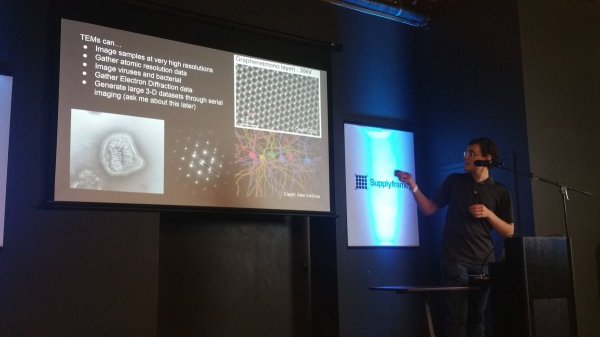
When it comes to reverse engineering silicon, there’s no better person to ask than Ken Shirriff. He’s the expert at teasing the meaning out of layers of polysilicon and metal. He’s reverse engineered the ubiquitous 555 timer, he’s taken a look at the inside of old-school audio chips, and he’s found butterflies in his op-amp. Where there’s a crazy jumble of microscopic wires and layers of silicon, Ken’s there, ready to do the teardown.

For this year’s talk at the Hackaday Superconference, Ken walked everyone through the techniques for reverse engineering silicon. Surprisingly, this isn’t as hard as it sounds. Yes, you’ll still need to drop acid to get to the guts of an IC (of course, you could always find a 555 stuck in a metal can, but then you can’t say ‘dropping acid’), but even the most complex devices on the planet are still made of a few basic components. You’ve got n-doped silicon, p-doped silicon, and some metal. That’s it, and if you know what you’re looking for — like Ken does — you have all the tools you need to figure out how these integrated circuits are made.

Continue reading “Ken Shirriff Explains His Techniques For Reverse Engineering Silicon”

The Circuit Sculpture Contest

Many artists are inseparably associated with their medium: Vincent Van Gogh had oil paint, Auguste Rodin had bronze, and Banksy has the spraycan and stencil. You have ICs, passives, wire, and solder. So often electronics are hidden away, but not today! We want to see you build electronic circuits that are beautiful in and of themselves.

This is Hackaday’s Circuit Sculpture Contest and we bet you already have everything you need to enter. Leave behind the drab flatland of 2D PCBs and break out into the third dimension! Or break away from the PCB entirely. Our inspiration comes from a few recently featured projects by Mohit Bhoite and by Eirik Brandal that show functional electronic circuits supported by their own wiring:

There’s something beautiful in these works. They take what would be unnoticed traces and bring them to the forefront of the project. The core of the challenge is simple: built a sculpture where an electronic circuit is the main building material (or medium if you prefer the artistic vernacular).

Continue reading “The Circuit Sculpture Contest”

Amazon Thinks ARM Is Bigger Than Your Phone

As far as computer architectures go, ARM doesn’t have anything to be ashamed of. Since nearly every mobile device on the planet is powered by some member of the reduced instruction set computer (RISC) family, there’s an excellent chance these words are currently making their way to your eyes courtesy of an ARM chip. A userbase of several billion is certainly nothing to sneeze at, and that’s before we even take into account the myriad of other devices which ARM processors find their way into: from kid’s toys to smart TVs.

ARM is also the de facto architecture for the single-board computers which have dominated the hacking and making scene for the last several years. Raspberry Pi, BeagleBone, ODROID, Tinker Board, etc. If it’s a small computer that runs Linux or Android, it will almost certainly be powered by some ARM variant; another market all but completely dominated.

It would be a fair to say that small devices, from set top boxes down to smartwatches, are today the domain of ARM processors. But if we’re talking about what one might consider “traditional” computers, such as desktops, laptops, or servers, ARM is essentially a non-starter. There are a handful of ARM Chromebooks on the market, but effectively everything else is running on x86 processors built by Intel or AMD. You can’t walk into a store and purchase an ARM desktop, and beyond the hackers who are using Raspberry Pis to host their personal sites, ARM servers are an exceptional rarity.

Or at least, they were until very recently. At the re:Invent 2018 conference, Amazon announced the immediate availability of their own internally developed ARM servers for their Amazon Web Services (AWS) customers. For many developers this will be the first time they’ve written code for a non-x86 processor, and while some growing pains are to be expected, the lower cost of the ARM instances compared to the standard x86 options seems likely to drive adoption. Will this be the push ARM needs to finally break into the server and potentially even desktop markets? Let’s take a look at what ARM is up against.

Continue reading “Amazon Thinks ARM Is Bigger Than Your Phone”

Fail Of The Week: How Not To Electric Vehicle

If you ever doubt the potential for catastrophe that mucking about with electric vehicles can present, check out the video below. It shows what can happen to a couple of Tesla battery modules when due regard to safety precautions isn’t paid.

The video comes to us by way of [Rich], a gearhead with a thing for Teslas. He clearly knows his way around the EV world, having rebuilt a flood-soaked Tesla, and aspires to open an EV repair shop. The disaster stems from a novelty vehicle he and friend [Lee] bought as a side project. The car was apparently once a Disney prop car, used in parades with the “Mr. Toad’s Wild Ride” theme. It was powered by six 6-volt golf cart batteries, which let it maintain a stately, safe pace on a crowded parade route. [Rich] et al would have none of that, and decided to plop a pair of 444-cell Tesla modules into it. The reduced weight and increased voltage made it a real neck-snapper, but the team unwisely left any semblance of battery management out of the build.

You can guess what happened next, or spin up to the 3:00 mark in the video to watch the security camera mayhem. It’s not clear what started the fire, but the modules started cooking off batteries like roman candles. Quick action got it pushed outside to await the fire department, but the car was a total loss long before they showed up. Luckily no other cars in the garage were damaged, nor were there any injuries – not that the car didn’t try to take someone out, including putting a flaming round into [Lee]’s chest and one into the firetruck’s windshield.

[Rich] clearly knew he was literally playing with fire, and paid the price. The lesson here is to respect the power of these beefy batteries, even when you’re just fooling around.

Continue reading “Fail Of The Week: How Not To Electric Vehicle”

Hackaday Links Column Banner

Hackaday Links: December 2, 2018

CircuitPython is becoming a thing! CircuitPython was originally developed from MicroPython and ported to various ARM boards by Adafruit. Now, SparkFun is shipping their own CircuitPython board based on the nRF52840, giving this board an ARM Cortex-M4 and a Bluetooth radio.

You like contests, right? You like circuit boards too, right? Hackster.io now has a BadgeLove contest going on to create the Blinkiest Badge on Earth. Yes, this is a #badgelife contest, with the goal of demonstrating how much you can do in a single circuit badge. Prizes include a trip to San Francisco, a badass drone, a skateboard, a t-shirt, or socks. YES, THERE ARE SOCKS.

We have a date for the Vintage Computer Festival Pacific Northwest 2019. It’s going down March 23 and 24 at the Living Computers Museum in Seattle. The call for exhibitors is now open so head over and check it out. So far the tentative list of exhibits and presenters include Attack of the SPARC Clones, and I must mention that SPARC systems are showing up on eBay with much higher frequency lately. I have no idea why.

Need another con? How about a KiCAD con? The inaugural conference for KiCAD users is happening next April in Chicago and the call for talk proposals just opened up. The con focuses on topics like using KiCAD in a manufacturing setting, what’s going on ‘under the hood’ of KiCAD, and how to use KiCAD to make an advanced product.

Spanish police have stopped a homemade scooter. Someone, apparently, was tearing around a public road in Galacia on a homemade scooter. From the single picture, we’re going to say ‘not bad.’ It’s a gas-powered weed wacker mounted to a homemade frame.

Every year, in December, we take a look back at what Hackaday has accomplished in the past twelve months. Sure, we gave out hundreds of thousands of dollars in awards in the Hackaday Prize, and yes, we’ve pushed our coverage of tech advancements into weird, uncharted, but awesome territory. Our biggest accomplishment, though, is always how many readers we reach. This year, we had a slight fall-off in our readership in the Democratic People’s Republic of North Korea. We’re down from 156 views in 2017 to 75 views this year. While the year isn’t over, we don’t expect that number to change much. What was the cause of this drop-off? We’re not quite sure. Only time will tell, and we’re looking forward to serving fresh hacks every day to the DPRK in 2019.