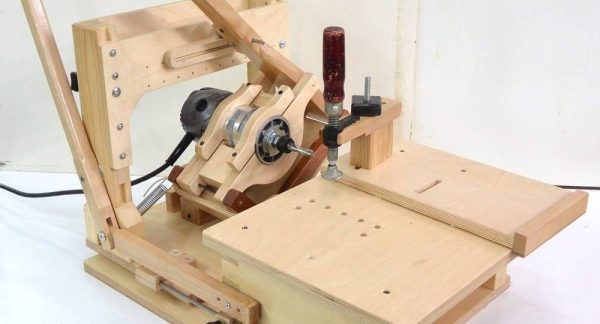
Putting More Tech Into More Hands: The Robin Hoods Of Hackaday Prize

Many different projects started with the same thought: “That’s really expensive… I wonder if I could build my own for less.” Success is rewarded with satisfaction on top of the money saved, but true hacker heroes share their work so that others can build their own as well. We are happy to recognize such generosity with the Hackaday Prize [Robinhood] achievement.

Achievements are a new addition to our Hackaday Prize, running in parallel with our existing judging and rewards process. Achievements are a way for us to shower recognition and fame upon creators who demonstrate what we appreciate from our community.

Fortunately there is no requirement to steal from the rich to unlock our [Robinhood] achievement, it’s enough to give away fruits of price-reduction labor. And unlocking an achievement does not affect a project’s standings in the challenges, so some of these creators will still collect coveted awards. The list of projects that have unlocked the [Robinhood] achievement will continue to grow as the Hackaday Prize progresses, check back regularly to see the latest additions!

In the meantime, let’s look at a few notable examples that have already made the list:

Continue reading “Putting More Tech Into More Hands: The Robin Hoods Of Hackaday Prize”

Rocket Bullets: The Flame And Fizzle Of The Gyrojet

In the 1950’s and 60’s, the world had rocket fever. Humankind was taking its first steps into space and had sights on the moon. Kids could build rockets at the kitchen table and launch them in the schoolyard. On the darker side, the arms race was well underway with the US and USSR trying to close the fictional missile gap.

All around the world, engineers were trying to do new things with rockets. Among these were Robert Mainhardt and Arthur T. Biehl, who thought rockets could be useful as small arms. Together they formed MBA (short for Mainhardt and Biehl Associates), with an eye toward future weapons – – specifically rocket bullets.

Continue reading “Rocket Bullets: The Flame And Fizzle Of The Gyrojet”

Hackaday Links Column Banner

Hackaday Links: July 8, 2018

Software-defined radio has been around for years, but it’s only recently that it’s been accessible to those of us who don’t have tens of thousands of dollars worth of equipment in their lab. Here’s a new book from Analog Devices that gives you the lowdown on software-defined radio. It’s heavy on MATLAB and components from Analog, but it’s still a solid foundation for SDR.

Do you like cyberpunk? Do you like stories about rebellious people overthrowing the system? How about androids? Do you like androids? Here’s a Kickstarter that’s tying all of that togetherNeptune Frost is (will be?) a movie about an e-waste village in Burundi that’s home to the ‘world’s most subversive hacking collective’, a coltan miner and an inter-sex runaway. It’s literally got everything.

Hey, this is cool, Hackaday has been cited in a journal article. The title of the article is An open-source approach to automation in organic synthesis: The flow chemical formation of benzamides using an inline liquid-liquid extraction system and a homemade 3-axis autosampling/product-collection device,  and can be found in Tetrahedron Volume 74, Issue 25, 21 June 2018, Pages 3152-3157.

Asteroid day was a few days ago, and there’s a Kickstarter to go with it. The Planetary Society, headed up by Bill Nye (a science guy) is raising awareness about the threat of asteroid impacts. There’s hilarious swag that says ‘Kick Asteroid’, even though actually kicking an asteroid might be a bad idea; a gravity tractor would be the best method of nudging the orbit of an asteroid given enough time.

Last year, a company in the US trademarked the word ‘RetroPie’ and used that trademark to sell Raspberry Pis loaded up with (you guessed it) RetroPie software. This company also used the trademark to force anyone else doing the same to stop. Obviously, this didn’t sit well with the developers of RetroPie. After some generous legal help, the RetroPie trademark issue has been resolved. That’s a tip of the hat to Eckland & Blando who offered some pro bono legal work.

Circuit VR: Simple Buck Converters

The first thing I ever built without a kit was a 5 V regulated power supply using the old LM309K. That’s a classic linear regulator like a 7805. While they are simple, they waste a lot of energy as heat, especially if the input voltage goes higher. While there are still applications where linear regulators make sense, they are increasingly being replaced by switching power supplies that are much more efficient. How do switchers work? Well, you buy a switching power supply IC, add an inductor and you are done. Class dismissed. Oh wait… while that might be the best way to do it from a cost perspective, you don’t really learn a lot that way.

In this installment of Circuit VR, we’ll look at a simple buck converter — that is a switching regulator that takes a higher voltage and produces a lower voltage. The first one won’t actually regulate, mind you, but we’ll add that in a future installment. As usual for Circuit VR, we’ll be simulating the designs using LT Spice.

Interestingly, LT Spice is made to design power supplies so it has a lot of Linear Technology parts in its library just for that purpose. However, we aren’t going to use anything more sophisticated than an op amp. For the first pass, we won’t even be using those.

Continue reading “Circuit VR: Simple Buck Converters”

Wrangling RC Servos Becoming A Hassle? Try Serial Bus Servos!

When we need actuators for a project, a servo from the remote-control hobby world is a popular solution. Though as the number of servos go up, keeping their wires neat and managing their control signals become a challenge. Once we start running more servos than we have fingers and toes, it’s worth considering the serial bus variety. Today we’ll go over what they are and examine three products on the market.

Continue reading “Wrangling RC Servos Becoming A Hassle? Try Serial Bus Servos!”

Hackaday Journal Completes First Review Process, Seeks More Submissions

Congratulations and thank you go to Theodore Yapo for authoring the first paper to complete the peer review process for the Hackaday Journal. You can read the standalone paper here; it will be included in the first volume of the Hackaday Journal officially released later this year.

The Hackaday Journal is an open access, peer reviewed journal that seeks to ensure hard-won domain knowledge is preserved and made available for the benefit of all. Before jumping into Ted’s topic, please take a moment to consider submitting your own paper for the journal.

Paper Submissions Wanted

We have other submissions in the pipleline now but we still need more papers to round out the first volume of the Hackaday Journal. Please consider authoring a paper on any creative research, engineering, or entertaining discovery in the areas of interest to the Hackaday community. The full name of our journal is the Hackaday Journal of What You Don’t Know — it will be a tome of infinite appeal to any who seek to broaden their minds in the engineering space. But for that to happen we need you to share your knowledge.

We are in an age of unparalleled opportunity for individuals and small teams to make interesting discovery. You should not need to be working on a degree to have your findings published, but of course students and faculty are encouraged to submit their papers. Do not hesitate to get in touch with us about topics you want to write about.

Scalar Network Analyzer Leakage Correction by Theodore Yapo

Low-pass filter being tested by a Rigol DSA-815 using the phase shifting correction technique

The title of Ted’s paper is a mouthful and the subject material wades into radio frequency knowledge with gusto. We applaud him, and the peer reviewers, for the attention to detail while moving toward publication.

In his work, Ted finds an interesting opportunity to get more performance out of relatively inexpensive bench equipment used to characterize RF components. This task is often reserved for Vector Network Analyzers (VNA) but with a heafty price tag these tools aren’t available to everyone. Spectrum Analyzers with Tracking Generators (SA/TG) have come onto the market, but especially with early versions, there is a leakage problem that causes inaccuracy. Ted found a simple technique that can correct for the leakage.

The solution is based on phase shifting the measurement. Starting with a properly calibrated machine, Ted uses a small board he built to electronically shift the phase of the Tracking Generator where the leakage is a problem. The signal is first measured, then measured again with a phase shift of 180 degrees. This effectively cancels out the error while preserving the signal being measured.

This paper goes into great technical detail in the RF domain. It is worth noting that the Hackaday Journal is open to discovery on multiple topics and levels of complexity. Don’t let what you think is a simple, useful idea go unpublished. We’re interested in a wide range of the simple, the obscure, and the frighteningly technical as long as the ideas of both novel and well supported.

This is Your Journal

You, yes you reading this right now, embody a movement of inventive and curious people working both inside and outside of formal academic structures. This is our time to contribute to the knowledge base of humanity. Pour yourself a refreshing beverage, saddle up your headphones, crack those knuckles, and let the writing process begin. Let us now what we don’t know. Submit your paper now.

Calculus And A Calculator

Earlier this year, [Dan Maloney] went inside mechanical calculators. Being the practical sort, [Dan] jumped right into the Pascaline invented by Blaise Pascal. It couldn’t multiply or divide. He then went into the arithmometer, which is arguably the first commercially successful mechanical calculator with four functions. That was around 1821 or so. But [Dan] mentions it used a Leibniz wheel. I thought, “Leibniz? He’s the calculus guy, right? He died in 1716.” So I knew there had to be at least a century of backstory to get to the arithmometer. Having a rainy day ahead, I decided to find out exactly where the Leibniz wheel came from and what it was doing for 100 years prior to 1821.

If you’ve taken calculus you’ve probably heard of Gottfried Wilhelm Leibniz (who would have been 372 years old on July 1st, by the way). He’s the guy that gave us the notation we use in modern calculus and oddly was one of two people who apparently figured out calculus, the other being Issac Newton. Both men, by the way, accused each other of stealing, although it is more likely they both built on the same prior work. When you are struggling to learn calculus, it is sometimes amazing that not only did someone think it up, but two people thought it up at one time. However, Leibniz also built what might be the first four function calculator in 1694. His “stepped reckoner” used a drum and some cranks and the underlying mechanism found inside of it lived on until the 1970s in other mechanical calculating devices. Oddly, Leibniz didn’t use the term stepped reckoner but called the machine Instrumentum Arithmeticum.

Many of us remember when a four function electronic calculator was a marvel and not even very inexpensive. Nowadays, you’d have to look hard to find one that only had four functions and simple calculators are cheap enough to give away like ink pens. But in 1694, you didn’t have electronics and integrated circuits necessary to pull that off.

Continue reading “Calculus And A Calculator”