Hackaday Links Column Banner

Hackaday Links: February 25, 2018

Hipster hardware! [Bunnie] found something interesting in Tokyo. It’s a LED matrix display, with a few PDIP chips glued onto the front. There are no through-holes or vias, and these PDIPs can’t be seen through on the back side of the board. Someone is gluing retro-looking chips onto boards so it looks cool. It’s the ‘gluing gears to everything therefore steampunk’ aesthetic. What does this mean for the future? Our tubes and boxes of 74-series chips will be ruined by a dumb kid with a hot glue gun when we’re dead.

Is it Kai-CAD or Key-CAD? Now you can share your troubles with the greatest problem in Electronic Design Automation with others.

Speaking of unimaginable problems in EDA suites and PCB design tools, here’s a Git-based visual version control thingy for Eagle. Cadlab.io is a version control system for Github and Eagle that offers visual diff of PCB layouts and schematics. Neat? Yes, especially if you have more than one person working on a board.

How about a 3D printed business card embosser? [Taekyeom] designed and printed a pair of 3D rollers, one of which is embossed with the ‘negative’ of a design, the other with the ‘positive’ of a design. When rolled against each other, these rollers mesh and putting a piece of paper through the pinky pinching machine embosses paper. Add a frame, a handle, and a few zip ties for belts, and you have a fully 3D printed paper embosser.

There’s a new ransomware that encrypts your files and won’t allow you to access them until you pay someone some crypto. Big news, huh? Well, yes, actually. The HC7 Planetary ransomware is apparently the first bit of ransomware that accepts Etherium. ETH is all grown up now.

Aw, snap, 3D printers with automatic tool changing. This is a project from E3D that shows off magnetic (?) extruders and hot ends for 3D printers. You can change your hot end (and nozzle, and filament) in mid-print. What does this mean? Well, swapping filament is the most obvious use case, but the Prusa system might have this nailed down. What is more interesting is swapping hotends, allowing you to print in multiple temperatures (and different materials), and maybe even different nozzle sizes. This is coming to MRRF, the greatest 3D printing con on the planet. MRRF is happening in March 23-25th in beautiful scenic Goshen, Indiana.

hardware demoscene? Yes, it’s true! #badgelife is a hardware demoscene wrapped up around wearable conference badges. We just had a meetup in San Francisco this week, and the talks were amazing. [Kerry Scharfglass] talked about scaling one Diamond Age badge to one hundred Diamond Age badges. [Whitney Merrill] talked about building badges for the Crypto and Privacy village at Defcon. If you’re into electronics, you are, by default, into manufacturing and this is the best education in manufacturing and logistics you will ever get. The true pros know how to reduce air freight costs by two hundred percent!

Retrotechtacular: The Best Jeep Commercial Ever

How often do we find ourselves thankful for advertising? When it comes to Hackaday’s Retrotechtacular column it’s actually quite often since it snapshots a moment in culture and technology. Today’s offering is a shining example, where we get a great look into vehicular utility of the day that is rarely seen in our modern lives.

The origin story of the Jeep is of course its prominence in World War II when more than half a million were produced. GIs who drove the vehicles constantly during the war greatly appreciated the reliability and versatility and wanted one for their own when returning home and a market rose up to satisfy that need. The modern equivalent would be the Hummer fad that started in the 1990’s. Humvee, the early ancestor of the Hummer, replaced the Jeep in the US military in the 1980’s and a version called Hummer entered the consumer market in ’92. But that was more of a comfort-meets-icon proposition, where the Jeep of the 1950’s (seen in the commercial below) delivered — even over delivered — on a promise of utility.

In this ad, the case is made for Jeep as farm implement, acting as plow, mower, even post hole digger. As a firefighting implement the announcer boasts that “One man with a Jeep can do the work of 100 men with shovels” by cutting fire breaks into the soil. It’s sold as the workhorse of cemeteries, ranches, county service crews, and anything else their marketing gurus could write into copy. We think the metrics are dubious but certainly the inexpensive build, versatile nature, and need for power equipment across the countryside brought these Jeeps into widespread rural and industrial service in myriad roles.

Power take off driving shaft to power circular saw. You can also see the hydraulics that lift and lower the saw.

What makes most of this possible is the existence of a power take-off (PTO). This is a mechanical connection from the engine of the vehicle to external components that can be switched out. Once connected, the speed of the engine can be controlled to adjust the power take-off operation. In conjunction with a hydraulic system that can lift and lower the implement, it becomes a remarkably versatile system. We begin to wonder the American vernacular includes the saying “it’s like the Swiss Army knife of…” rather than calling everything that’s insanely useful a Jeep.

Connect a pump to the PTO and you have a fire-fighting Jeep. Connect a generator and you can drive electric tools like the chainsaw used to cut down a tree in the video and to power an arc welder. There’s a gnarly-looking circular saw blade, and you’re going to spill your coffee when you get to the “Jeep-a-trench”. That’s right, a trenching attachment gives the vehicle’s suspension a rough workout. It boasts the ability to dig down six feet and complete the footings for an ordinary house in just three hours.

Willy’s MB, the company behind the Jeep must have employed a crew of hackers. What a blast it would have been to be in the research and development sessions to come up with 1,001 more uses for the equipment. The company has a bit of Jeep history you can peruse, but we’d really love to hear about the addon equipment ideas that didn’t make the cut. Are there any readers who have some stories along these lines? Let us know in the comments below.

Continue reading “Retrotechtacular: The Best Jeep Commercial Ever”

Friday Hack Chat: Trusting The Autorouter

Ah, the autorouter. Inside every PCB design tool, there’s a function called the ‘autorouter’. This function, when used correctly, is able to automagically lay traces between pads, producing a perfect board in under a minute. The trouble is, no one uses it. We have been told not to trust the autorouters and we hear a lot of other dire warnings about it. The autorouter never works. The autorouter will put traces everywhere. The autorouter doesn’t consider floorplanning, and sometimes you’re going to get traces that go right through the edge of your board. Is avoiding the autorouter sound advice?

For this week’s Hack Chat, we’re talking about trusting the autorouter. The autorouter is just a tool, and like any tool, it will do exactly what you tell it. The problem, therefore, is being smart enough to use the autorouter.

Our guest for this week’s Hack Chat is Ben Jordan, Director of Community Tools and Content at Altium. Ben is a Computer Systems engineer, with 25 years experience in board-level hardware and embedded systems design. He picked up a soldering iron at 8, and wrote some assembly at 12. He’s also an expert at using an autorouter successfully.

In this Hack Chat, we’re going to talk to Ben about Altium, Circuit Maker, and how to get the best performance out of an autorouter. How do you set the autorouter up? How do you test your settings? What, actually, is the technology and math that goes into an autorouter? What is the best way to design a multilayer board? How do you do multiboard designs? And what’s the deal with mixed signals?

join-hack-chat

Our Hack Chats are live community events on the Hackaday.io Hack Chat group messaging. This Hack Chat is going down Friday, February 23rd at noon, Pacific time. Want to know what time this is happening in your neck of the woods? Here, look at the neat time zone converter thingy.

Click that speech bubble to the right, and you’ll be taken directly to the Hack Chat group on Hackaday.io.

You don’t have to wait until Friday; join whenever you want and you can see what the community is talking about.

The King Of Machine Tools

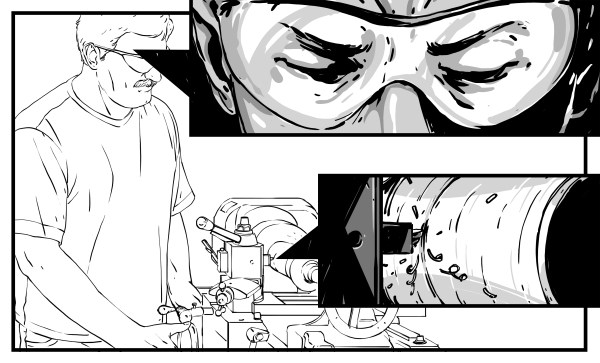
The lathe is known as the King of Machine Tools for a reason. There are very few things that you can’t make with one. In fact, people love to utter the old saw that the lathe is the only machine tool that can make itself. While catchy, I think that’s a bit disingenuous. It’s more accurate to say that there are parts in all machine tools that (arguably) only a lathe can make. In that sense, the lathe is the most “fundamental” machine tool. Before you harbor dreams of self-replication, however, know that most of an early lathe would be made by hand scraping the required flat surfaces. So no, a lathe can’t make itself really, but a lathe and a skilled craftsperson with a hand-scraper sure can. In fact, if you’ve read the The Metal Lathe by David J. Gingery, you know that a lathe is instrumental in building itself while you’re still working on it.

We’re taking trip through the machining world with this series of articles. In the previous article we went over the history of machine tools. Let’s cut to the modern chase now and help some interested folks get into the world of hobby machining, shall we? As we saw last time, the first machine tools were lathes, and that’s also where you should start.

Continue reading “The King Of Machine Tools”

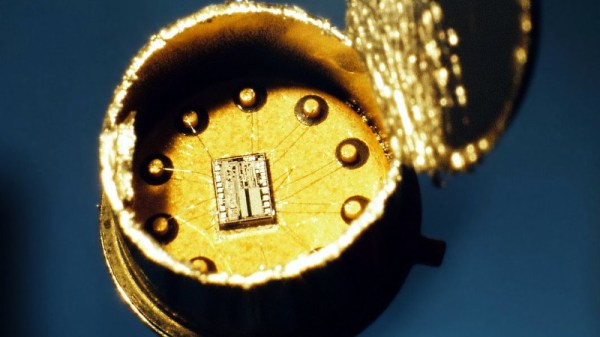
Deconstructing A Simple Op-Amp

Maybe you are familiar with the op-amp as an extremely versatile component, and you know how to quickly construct a huge variety of circuits with one. Maybe you even have a favorite op-amp or two for different applications, covering many possible niches. Standard circuits such as an inverting amplifier are your bread and butter, and the formula gain=-Rf/Ri is tattooed on your forearm.

But you can know how to use op-amps without really knowing how they work. Have you ever peered under the hood of an op-amp to find out what’s going on in there? Would you like to? Let’s take a simple device and examine it, piece by piece.

Continue reading “Deconstructing A Simple Op-Amp”

You All Know Reginald Fessenden. Who?

Quick, name someone influential in the history of radio. Who do did you think of? Marconi? Tesla? Armstrong? Hertz? Perhaps Sarnoff? We bet only a handful would have said Reginald Fessenden. That’s a shame because he was the first to do something that most of us do every day.

Few know this Canadian inventor’s name even though he developed quite a few innovations. Unlike Colpitts and Hartley we don’t have anything named after him. However, Fessenden was the first man to make a two-way transatlantic radio contact (Marconi’s was one way) and he was a pioneer in using voice over the radio.

He did even more than that. He patented transmitting with a continuous wave instead of a spark, which made modern radio practical. This was unpopular at the time because most thought the spark was necessary to generate enough energy. In 1906, John Fleming (who gave us tubes that are sometimes still called Fleming valves) wrote that “a simple sine-curve would not be likely to produce the required effect.” That was in 1906, five years after Fessenden’s patent.

Continue reading “You All Know Reginald Fessenden. Who?”

Hackaday Links Column Banner

Hackaday Links: February 18, 2018

Hacker uses pineapple on unencrypted WiFi. The results are shocking! Film at 11.

Right on, we’ve got some 3D printing cons coming up. The first is MRRF, the Midwest RepRap Festival. It’s in Goshen, Indiana, March 23-25th. It’s a hoot. Just check out all the coverage we’ve done from MRRF over the years. Go to MRRF.

We got news this was going to happen last year, and now we finally have dates and a location. The East Coast RepRap Fest is happening June 22-24th in Bel Air, Maryland. What’s the East Coast RepRap Fest? Nobody knows; this is the first time it’s happening, and it’s not being produced by SeeMeCNC, the guys behind MRRF. There’s going to be a 3D printed Pinewood Derby, though, so that’s cool.

జ్ఞ‌ా. What the hell, Apple?

Defcon’s going to China. The CFP is open, and we have dates: May 11-13th in Beijing. Among the things that may be said: “Hello Chinese customs official. What is the purpose for my visit? Why, I’m here for a hacker convention. I’m a hacker.”

Intel hit with lawsuits over security flaws. Reuters reports Intel shareholders and customers had filed 32 class action lawsuits against the company because of Spectre and Meltdown bugs. Are we surprised by this? No, but here’s what’s interesting: the patches for Spectre and Meltdown cause a noticeable and quantifiable slowdown on systems. Electricity costs money, and companies (server farms, etc) can therefore put a precise dollar amount on what the Spectre and Meltdown patches cost them. Two of the lawsuits allege Intel and its officers violated securities laws by making statements or products that were false. There’s also the issue of Intel CEO Brian Krzanich selling shares after he knew about Meltdown, but before the details were made public. Luckily for Krzanich, the rule of law does not apply to the wealthy.

What does the Apollo Guidance Computer look like? If you think it has a bunch of glowey numbers and buttons, you’re wrong; that’s the DSKY — the user I/O device. The real AGC is basically just two 19″ racks. Still, the DSKY is very cool and a while back, we posted something about a DIY DSKY. Sure, it’s just 7-segment LEDs, but whatever. Now this project is a Kickstarter campaign. Seventy bucks gives you the STLs for the 3D printed parts, BOM, and a PCB. $250 is the base for the barebones kit.