Mathieu Stephan : The Making Of A Secure Open Source Hardware Password Keeper

Mathieu Stephan is an open source hardware developer, a Tindie seller who always has inventory, a former Hackaday writer, and an awesome all-around guy. One of his biggest projects for the last few years has been the Mooltipass, an offline password keeper built around smart cards and a USB interface. It’s the solution to Post-It notes stuck to your monitor and using the same password for all your accounts around the Internet.

The Mooltipass is an extremely successful product, and last year Mathieu launched the Mooltipass Mini. No, it doesn’t have the sweet illuminated touch-sensitive buttons, but it is a bit cheaper than its big brother and a bit more resistant to physical attacks — something you want in a device that keeps all your passwords secure.

Mathieu didn’t build the Mooltipass alone, though. This is an Open Source project that has developers and testers from around the globe. It may have started off as a Hackaday Post, but now the Mooltipass has grown into a worldwide development team with contributors across the globe. How did Mathieu manage to pull this off? You can check out his talk at the 2017 Hackaday Superconference below.

Continue reading “Mathieu Stephan : The Making Of A Secure Open Source Hardware Password Keeper”
Retrotechtacular: Circuit Boards The Tektronix Way

Printed circuit boards are a fundamental part of both of commercial electronic equipment and of the projects we feature here on Hackaday. Many of us have made our own, whether done so from first principles with a tank of etchant, or sent off as a set of Gerbers to a PCB fab house.

To say that the subject of today’s Retrotechtacular is the manufacture of printed circuit boards might seem odd, because there is nothing archaic about a PCB, they’re very much still with us. But the film below the break is a fascinating look at the process from two angles, both for what it tells us about how they are still manufactured, and how they were manufactured in 1969 when it was made.

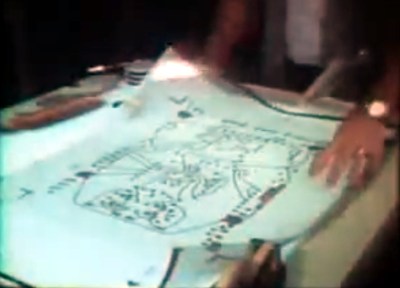
Board artwork laid out at four-times actual size

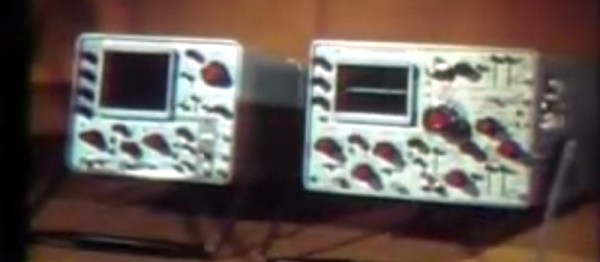
Tektronix were as famous for the manufacturer of particularly high quality oscilloscopes back then as they are now. The Tektronix ‘scopes of the late 1960s featured several printed circuit boards carrying solid-state electronics, and were manufactured to an extremely high standard. The film follows the manufacturing process from initial PCB layout to assembled board, with plenty of detail of all production processes.

In 2017 you would start a PCB design in a CAD package, but in 1969 the was incredibly manual. Everything was transcribed by hand from a paper schematic to transparent film. Paper mock-ups of component footprints four times larger than actual size are placed on a grid, and conductors drawn in pencil on an overlaid piece of tracing paper. Then the pads and pattern of tracks are laid out using black transfers and tape on sheets of film over the tracing paper, one each for top and bottom of the board. A photographic process reduces them to production size onto film, from which they can be exposed and etched in the same way that you would in 2017.

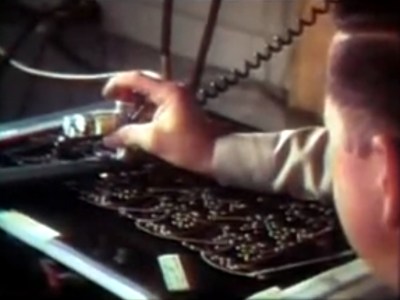
Pantograph drilling machine uses a manually moved styuls on a template to drill six boards at once

Most of the physical process of creating a PCB has not changed significantly since 1969. We are shown the through-plating and gold plating processes in detail, then the etching and silkscreening processes, before seeing component installation and finally wave soldering.

What are anachronistic though are some of the machines, and the parts now robotised that were done in 1969 by hand. The PCB drilling is done by hand with a pantograph drill for small runs, but for large ones a fascinating numerically-controlled drilling rig is used, controlled by punched tape without a computer in sight. Component placement is all by hand, and the commentator remarks that it may one day be done by machine.

The film remains simultaneously an interesting look at PCB production and a fascinating snapshot of 1960s manufacturing. It’s probable that many of the Tek ‘scopes made on that line are still with us, they’re certainly familiar to look at from our experience at radio rallies.

Continue reading “Retrotechtacular: Circuit Boards The Tektronix Way”

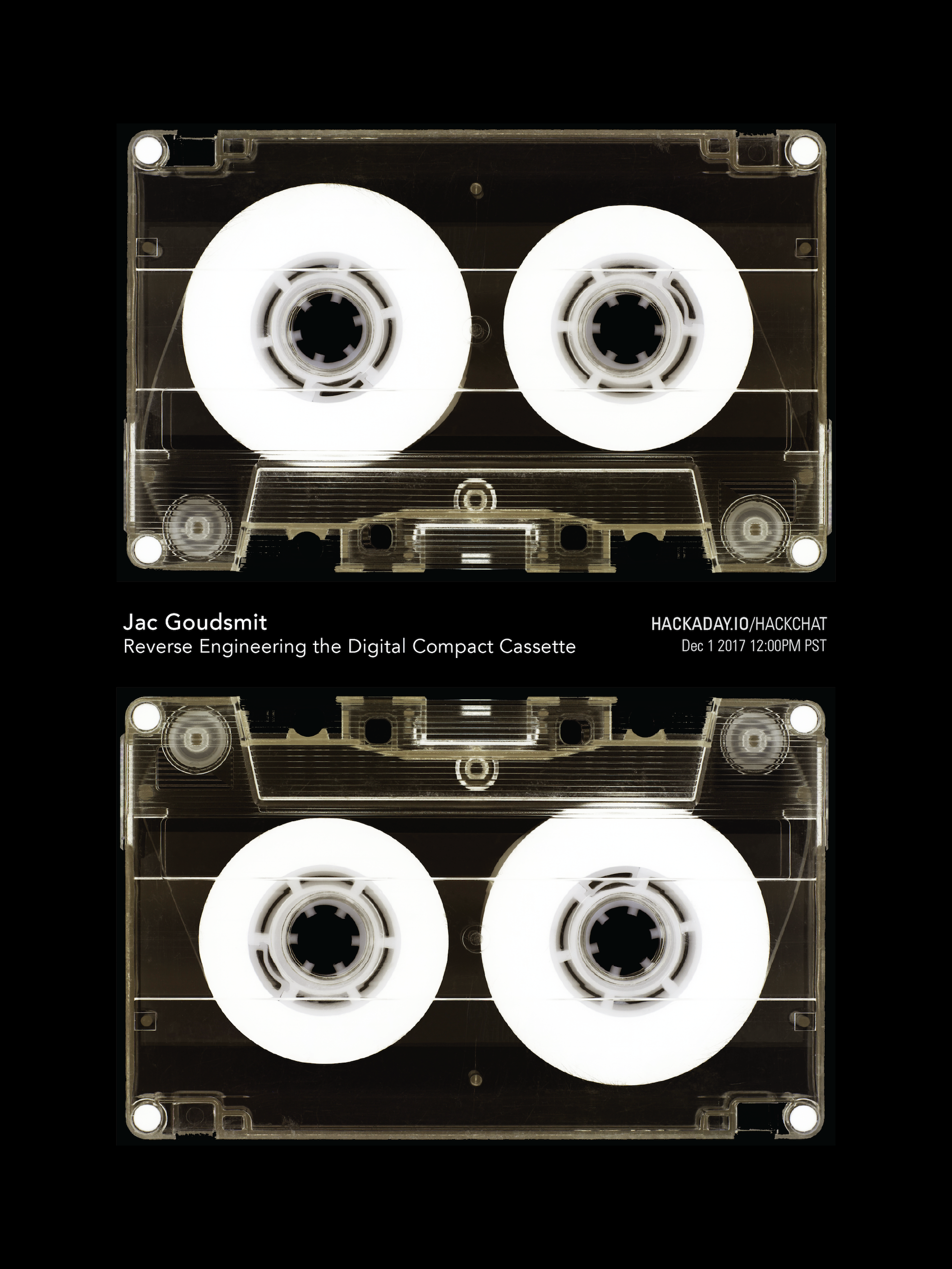
Friday Hack Chat: Reverse Engineering The Digital Compact Cassette

For this week’s Hack Chat, we’re talking about reverse engineering the Digital Compact Cassette. Why should we care about an obsolete format that was only on the market for four years?  Because if a copy of the Spin Doctor’s Pocket Full of Kryptonite costs $50 USD on the used market, it has to be good.

In the early 1990s, several different digital magnetic tape formats came onto the scene. The MiniDisc was magneto-optical, yes, but back in the day it was amazing for recording bootlegs. DAT also appeared in the early 90s, and it was a godsend for recording studios. There was another format introduced in 1992, the Digital Compact Cassette. It was backward compatible with standard audio cassettes, an important feature, because no one would want to replace their entire cassette-based music collection with a new-fangled digital format. That would be just lunacy.

Our guest for this week’s Hack Chat will be [Jac Goudsmit], prolific creator on Hackaday.io, with projects ranging from the L-Star Software Defined 6502 Computer to a GPS Controlled FischerTechnik Clock. [Jac] grew up on a PET 2001, and in the years since he’s worked on projects ranging from motion control systems for lithography equipment, pick and place machines, and even at a Radio Shack. In this Hack Chat, he’ll be discussing the history of the Digital Compact Cassette, the behind the scenes on how stereo PCM is recorded to tape, and other topics like the difference between CS/EE careers in the Netherlands and the USA.

join-hack-chatOur Hack Chats are live community events on the Hackaday.io Hack Chat group messaging. Our Hack Chats usually happen on Fridays at Noon, so buckle up because this is going down Friday, December 1, at 12:00 PST. What time is that where you live? Who cares! Here’s a time zone converter!

Click that speech bubble to the left, and you’ll be taken directly to the Hack Chat group on Hackaday.io.

You don’t have to wait until Friday; join whenever you want and you can see what the community is talking about.

Mike Ossmann And Dominic Spill: IR, Pirates!

Mike Ossmann and Dominic Spill have been at the forefront of the recent wave of software-defined radio (SDR) hacking. Mike is the hardware guy, and his radio designs helped bring Bluetooth and ISM-band to the masses. Dominic is the software guy who makes sure that all this gear is actually usable. The HackRF SDR is still one of the best cheap choices if you need an SDR that can transmit and receive.

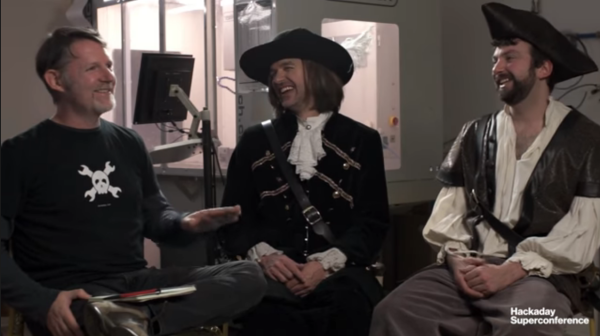
So what are these two doing on stage giving a talk about IR communication? Can you really turn traffic lights green by blinking lights? And can you spoof a TV remote with a cardboard cutout, a bicycle wheel, and a sparkler? What does IR have to do with pirates, and why are these two dressed up as buccaneers? Watch our video interview and find out, or watch the full talk for all of the juicy details.

Continue reading “Mike Ossmann And Dominic Spill: IR, Pirates!”

Ask Hackaday: How On Earth Can A 2004 MP3 Player Read An SDXC Card?

What were you doing in 2004? Can you even remember 2004? Maybe it’s like the old joke about the 1960s, if you can remember it, you weren’t really there, man. Cast your mind back, [Lance Armstrong] was winning the Tour de France, and SpaceShipOne made it into space.

[Gregg Eshelman], wrote to us to say that in 2004 he bought an MP3 player. Ask your parents about them, they were what hipsters used before they had cassette tapes: portable music players that everyone thought were really cool back then, onto which music didn’t come from the Internet but had to be manually loaded from a computer.

Jokes about slightly outdated consumer electronics aside, [Gregg]’s player, a GPX MW3836, turned out to be a really good buy. Not only does it still work, it packs an unexpected bonus, it reads 64Gb SD cards when they are formatted as FAT32. This might not seem like a big deal at a cursory glance, but it’s worth considering a little SD card history.

Back when the GPX was made, the maximum capacity of an SD card was 2Gb, a figure that must have seemed huge when the standard was created, but by the middle of the last decade was starting to look a little cramped. The GPX player is designed to only read these original 2Gb cards. In the years since then there have been a couple of revisions to the standard, SDHC, and SDXC, which have given us the huge cards we are used to today. Many other devices from the 2Gb SD era, made before SDHC and SDXC existed, cannot read the modern cards, yet [Gregg]’s GPX can.

Hackaday’s readership constantly amaze us with the sheer breadth of their knowledge and expertise, so we are sure that among you reading this piece will be experts on SD card standards who can shed some light on this mystery. Why can a player designed for the original SD card standard read the much newer cards when other contemporary ones can not? [Gregg] would love to know, and now our curiosity has been whetted, so would we.

If you think you’ve heard [Gregg]’s name before, it might be for his expertise in resin casting automotive parts.

SD card image: Andreas Frank (CC BY 2.5).

Coin Cell Challenge: Use Coin Cell, Win Prizes

Today, we’re calling all hackers to do the most with a single coin cell. It’s the Coin Cell Challenge, and we’re looking for everything from the most low-power electronics to a supernova in a button cell battery.

Electronics are sucking down fewer and fewer amps every year. Low power is the future, and we’re wondering how far we can push the capabilities of those tiny discs full of power. The Coin Cell Challenge is your chance to plumb the depths of what can be done with the humble coin cell.

This is a contest, and as with the tradition of the Open 7400 Logic Competition and the recent Flashing Light Prize, we want to see what the community can come up with. The idea is simple: do something cool with a single coin cell and you’ll secure your fifteen minutes of fame and win a prize.

Three Challenges

To kick this contest off, we’re opening up three challenges to all contenders to the world heavyweight champion of button cell exploits. The first, the Lifetime Award, will go to whoever can run something interesting the longest amount of time on a coin cell. The Supernova Award is the opposite – what is the most exciting thing you can do with a button cell battery, lifetime be damned? The Heavy Lifting Award will go to the project that is the most unbelievable. If you think you can’t do that with a coin cell battery — lifting a piano or starting a car, for example — odds are you probably can. We want to see it.

Prizes and Rules

All Hackaday hardware hacking challenges need prizes, and for this one, we’re rolling out the red carpet. We’re offering up cash prizes for the top coin cell hacks. There are three $500 USD cash prizes, one for each winner of the Lifetime, Supernova, and Heavy Lifting awards. We’re not stopping there, because the top twenty builds overall will each receive $100 in Tindie credit, where the winners can cash in on some artisanal electronics sold by the people who design them.

What do you have to do to get in on this action? First, you need to build something. This something must be powered by nothing more than a single coin cell battery and must include some type of electronics. We also want this to be Open Source, and you’ll need to start a project on hackaday.io. The full rules are available over here, but don’t wait — the deadline for entry is January 8th, 2018.

We’re excited to see what the community comes up with, and who will find a production coin cell that’s the size of a dinner plate. This is going to be a great contest with overheating coin cells and tiny bits of metal flying across the room. This is going to be a contest filled with blinkies and wireless devices that run for far, far too long. Someone is going to misread the rules and tape together a meter tall pile of coin cells. It’s going to be awesome, so start your project now.

Marguerite Perey: When The Lab Assistant Gets The Credit

Most people obtain a bachelor’s degree before getting their masters, and even that is a prerequisite for a doctorate. Most people, however, don’t discover a new chemical element.

Marguerite Perey graduated with a chemistry diploma from Paris’ Technical School of Women’s Education in 1929, and applied for work at the Curie Institute, at the time one of the leading chemistry and physics labs in the world. She was hired, and put to work cataloging and preparing samples of the element actinium. This element had been discovered thirty years before by a chemist who had also been working in the Curie laboratory, but this was the height of the chemical revolution and the studies and research must continue.

When Marie Curie died in 1934, the discoverer of actinium, André-Louis Debierne, continued his research and Perey kept providing samples. Marguerite’s work was recognized, and in time she was promoted from a simple lab assistant to a  radiochemist. It would not be an exaggeration to say that Marguerite was, at the time, the world’s leading expert in the preparation of actinium. This expertise would lead her to the discovery of the bottom left corner of the periodic table: francium, element 87, the least electronegative element, and arguably the most difficult naturally occurring element to isolate.

Continue reading “Marguerite Perey: When The Lab Assistant Gets The Credit”