Teardown With A Twist: 1975 Sinclair Scientific Calculator

When writing a recent piece about Reverse Polish Notation, or RPN, as a hook for my writing I retrieved my Sinclair Scientific calculator from storage. This was an important model in the genesis of the scientific calculator, not for being either a trailblazer or even for being especially good, but for the interesting manner of its operation and that it was one of the first scientific calculators at an affordable price.

I bought the calculator in a 1980s rummage sale, bodged its broken battery clip to bring it to life, and had it on my bench for a few years. Even in the early 1990s (and even if you didn’t use it), having a retro calculator on your bench gave you a bit of street cred. But then as life moved around me it went into that storage box, and until the RPN article that’s where it stayed. Finding it was a significant task, to locate something about the size of a candy bar in the storage box it had inhabited for two decades, among a slightly chaotic brace of shelves full of similar boxes.
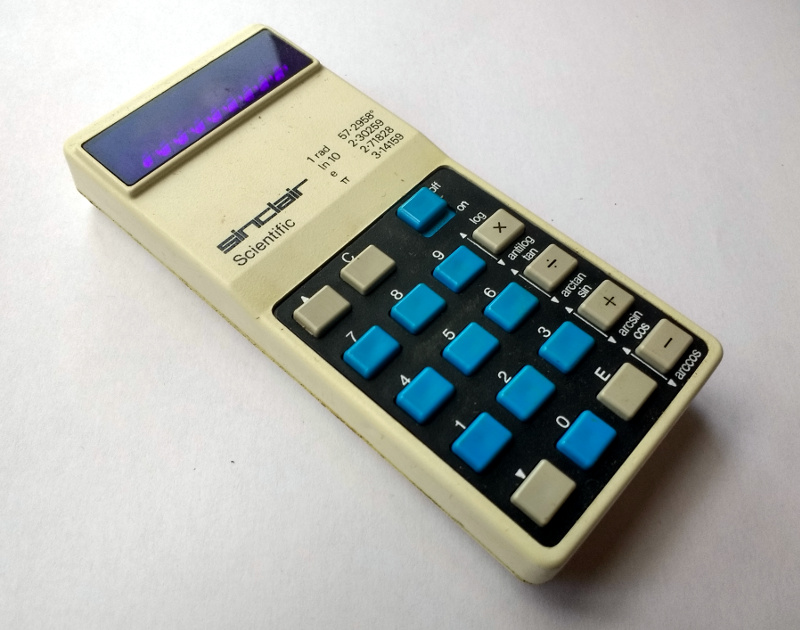
The Sinclair's clean design still looks good four decades later.
The Sinclair’s clean design still looks good four decades later.

Looking at it though as an adult, it becomes obvious that this is an interesting machine in its own right, and one that deserves a closer examination. What follows will not be the only teardown of a Sinclair Scientific on the web, after all nobody could match [Ken Shirriff]’s examination of the internals of its chip, but it should provide an insight into the calculator’s construction, and plenty of satisfying pictures for lovers of 1970s consumer electronics.

The Sinclair is protected by a rigid black plastic case, meaning that it has survived the decades well. On the inside of the case is a crib sheet for its RPN syntax and scientific functions, an invaluable aid when it comes to performing any calculations.

It shares the same external design as the earlier Sinclair Cambridge, a more humble arithmetic calculator, but where the Cambridge’s plastic is black, on the Scientific it is white. The LED display sits behind a purple-tinted window, and the blue-and-black keyboard occupies the lower two-thirds of the front panel. At 50 x 111 x 16 mm it is a true pocket calculator, with an elegance many of its contemporaries failed to achieve and which is certainly not matched by most recent calculators. Good industrial design does not age, and while the Sinclair’s design makes it visibly a product of the early 1970s space-age aesthetic it is nevertheless an attractive item in its own right.

Continue reading “Teardown With A Twist: 1975 Sinclair Scientific Calculator”

Friday Hack Chat: Fundamentals Of RF

Designing a system for communication over RF is a dark art. It’s an obscure domain filled with photonmancy, wires going every which way, and imaginary numbers. RF is reserved entirely for wizards. The guy who simplified Maxwell’s equations into the form we now use went literally insane and replaced all the furniture in his house with granite blocks. This is weird stuff, man.

For this week’s Hack Chat, we’re talking about RF. Everything from the capabilities of different bands, how bandwidth is incorporated into designs, different modulation schemes, RF concepts, I/Q, Nyquist, and other deep-dive topics that elucidate the mysteries of the universe and include all the math.

If you’ve ever wondered how bits get turned into radio waves, what all the PSKs and SSBs are all about, and how bandwidth and range of a radio system play into what frequencies are used, this is the Hack Chat for you.

Our guest for this week’s Hack Chat is [Nick Kartsioukas]. He’s an infosec engineer, an amateur radio operator with an Extra license, hardware hacker, plays around with radio and antenna projects, SDR, and he’s an RC pilot. There’s a lot of RF swimming around [Nick], and he’s got the skills to pay the bills.

This is a community Hack Chat, and we’re taking questions from the community. If you have a question or something you’d like to discuss, add it to the sheet.

join-hack-chatOur Hack Chats are live community events on the Hackaday.io Hack Chat group messaging. This Hack Chat is going down noon, PDT, Friday, November 3rd. Do you wish every time zone was UTC? Yeah, it’s a great idea, but when you really think about it, it would be terrible. Here’s a time zone converter!

Click that speech bubble to the left, and you’ll be taken directly to the Hack Chat group on Hackaday.io.

You don’t have to wait until Friday; join whenever you want and you can see what the community is talking about.

We’re also looking for new Hack Chat hosts! If you’ve built something cool, you’re working on an interesting project, or you’re about to introduce a really cool product, hit us up! Email our wonderful community managers, and we’ll see if we can slot you in.

Rita Levi-Montalcini Had Nerves Of Steel

When we think of role models, it’s easy to categorize them narrowly on the basis of their skill set. We might say that he’s a great mathematician, or that she is an excellent chemist. Some role models are admirable on a deeper, human level. These are the kinds of heroes who obliterate all the obstacles dropped in front of them to tirelessly pursue their interests and devote their lives to doing the kind of stuff that makes the world better for everyone.

Italian Nobel Laureate Rita Levi-Montalcini is this kind of role model. Her scientific curiosity and unconventional thinking led her to discover nerve growth factor (NGF), a naturally occurring protein which we now know is responsible for nerve growth and regulation. Rita’s discovery provided great insight into the way the nervous system develops. The discoveries that she made underlie much of modern research into neurologically degenerative diseases like Alzheimer’s and cancer, and NGF is used experimentally the treatment of both.

Continue reading “Rita Levi-Montalcini Had Nerves Of Steel”

Coffee, Conspiracy, And Citizen Science: An Introduction To Iodometry

I take coffee very seriously. It’s probably the most important meal of the day, and apparently the largest overall dietary source of antioxidants in the United States of America. Regardless of whether you believe antioxidants have a health effect (I’m skeptical), that’s interesting!

Unfortunately, industrially roasted and ground coffee is sometimes adulterated with a variety of unwanted ‘other stuff’: corn, soybeans, wheat husks, etc. Across Southeast Asia, there’s a lot of concern over food adulteration and safety in general, as the cost-driven nature of the market pushes a minority of vendors to dishonest business practices. Here in Vietnam, one of the specific rumors is that coffee from street vendors is not actually coffee, but unsafe chemical flavoring agents mixed with corn silk, roasted coconut husks, and soy. Local news reported that 30% of street coffee doesn’t even contain caffeine.

While I’ve heard some pretty fanciful tales told at street side coffee shops, some of them turned out to be based on some grain (bean?) of truth, and local news has certainly featured it often enough. Then again, I’ve been buying coffee at the same friendly street vendors for years, and take some offense at unfounded accusations directed at them.

This sounds like a job for science, but what can we use to quantify the purity of many coffee samples without spending a fortune? As usual, the solution to the problem (pun intended) was already in the room:

Continue reading “Coffee, Conspiracy, And Citizen Science: An Introduction To Iodometry”

Hackaday Links Column Banner

Hackaday Links: ???? ???? Spooky Edition, 2017

A few links posts ago, we wrote something about a company selling huge LED panels on eBay, ten panels for $50. Those panels are gone now, but a few lucky hackers got their hands on some cool hardware. Now there’s a project to reverse engineer these Barco NX-4 LED panels. Who’s going to be the first to figure out how to drive these things? Doesn’t matter — it’s a group project and we’re all made richer by the contributions of others.

Prague is getting a new hackerspace.

A year and a half ago, a $79 3D printer popped up on Kickstarter. I said I would eat a hat if it shipped by next year. Seeing as how it’s basically November, and they’re not selling a $79 printer anymore — it’s $99 — this might go down as one of my rare defeats, with an asterisk, of course. I’m going to go source some very large fruit roll-ups and do this at Supercon. Thanks, [Larry].

Speaking of bets, this week Amazon introduced the most idiotic thing ever invented. It’s called Amazon Key. It’s an electronic lock (dumb), connected to the Internet (dumber), so you let strangers into your house to deliver packages (dumbest). CCC is in a few months, so I don’t know if Amazon Key will be hacked by then, but I’m pretty confident this will be broken by March.

The Lulzbot Taz is one of the best printers on the market, and it is exceptionally Open Source. The Taz is also a great printer for low-volume production. It was only a matter of time until someone built this. The Twoolhead is a parallel extruder for the Taz 6. Instead of one extruder and nozzle, it’s two, and instead of printing one object at a time, it prints two. Of course it limits the build volume of the printer, but if you need smaller parts faster, this is the way to go.

Hey, did you hear? Hackaday is having a conference the weekend after next. This year, we’re opening up the doors a day early and having a party at the Evil Overlord’s offices. Tickets are free for Supercon attendees, so register here.

At CES this year, we caught wind of one of the coolest advances in backyard astronomy in decades. The eVscope is ‘astrophotography in the eyepiece’, and it’s basically a CCD, a ton of magic image processing, and a small display, all mounted inside a telescope. Point the scope at a nebula, and instead of seeing a blurry smudge, you’ll see tendrils and filaments of interstellar gas in almost real-time. Now the eVscope is on Kickstarter. It’s a 4.5 inch almost-Newtonian (the eyepiece is decoupled from the light path, so I don’t even know how telescope nomenclature works in this case), an OLED display, and a 10-hour battery life.

Is the fidget spinner fad over? Oh, we hope not. A technology is only perfected after it has been made obsolete. Case in point? We can play phonographs with lasers. The internal combustion engine will be obsolete in automobiles in twenty years, but track times will continue going down for forty. Fidget spinners may be dead, but now you can program them with JavaScript. What a time to be alive!

Audio tomphoolery even an idiot tech blogger can see through! I received a press kit for a USB DAC this week that included the line, “…low drop out voltage regulators running at 3.3 V, meaning the 5 V USB limit is well preserved.” Yes, because you’re running your system at 3.3 V, you won’t draw too much current from a USB port. That’s how it works, right?

[Peter Sripol] is building an ultralight in his basement. The last few weeks of his YouTube channel have been the must-watch videos of the season. He’s glassed the wings, installed all the hardware (correctly), and now he has the motors and props mounted. This is an electric ultralight, so he’s using a pair of ‘150 cc’ motors from HobbyKing. No, that’s not displacement, it’s just a replacement for a 150 cc gas engine. On a few YouTube Live streams, [Peter] did what was effectively a high-speed taxi test that got out of hand. It flew. Doing that at night was probably not the best idea, but we’re looking forward to the videos of the flight tests.

Fail Of The Week — Accidental Demagnetization

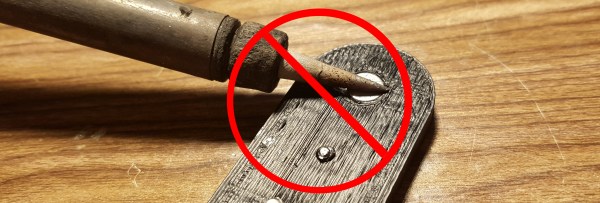
There’s a trick in the world of plastic enclosures. The threaded insert is a small cylinder of metal with threads on the inside and a rough edge on the outside. To make a plastic part with a hole for securely connecting bolts that can be repeatedly screwed without destroying the plastic, you take the threaded insert and press it (usually with the help of a soldering iron to heat the insert)  into a hole that’s slightly smaller than the insert. The heat melts the plastic a little bit and allows for the insert to go inside. Then when it cools the insert is snugly inside the plastic, and you can attach circuit boards or other plastic parts using a bolt without stripping the screw or the insert. We’ve seen Hackaday’s [Joshua Vasquez] installing threaded inserts with an iron, as well as in a few other projects.

This trick is neat. And I’ve now proven that it does not work with neodymium magnets.

Continue reading “Fail Of The Week — Accidental Demagnetization”

The Most Useless Tools You Can’t Seem To Part With

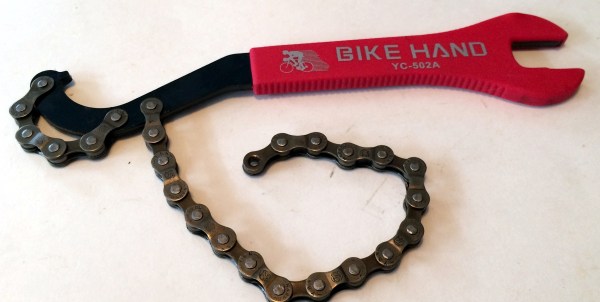
I’m a tool person. No matter how hard I try, I eventually end up with a bunch of tools that I just can’t bear to banish from my workshop. Why? I’m gonna keep it 100%: it’s the same emotion behind hoarding — fearing that you might need a thing later and not be able to have it.

The stuff costs money, and if you have to script to buy a bunch of tools pertaining to Project X, you expect to still have and probably need those very same tools — even if they have to sit in a box on my shelf for 20 years, taunting me every time I have to move it to one side.  “Heat-bending element” the box’s label describes at tool I haven’t used in at least 5 years. I have a bunch of these white elephants. I’ll probably need to heat-bend acrylic real soon… yeah.

I’ve found that pretty much everyone in our crowd can relate. You buy a special tool for one project and it was expensive and tremendously helpful, and since then it’s been sitting around uselessly. You certainly couldn’t part with it, what if you needed it again? So you store it in your house for 20 years, occasionally coming across it when looking for something else, but it never actually gets used.

Join me now in a walk down our memory lane of useless tools.

Continue reading “The Most Useless Tools You Can’t Seem To Part With”