Friday Hack Chat: ASIC Design

Join [Matt Martin], ASIC designer at Keysight, for this week’s Hack Chat.

Every week, we find a few interesting people making the things that make the things that make all the things, sit them down in front of a computer, and get them to spill the beans on how modern manufacturing and technology actually happens. This is the Hack Chat, and it’s happening this Friday, March 17, at noon PDT (20:00 UTC).

[Matt] has been working at Agilent / Keysight since 2007 as an ASIC designer. The work starts with code that is synthesized into logic gates. After that, [Matt] takes those gates and puts them into silicon. He’s worked with processes from 0.13um to 28nm. Turning code into silicon is still a dark art around here, and if you’ve ever wanted to know how all of this works, this is your chance to find out.

Here’s How To Take Part:

join-hack-chatOur Hack Chats are live community events on the Hackaday.io Hack Chat group messaging.

Log into Hackaday.io, visit that page, and look for the ‘Join this Project’ Button. Once you’re part of the project, the button will change to ‘Team Messaging’, which takes you directly to the Hack Chat.

You don’t have to wait until Friday; join whenever you want and you can see what the community is talking about.

Upcoming Hack Chats

We’ve got a lot on the table when it comes to our Hack Chats. On March 24th, we’re going to argue the merits of tube amplifiers in audio applications. In April, we have [Samy Kamkar], hacker extraordinaire, to talk reverse engineering.

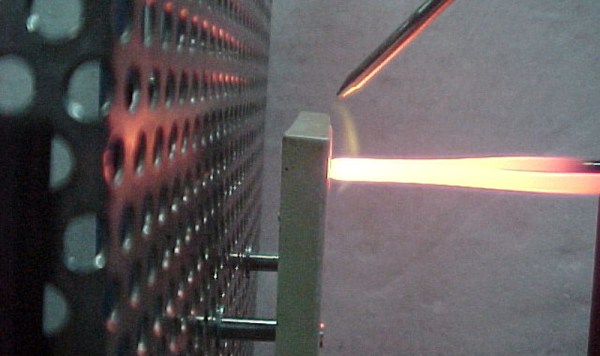
Because I’ve never had the opportunity to do so, and because these Hack Chat announcement posts never get many comments anyway, I’m going to throw this one out there. What would it take to build out a silicon fabrication plant based on technology from 1972? I’m talking about a 10-micrometer process here, something that might be able to clone a 6502. Technology is on our side — a laser printer is cheaper than a few square feet of rubylith — and quartz tube heaters and wire bonding machines can be found on the surplus market. Is it possible to build a silicon fab in your garage without going broke? Leave your thoughts in the comments, and then bring them with you to the Hack Chat this Friday.

Hackaday Unconference This Saturday (in Triplicate)

This Saturday we’re hosting the Hackaday Unconference — three live events in Chicago, Los Angeles, and San Francisco that are going to jumpstart the idea engines and enthusiasm of everyone who attends. We can’t even tell you what the Unconference is about; it’s the people who participate that make the schedule and guide the discussion. Everyone there will be ready to give a talk of at least eight minutes on something that excites them right now. As the day goes on, ideas will feed off of each other and people will give talks and lead discussions they hadn’t even thought of before hearing other presentations of the day. It’s an atmosphere that you’ve never experienced unless you’ve been to an Unconference.

If you are located near one of these events it’s not too late to sign up. We’ve expanded the RSVP limit for Chicago and Los Angeles. And San Francisco has a waiting list that will likely be released at some point this week. So sign up now!!

Those not located nearby can still peek in to see what’s happening. We’ll be covering all three events on Hackaday Twitter,  Hackaday Facebook (including some Facebook Live blips throughout the day), and Hackaday Instagram using the #HackadayUncon hashtag. While you’re looking through all the ways to stay connected with us, you should sign up for the weekly Hackaday.com newsletter to pick up any stories you might have missed and get a few hints of what is ahead.

The God Particle

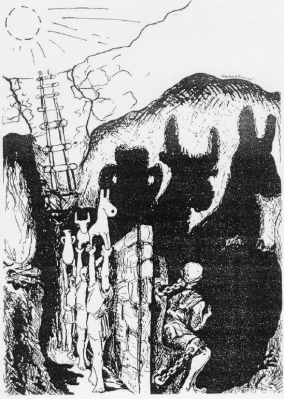
The Greek philosopher Plato is well known for his allegories and metaphors. Of particular interest is his Allegory of the Cave, which appeared in The Republic, written around 380BCE. In it, Plato describes a group of prisoners which are chained to a wall within a cave, and have been all of their lives. They have no direct interaction with the world outside of the cave. They only know of the world via shadows that are cast on the wall opposite of them.  For the prisoners, the shadows are their reality.  Though you and I know the shadows are only a very low-resolution representation of that reality.

standard_01
Plato’s “Allegory of the Cave”, drawing by Markus Maurer

Theoretical physicist Steven Weinberg, a Nobel Prize winner who works out of the University of Texas at Austin, once likened himself to a prisoner in Plato’s cave. We are forever chained to this cave by the limitations in measurements we can make and experiments we can perform. All that we can know are shadows of the reality that exists in the sub-atomic world. We can see the shadowy figures lurking in our math and as wisps of misty vapor trails in our cloud chambers. We attempt to pierce the veil with the power of our imagination and draw nifty looking charts and animations depicting what our mind’s eye thinks it can see. But in the end, we are all trapped in a cave… staring at shadows. Reflections of a reality we can never truly know.

In our last Quantum Mechanics article, we introduced you to the idea of quantum electrodynamics, or to put it more simply — quantum field theory. In this article, we’re going to explore how QED lead to the prediction and eventual confirmation of something known as the Higgs Boson, also known as the God Particle. As usual, we’ll aim to keep things as simple as possible, allowing anyone with a curious mind to know what this God particle talk is all about. Like so many things in the quantum world, it all started with an unexpected outcome…

Continue reading “The God Particle”

Hackaday Links: March 12, 2017

The world’s first public installation of a solar roadway caught fire or something.

Hey hardware nerds in the UK! Nottingham is having its first monthly hardware meetup. This get together is being put together by [Spencer], creator of the extremely popular RC2014 Homebrew Z80 computer kit. The meetup is free, and it’s happening this Tuesday.

[danjovic] sent in a link to this YouTube channel of a guy building stuff out of PVC sheets and CA glue. There’s a lot of stuff in here from a PVC tripod to instructions on how to get PVC sheets out of PVC pipe. Small warning: this is PVC, and it will kill you instantly, for reasons we can’t yet determine. Additionally, he’s heating PVC, which means cancer for your yet-unborn great-grandchildren. How it both kills you while still allowing you to breed is beyond our comprehension. That’s how bad PVC really is.

NASA has updated their available software catalog. If you want to go to Saturn, you first have to go to Venus three times. Here’s a tool that packs batteries. You should build a router for the interplanetary Internet.

[jlbrian7] is Breaking Android over on Hackaday.io

Last week, we had a Raspberry Pi Hack Chat with [Roger Thornton], the principal hardware engineer at Raspberry Pi. We talked about the hardware that goes into the Raspberry Pi (and the new Pi Zero W), and gave away a few Pi Zero Ws to a few people on hackaday.io that had great ideas for a project. One of the winners of a free Raspberry Pi Zero W was [arsenijs] for his Raspberry Pi Project. This is a really great project that uses a Raspberry Pi and Raspberry Pi accessories. It’s pushing the envelope of what a Pi can be, and a free Raspberry Pi Zero W couldn’t have gone to a more worthy project.

What are you doing the weekend of March 31st? We’re going to New Jersey for the Vintage Computer Festival East. This is one of the better cons we go to. Maybe this year we’ll organize a trip to the pinball museum in Asbury Park.

Ask Hackaday: Helping Hands

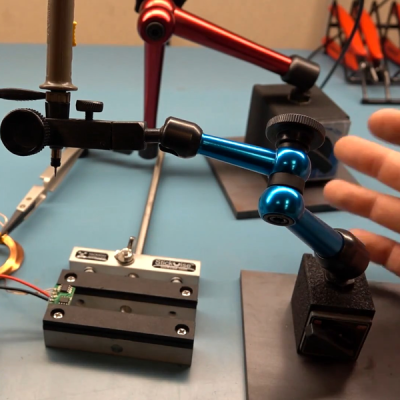
[ProtoG] sent us in this video (also below) where he demonstrates the use of machinist’s dial-gauge indicator arms as helping hands. I’ll admit that I got so jealous that I ordered a pair. I wouldn’t say that I need more tools to hold things in place, but I certainly want them. The rapid coarse placement combined with fine adjustment looks so sweet. Using them as scope-probe holders is brilliant.

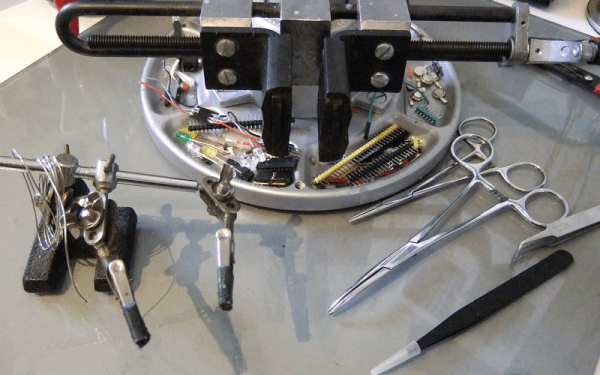
Our own helping hands, purchased for $5 from a surplus shop, have seen nearly twenty years of use now. About ten years ago, I heat-shrinked and plasti-dipped the jaws, and since then they do less damage to cable insulation. The clips kept coming loose, but that was fixed with a little epoxy. I never used the magnifying glass, and by removing it I bought some more sliding room for the jaws, which was an easy win. The base has a “non-slip” coating of Shoe-Goo that keeps it in place on the desk. Cork might be classier.



For bigger holding, there’s always the desk vise, though I’ll admit that I mostly use it for holding PCBs while soldering, and that a better solution for that particular task wouldn’t hurt. [Mike Szczys] tells me that the Stickvise seen here is a handy thing to have on the bench. It started on Hackaday.io and we still carry it in the store.

For grabbing the fiddly little things, nothing beats a pair of hemostats and a range of tweezers. Hemostats in the desk vise make a great ad hoc holder. Good sharp tweezers pay for themselves with the first removed splinter, or placing SMT parts.

So, Hackaday, what do you use for holding things? What do you hold your PCBs with while soldering? What do you use to hold down SMD parts? What’s your third hand, or twenty-third? Continue reading “Ask Hackaday: Helping Hands”

Linux-Fu: Keeping Things Running

If you’ve used Linux from the early days (or, like me, started with Unix), you didn’t have to learn as much right away and as things have become more complex, you can kind of pick things up as you go. If you are only starting with Linux because you are using a Raspberry Pi, became unhappy with XP being orphaned, or you are running a cloud server for your latest Skynet-like IoT project, it can be daunting to pick it all up in one place.

Recently my son asked me how do you make something run on a Linux box even after you log off. I thought that was a pretty good question and not necessarily a simple answer, depending on what you want to accomplish.

There’s really four different cases I could think of:

  1. You want to launch something you know will take a long time.
  2. You run something, realize it is going to take a long time, and want to log off without stopping it.
  3. You want to write a script or other kind of program that detaches itself and keeps running (known as a daemon).
  4. You want some program to run all the time, even if you didn’t log in after a reboot.

Continue reading “Linux-Fu: Keeping Things Running”

Retrotechtacular: The Last Main Line

If you were to nominate a technology from the 19th century that most defined it and which had the greatest effect in shaping it, you might well settle upon the railway. Over the century what had started as horse-drawn mining tramways evolved into a global network of high-speed transport that meant travel times to almost anywhere in the world on land shrank from months or weeks to days or hours.

For Brits, by the end of the century a comprehensive network connected almost all but the very smallest towns and villages. There had been many railway companies formed over the years to build railways of all sizes, but these had largely conglomerated into a series of competing companies with a regional focus. Each one had its own main line, all of which radiated out from London to the regions like the spokes of a wheel.

A Ruston steam navvy excavating near Wembley, London. S.W.A.Newton/Leicestershire County Council (Fair use)

By the 1890s there was only one large and ambitious railway company left that had not built a London main line. The Great Central Railway’s heartlands lay in the North Midlands and the North of England, yet had never extended southwards. In the 1890s they launched their ambitious scheme to build  their London connection, an entirely new line from their existing Nottingham station to a new terminus at Marylebone, in London.

Since this was the last of the great British main lines, and built many decades after its rivals, it saw the benefit of the century’s technological advancement. Gone were the thousands of navvies (construction workers, from “Navigational”) digging and moving soil and rock by hand, and in their place the excavation was performed using the latest steam shovels. The latest standards were used in its design, too, with shallow curves and gradients, no level crossings, and a wider Continental loading gauge in anticipation of a future channel tunnel to France This was a high-speed railway built sixty years before modern high-speed trains, and nearly ninety years before the Channel Tunnel was opened.

Continue reading “Retrotechtacular: The Last Main Line”