Hacklet 112 – Skateboard Projects

Skateboarding is a sport that was born of hacking. The identity of the person who first nailed roller skate wheels to a board with a milk crate box is lost to history. Those crate scooters were a staple of the 1940’s and 1950’s neighborhoods. Everyone built their own scooter, so the designs evolved. Eventually the milk crates disappeared. At some point, surfers realized that they could use these wheeled boards to surf the concrete jungle. Things just took off from there. Skateboarding is now a multi-billion dollar industry, but at its heart there are still hackers trying out new designs. This week’s Hacklet is all about skateboarding projects.

long1We start with [brian.rundle] and Electric Longboard. [Brian] built his board using trucks and mechanical parts from a DIY skateboard online shop. The motor is a brushless outrunner R/C plane motor from HobbyKing. Batteries are of the LiPo variety. An Arduino Nano provides the PWM signal which drives the Electronic Speed Control (ESC). Throttle control is via RF link using the popular Nordic Semi NRF2401. [Brian] is focusing on building a safe skateboard. He designed it to carry two batteries, though only one is in use at a time. Rather than use a switch, he’s created a fool-proof system with arming plugs and jumpers. Each battery has its own arming plug. There is one jumper, so only one battery can be connected to the board at a time.
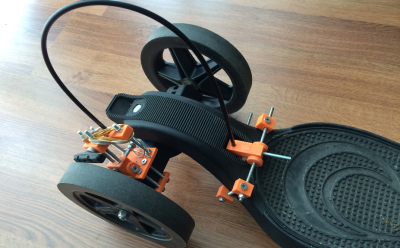
brake1Next up is [suiram21] with Longboard Brake. Downhill longboarding can be a dangerous sport. Running downhill at 40MPH or more with no brakes makes for quite an adrenaline rush. [suiram21] loves longboarding but wanted the safety of having a brake if and when he needed it. He started with a Onda board, which is a longboard with large diameter wheels. He 3D printed brackets for a cable actuated braking system. The brake is activated by stepping on a lever at the rear of the board. A lever presses a bicycle brake pad into the inside edge of the tire. This brings the board to a gentle stop. [suiram21] is thinking of adding a second brake to the other wheel to increase braking authority.

speedo1Next we have [edbraun] with Skateboard Speedometer by inventED. [edbraun] wanted to know how fast he was going. A GPS would work, but GPS signals are often blocked in cities. A more accurate way to gather speed data is directly from the wheels. Two tiny magnet plugs are placed in holes drilled in the wheel. A hall effect sensor detects the magnets and passes this data on to an Arduino Pro Mini. Once the speed is calculated, it’s sent to a Bluetooth radio. [edbraun’s] Android phone receives the data and displays current speed and total distance traveled. The speedometer and its slick 3D printed case almost hide between the trucks and the board itself. Nice work [edbraun]!
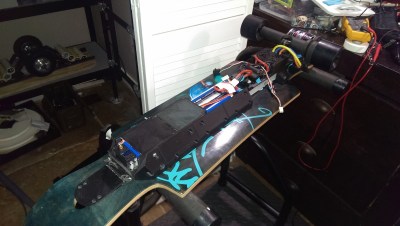
josh1Finally we have Hackaday alum [Josh Marsh] and EV Commuter Longboard. [Josh] uses an electric longboard for his daily commute. His project is an excellent overview and tutorial on building an electric skateboard from scratch. Like many others, [Josh] utilizes R/C Airplane brushless motors and speed controllers. An Arduino or similar microcontroller is all you need to drive these devices. For batteries, [Josh] loves LiPo packs. Long form six cell affairs provide 22.2 Volts with a capacity of 5000 mAh or more. Plenty of power for carving your way to work!

If you want to see more skateboard projects, check out our new skateboard projects list! If I missed your project, don’t be shy, just drop me a message on Hackaday.io. That’s it for this week’s Hacklet. As always, see you next week. Same hack time, same hack channel, bringing you the best of Hackaday.io!
Ask Hackaday: Whatever Happened To LED Light Sensors?

If you’re a long-time Hackaday reader like we are, you’ll certainly remember a rash of projects from around ten years ago that all (mis-)used an LED as a light sensor. The idea wasn’t new, but somehow it made the rounds and insinuated itself into our collective minds. Around the same time, a cryptographic cipher with an exceptionally small memory footprint was also showing up in hacker projects: TEA (Tiny Encryption Algorithm).

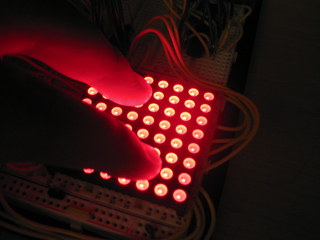
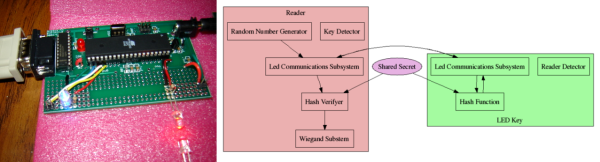
This old project by [Marcin Bojanczyk], [Chris Danis], and [Brian Rogan] combines both the LED-as-light-sensor meme and TEA to make a door-entry keyfob that works over visible light. And they do so using almost nothing — a few LEDs and just over 2Kb of code. It’s pretty sweet.

Which brings us to the question: where are they (LED-sensors and TEA) now?

ledtouch_photoLED-as-light-sensor was just cool. We certainly loved the idea back in 2006. But [Forrest Mims] had been using the phenomenon for decades back then. It certainly makes sense when you’re trying to squeeze as much as possible out of as little as possible, or when budget is a main concern and you just can’t afford an extra photodiode.

But our own experience with LEDs as light sensors is that the results are extremely variable across different LEDs. Code that works with water-clear red LEDs might not work with the ones that come in red-tinted plastic, for instance. Is that why they went extinct?
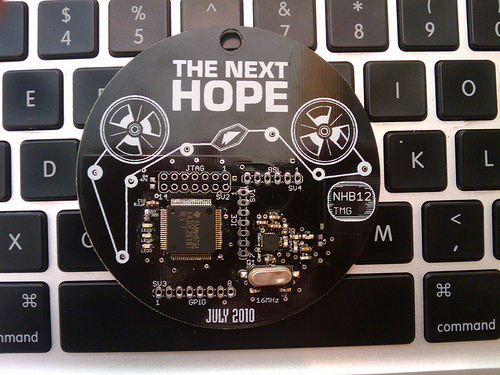
4746123271_7888160588Similarly, the TEA family of ciphers showed up in a bunch of projects around this time, from the badge for the HOPE conference in 2010 to a widely used RFM12B radio library. There are a couple of attacks on XXTEA, but they only affect reduced-round versions of the cipher, and rely on a tremendous amount of intercepted data — more than we’d see in a home-automation network over years.

Over the last five years or so, there’s been a lot more Internet of Things, which means using standard Internet-style encryption methods (AES and so on) that are widespread on non-memory-constrained computers. Is that what happened to XXTEA?

Anyway, we got tipped off to a project that combined a few of our favorite (old) ideas in one, so we thought that we’d share. Thanks [Blue Smoke] for the walk down memory lane. Any of you out there keeping the flame(s) alive? Have you used sensing LEDs or XXTEA? Are those projects still going, or do you have any future projects planned with these tricks still up your sleeve? Let us know in the comments below.

Fail Of The Week: Where’s Me Jumper?

Just in case you imagine that those of us who write for Hackaday are among the elite of engineering talent who never put a foot wrong and whose benches see a succession of perfectly executed builds and amazing hacks, let me disabuse you of that notion with an ignominious failure of my own.

I was building an electronic kit, a few weeks ago. It’s a modular design with multiple cards on a backplane, though since in due course you’ll see a review of it here I’ll save you its details until that moment. In my several decades of electronic endeavours I have built many kits, so this one as a through-hole design on the standard 0.1″ pitch should have presented me with no issues at all. Sadly though it didn’t work out that way.

Things started to go wrong towards the end of the build, I noticed that the temperature regulator on my soldering iron had failed at some point during its construction. Most of it had thus been soldered at a worryingly high temperature, so I was faced with a lot of solder joints to go over and rework in case any of them had been rendered dry by the excessive heat.

In due course when I powered my completed kit up, nothing worked. It must have been the extra heat, I thought, so out came the desolder braid and yet again I reworked the whole kit. Still no joy. Firing up my oscilloscope I could see things happening on its clock and data lines so there was hope, but this wasn’t a kit that was responding to therapy. A long conversation with the (very patient) kit manufacturer left me having followed up a selection of avenues, all to no avail. By this time a couple of weeks of on-and-off diagnostics had come and gone, and I was getting desperate. Somehow I’d cooked this thing with my faulty iron, and there was no way to find the culprit.

Continue reading “Fail Of The Week: Where’s Me Jumper?”

Linux: Assembly Required

Sometimes you might need to use assembly sometime to reach your project objectives. Previously I’ve focused more on embedding assembly within gcc or another compiler. But just like some people want to hunt with a bow, or make bread by hand, or do many other things that are no longer absolutely necessary, some people like writing in assembly language.

In the old days of DOS, it was fairly easy to write in assembly language. Good thing, because on the restricted resources available on those machines it might have been the only way to get things to fit. These days, under Windows or Linux or even on a Raspberry Pi, it is hard to get oriented on how to get an assembly language off the ground.

Continue reading “Linux: Assembly Required”

Symmetry For Dummies: Noether’s Theorem

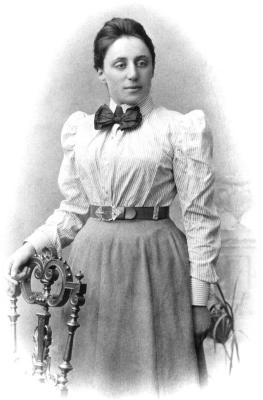
Einstein referred to her as the most important woman in the history of mathematics. Her theorem has been recognized as “one of the most important mathematical theorems ever proved in guiding the development of modern physics.” Yet many people haven’t the slightest clue of who this woman was, or what she did that was so significant to our understanding of how our world works. If you count yourself as one of those who have never heard of Emmy Noether and wish to enlighten yourself, please read on. I can only hope I do her memory justice. Not just by telling you who she was, but by also giving you an understanding of how her insight led to the coming together of symmetry and quantum theory, pointing academia’s arrow toward quantum electrodynamics.

N_01
Emmy Noether

Being a female in Germany in the late 1800s was not easy. She wasn’t allowed to register for math classes. Fortunately, her father happened to be a math professor, which allowed her to sit in on many of his classes. She took one of his final exams in 1904 and did so well that she was granted a bachelors degree. This allowed her to “officially” register in a math graduate program. Three years later, she earned one of the first PhD’s given to a woman in Germany. She was just 25 years old.

1907 was a very exciting time in theoretical physics, as scientists were hot on the heels of figuring out how light and atoms interact with each other. Emmy wanted in on the fun, but being a woman made this difficult. She wasn’t allowed to hold a teaching position, so she worked as an unpaid assistant, surviving on a small inheritance and under-the-table money that she earned sitting in for male professors when they were unable to teach. She was still able to do what professors are supposed to do, however – write papers. In 1916, she would pen the theorem that would have her rubbing shoulders with the other physics and mathematical giants of the era.

Noether’s Theorem – The Basics

Emmy Noether’s Theorem seems simple on the onset, but holds a fundamental truth that explains the fabric of our reality. It goes something like this:

For every symmetry, there is a corresponding conservation law.

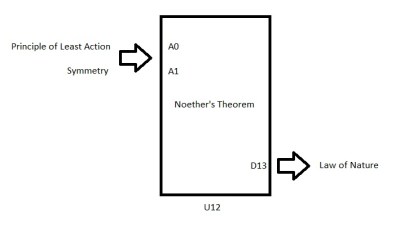
We all have heard of laws such as Newton’s first law of motion, which is about the conservation of momentum. And the first law of thermodynamics, which is about the conservation of energy. Noether’s theorem tells us that there must be some type of symmetry that is related to these conservation laws. Before we get into the meaning, we must first understand a little known subject called The Principle of Least Action.

The Universe is Lazy

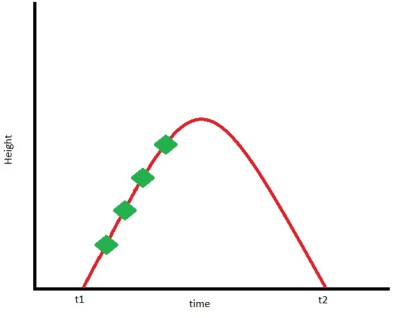
N_02I would wager a few Raspberry Pi Zeros that many of you already have an intuitive grasp of this principle, even if you’ve never heard of it before now. The principle of least action basically says that the universe has figured out the easiest way possible to get something done. Mathematically, it’s the sum over time of kinetic energy minus potential energy as the action occurs. Let us imagine that you’re trying to program an STM32 Discovery eval board in GCC. After about the 6,000th try, you toss the POS across the room and grab your trusty Uno. The graph depicts the STM32 moving through time and space.

 

The green points represent particular points of how how high the STM32 is at a given point in time. Note that there are no values for height and time – this example is meant to explain a principle. We can say that at these points (and all points along the curve), the SMT32 has both kinetic and potential energies. Let us call the kinetic energy (kt) and the potential energy (pt). The ‘t‘ subscript is for time, as both the energies are functions of time. The action for each point will be called s, and can be calculated as:

s = k_t-p_t

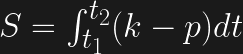
However, action is the total sum of the difference of energies at each point between t1 and t2. If you’ve read my integral post, you will know that we need to integrate in order to calculate the total action.

S = \int_{t_1}^{t_2} (k - p) dt

Now before you get your jumper wires in a bunch, all that is saying is that we’re taking the difference in potential (p) and kinetic (k) energies at each point along the curve between t1 and t2, and we’re adding them together. The elongated S symbol means a sum, and the (dt) means as it changes over time. The path that the STM32 will take will be the path where the action S is at its minimum value. Check out the video in the source section below if you’re confused. It’s only 10 minutes and goes into this concept in easy to follow details.

Noether’s Theorem – The Details

N_03Noether’s theorem is based upon a mathematical proof. It’s not a theory. Her proof can be applied to physics to develop theories, however. Now that we know what the principle of least action is, we can do just this.


Any law of nature can be traced back to a symmetry and the least action principle. Let’s consider two very simple examples – Newton’s first law of motion and the first law of thermodynamics.

Conservation of Momentum

Space has what is known as translational symmetry. That’s just fancy-pants talk for saying that what you do in one point in space is the same as what you do in another point in space. It doesn’t matter what hacker space you throw your STM32, it will act the same at all hacker spaces on earth. Space itself provides the symmetry. And because the principle of least action applies, you have a natural law – the first law of motion.

Conservation of Energy

Time has the same translational symmetry as space does. If I toss the STM32 now, and toss it tomorrow, it will act the same. It doesn’t matter what point in time I toss it, the results will always be the same. Thus energy is conserved between different points in time. Time is our symmetry, and the 1st law of thermodynamics is the result.

Now, I realize these examples might seem a bit useless. But when you dig a bit deeper, things get interesting. Electrical charge is also conserved. Noether says there must then be some type of symmetry involved. What do you suppose that symmetry might be? Keep following that rabbit hole, and you’ll end up face to face with QED. We’ll get there in a future article, so for now just keep Noether’s Theorem in mind.

Sources

Physics Helps, The principle of least action, video link.

Ransom Stephens, Ph.D., Emmy Noether and The Fabric of Reality, video link

Hackaday Links: June 12, 2016

The Navy is doing some crazy stuff out in China Lake. They were planning to test something out that could potentially make GPS unusable from San Diego to Las Vegas to San Francisco. Those plans were cancelled for ‘internal’ reasons. They will be testing something in Indiana shortly, though. What are they doing? Who knows. That’s what idle speculation in the comments section is for.

3D Hubs, the distributed ‘3D printing service’ thing, now has 30,000 machines distributed around the globe. They also put together the definitive guide to 3D printing recently. For just about everyone reading this, a ‘introduction to 3D printing’ is old news, but this is a very good guide for telling your weird aunt what you’re building in the basement. Forward this one to your family on Facebook.

This one is amazing. Over on Hackaday.io, [Arsenijs] is working on a Raspberry Pi project. It uses a Raspberry Pi, and several accessories and components to make this Raspberry Pi project work. This Raspberry Pi project is already getting far more than the usual number of likes and follows, making this one of the most interesting Raspberry Pi projects in recent memory.

Moog is re-releasing the Minimoog, the original Moog synth from 1970. That’s cool, but what about a DIY Minimoog? That’s what [Scott Rider] is doing with the Crowminius Analog Music Synthesizer on Kickstarter. It’s an analog synth that’s more or less a Minimoog with MIDI, and one of the Kickstarter rewards is a bare PCB.

The future is dancing robots, so here’s a servo-driven Stewart platform that is sure to bring on the robot apocalypse.

What do you do when you need to get your Hackaday fix, but all you have is a laptop from 1995 and a dial-up modem? The Hackaday Retro Edition, of course. That’s a bunch of retro Hackaday posts, posted five at a time, with all the CSS and JavaScript cruft stripped. We’re always interested to see the old machines that are pulling the retro edition down, and [djnikochan] has the latest entry. He found a Thinkpad 380ED from 1997 at the Goodwill store for $15. The RAM was upgraded with a 64MB SIMM, giving this machine a total of 80MB. The Hackaday Retro Edition is viewable with IE 5.5 over a trusty PCMICA WiFi card. Awesome job, and we love to see old iron rendering the retro edition. Send some pics in if you get your old battlestation to load it.

Retrotechtacular: An Unexpected Meeting With Philo T Farnsworth

It is not often that you look for one of your heroes on the Internet and by chance encounter another from a completely different field. But if you are a fan of the inimitable silent movie star [Buster Keaton] as well as being the kind of person who reads Hackaday then that could have happened to you just as it did here.

Our subject today is a 1957 episode of CBS’s TV game show I’ve Got a Secret! in which [Keaton] judges a pie-eating contest and is preceded first by a young man with a penchant for snakes and then rather unexpectedly by a true giant of twentieth century technology.

[Philo T Farnsworth] was a prolific engineer who is probably best known as the inventor of electronic television, but whose work touched numerous other fields. Surprisingly this short segment on an entertainment show was his only appearance on the medium to which his invention helped give birth. In it he baffles the panel who fail to guess his claim to fame, before discussing his inventions for a few minutes. He is very effacing about his achievement, making the point that the development of television had been a cumulative effort born of many contributors. He then goes on to discuss the future of television, and talks about 2000-line high-definition TV with a reduced transmission bandwidth, and TV sets like picture frames. All of which look very familiar to us nearly sixty years later in the early 21st century.

The full show is below the break, though [Farnsworth]’s segment is only from 13:24 to 21:24. It’s very much a show of its time with its cigarette product placement and United Airlines boasting about their piston-engined DC-7 fleet, but it’s entertaining enough.

Continue reading “Retrotechtacular: An Unexpected Meeting With Philo T Farnsworth”