Hackaday Links: January 3, 2016

Cx5 is a strange material that’s a favorite of model makers and prop replicators. It’s kind of like a wax, kind of like a clay, and a little bit like a plastic. Now it’s a 3D printer filament. It looks very interesting for sculpted and highly detailed models, something the 3D printing scene hasn’t had yet.

So you want a CNC machine, right? Tormach makes a good one, and here’s what it takes to put a PCNC440 in your garage. This is an incredible amount of work and a great excuse to buy an engine hoist.

[Zemnmez] could find dozens of apps and webpages that would calculate resistor color codes for him automatically. What he couldn’t find is one that would do it in reverse – i.e. type in a resistor value and return the correct color code. He made this.

[aggaz] needed a way to connect multiple MIDI devices to his computer. The MIDI spec provides a neat piece of hardware for just this occasion – the MIDI thru box. The only thing you need to build a single MIDI thru box is an opto-isolator and a buffer. It’s easy enough to build, although the DIN5 jacks used for MIDI devices are pretty expensive nowadays. (FWIW- We get an invalid certificate error when loading this page but you should still be able to load it.)

AliExpress always has some interesting stuff on it, and [Ethan] found something very cool. They’re A8 CPUs found in the latest iPhone. Are they real? Who knows. I bought one, and you’re going to get pictures in another links post in a month or so.

The Game Boy Micro was released by Nintendo in 2005 and quickly became one of the coolest and most desired handheld consoles on the planet. You need only look at the eBay listings for the Micro as evidence of its desirability. [ModPurist] took an old DS Lite and converted it into a Game Boy Micro – same idea, larger package.


Code Craft-Embedding C++: Hacking The Arduino Software Environment

The Arduino software environment, including the IDE, libraries, and general approach, are geared toward education. It’s meant as a way to introduce embedded development to newbies. This is a great concept but it falls short when more serious development or more advanced education is required. I keep wrestling with how to address this. One way is by using Eclipse with the Arduino Plug-in. That provides a professional development environment, at least.

The code base for the Arduino is another frustration. Bluntly, the use of setup() and loop() with main() being hidden really bugs me. The mixture of C and C++ in libraries and examples is another irritation. There is enough C++ being used that it makes sense it should be the standard. Plus a good portion of the library code could be a lot better. At this point fixing this would be a monumental task requiring many dedicated developers to do the rewrite. But there are a some things that can be done so let’s see a couple possibilities and how they would be used.

Continue reading “Code Craft-Embedding C++: Hacking The Arduino Software Environment”

Hackaday Links: December 27th, 2015

PCBs can be art – we’ve known this for a while, but we’re still constantly impressed with what people can do with layers of copper, fiberglass, soldermask, and silkscreen. [Sandy Noble] is taking this idea one step further. He took C64, Spectrum, and Sinclair PCBs and turned them into art. The results are incredible. These PCBs were reverse engineered, traced, and eventually turned into massive screen prints. They look awesome, and they’re available on Etsy.

$100k to bring down drones. That’s the tagline of the MITRE Challenge, although it’s really being sold as, “safe interdiction of small UAS that pose a safety or security threat in urban areas”. You can buy a slingshot for $20…

[styropyro] mas made a name for himself on Youtube for playing with very dangerous lasers and not burning his parent’s house down. Star Wars is out, and that means it’s time to build a handheld 7W laser. It’s powered by two 18650 cells, and is responsible for more than a few scorch marks on the walls of [styropyro]’s garage.

Everybody is trying to figure out how to put Ethernet and a USB hub on the Pi Zero. This means a lot of people will be launching crowdfunding campaigns for Pi Zero add-on boards that add Ethernet and USB. The first one we’ve seen is the Cube Infinity. Here’s the thing, though: they’re using through-hole parts for their board, which means this won’t connect directly to the D+ and D- USB signals on the Pi Zero. They do have a power/battery board that may be a little more useful, but I can’t figure out how they’re doing the USB.

[Keith O] found a fascinating video on YouTube and sent it into the tips line. It’s a machine that uses a water jet on pastries. These cakes start out frozen, and come out with puzzle piece and hexagon-shaped slices. Even the solution for moving cakes around is ingenious; it uses a circular platform that rotates and translates by two toothed belts. Who would have thought the latest advancements in cutting cakes and pies would be so fascinating?

It’s time to start a tradition. In the last links post of last year, we took a look at the number of views from North Korea in 2014. Fifty-four views, and we deeply appreciate all our readers in Best Korea. This year? For 2015, we’ve logged a total of thirty-six views from the Democratic People’s Republic of Korea. That’s a precipitous drop that deserves an investigation. Pyongyang meetup anyone?

Nick Sayer: Making 10ⁿ Isn’t The Same As Building One

Building one of something is tremendously easy. If you’re making one of something, you can cover the insides with hot glue, keep everything held together with duct tape, and mess around with it enough that it mostly works most of the time. Building more than one of something is another matter entirely. This is the thought behind DFM, or Design For Manufacturing. [Nick Sayer] is an experienced seller on Tindie and he’s put together enough kits to learn the ins and outs, rights and wrongs of building not one, but an inventory of things. Check out this last talk of the 2015 Hackaday SuperConference, then join us below for a bit more on the subject.

Continue reading “Nick Sayer: Making 10ⁿ Isn’t The Same As Building One”

Beyond Control: Maths Of A Control System

Control systems are all around us, and understanding them is going to make you much better at hardware design. In the last article — Beyond Control: The Basics of Control Systems — we looked at an overview of what a control systems are in general with the example: “everything in between water and time is a control system”. We also observed control systems in nature, where I described my keen ability to fill a glass of water without catastrophic results. That discussion involved the basic concept of a block diagram (without maths) and we expanded that a bit to see what our satellite dish example would look like (still without maths).

I promised some big ugly maths in this article, and we’ll get to that in a bit, never you fear. First let’s have a look at how some basic elements: resistors, inductors, and capacitors are defined in the time domain. Don’t let these first few definitions turn you off. No matter how you feel about calculus, you don’t necessarily need to fully understand each equation. What’s more important is how the equations themselves combine to solve the circuit. Also important is that I will do everything possible to get out of doing difficult math. So stick with me through the article and you’ll learn that agony-saving trick for yourself!

A quick recap on transfer functions before we get going might be beneficial. A control system is used to define electromechanical behavior. For example: our satellite dish (from the previous article) at some point will need to be moved from one position to another position and as control engineers it is our job to determine just how this action will take place. I’m not talking about setting the mood for the big emotional robotic rotation, more like: not damaging the equipment or any people that might be nearby when moving the dish. For many reasons the dish would need to be moved with extreme care and in a very precise manner. The control system is the mathematical definition of that movement. Often the maths of the definition are nasty differential equations, (remember I’m avoiding any math that can be avoided, right?) so, instead of using differential equations to define the system, the transfer function will define the system with algebra, relating the output of the system to the input.

Continue reading “Beyond Control: Maths Of A Control System”

The Hackaday 2015 Omnibus: A Puzzle So Dense, Even We Don’t Know The Answer

Print is dead, so we put a skull on it. That’s the philosophy behind the 2015 Hackaday Omnibus, the printed collection of the best Hackaday has to offer.

We have a few ideas of where we would like to take the print edition of Hackaday. Mad magazine-style fold-ins are on the list, specifically a fold-in style schematic that does two completely different things. Remember when records were included as a magazine insert? Those are called flexi-discs, and there’s exactly one company that still does it. All of these and more are plans for the future, and for the 2015 Hackaday Omnibus, we chose to include something we’re all very familiar with: a puzzle. This is no ordinary puzzle – even we don’t know what the solution is.

EOT ACK BS
The first clue on the front cover of the 2015 Omnibus

Continue reading “The Hackaday 2015 Omnibus: A Puzzle So Dense, Even We Don’t Know The Answer”

Retrotechtacular: Electronic Publishing In The 1930s

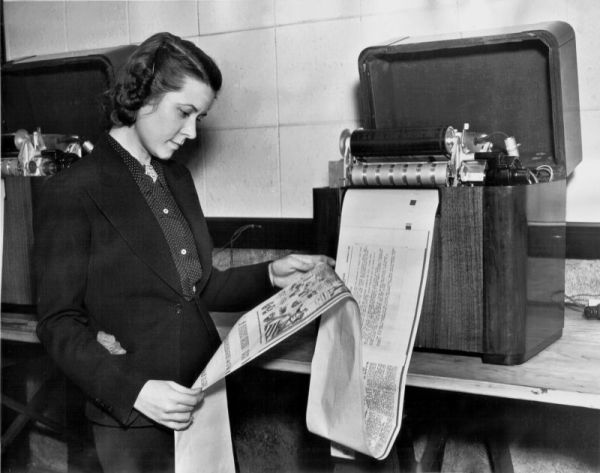
We are living in the age of citizen journalism and the 24-hour news cycle. Reports about almost anything newsworthy can be had from many perspectives, both vetted and amateur. Just a few decades ago, people relied on daily newspapers, radio, and word of mouth for their news. On the brink of the television age, several radio stations in the United States participated in an experiment to broadcast news over radio waves. But this was no ordinary transmission. At the other end, a new type of receiver printed out news stories, line drawings, and pictures on a long roll of paper.

Radio facsimile newspaper technology was introduced to the public at the 1939 World’s Fair at two different booths. One belonged to an inventor named William Finch, and one to RCA. Finch had recently made a name for himself with his talking newspaper, which embedded audio into a standard newspaper in the form of wavy lines along the edges that were read by a special device.

Continue reading “Retrotechtacular: Electronic Publishing In The 1930s”