This excellent content from the Hackaday writing crew highlights recurring topics and popular series like Linux-Fu, 3D-Printering, Hackaday Links, This Week in Security, Inputs of Interest, Profiles in Science, Retrotechtacular, Ask Hackaday, Teardowns, Reviews, and many more.
Everybody needs an external USB drive at some time or another. If you’re looking for something with the nerd cred you so desperately need, build a 5 1/4″ half height external drive. That’s a mod to an old Quantum Bigfoot drive, and also serves as a pretty good teardown video for this piece of old tech.
The Woxun KG-UV2D and KG-UV3D are pretty good radios, but a lot of amateur radio operators have found these little handheld radios eventually wear out. The faulty part is always a 24C64 Flash chip, and [Shane] is here to show you the repair.
Last year there was a hackathon to build a breast pump that doesn’t suck in both the literal and figurative sense. The winner of the hackathon created a compression-based pump that is completely different from the traditional suction-based mechanism. Now they’re ready for clinical trials, and that means money. A lot of money. For that, they’re turning to Kickstarter.
What you really need is head mounted controls for Battlefield 4. According to [outgoingbot] it’s a hacked Dualshock 4 controller taped to a bike helmet. The helmet-mounted controller has a few leads going to another Dualshock 4 controller with analog sticks. This video starts off by showing the setup.
Week 23 of the Caption CERN Contest has been laid to rest. Thanks to all the entrants who stopped by to pay their respects and leave captions for the dearly departed SC-1. CERN engineers and scientists are a crafty bunch, so we’re betting that SC-1’s spirit (and many if its components) lived on in newer CERN projects. We have to thank CERN’s unnamed photographer for capturing these events. It’s always great to see the people and the personalities behind the science.
The Funnies:
“After many years of ignoring the pitiful meows, it was finally determined that Schrödinger’s cat was, in fact, dead.” – [Josh Kopel]
“We gather here to mourn the deaths of all those brave and noble components that left this world surrounded by magic smoke to reside forever in great the parts bin in the sky.” – [Kid Iccurus]
“CERN’s annual Halloween parade was a huge disappointment that year, which was probably due to the fact that they held it in June.” – [DainBramage]
This week’s winner is [Scott Galvin] with “Services were held today for SC-1. SC1’s life ended earlier
this week after a devastating head on collision” Scott describes himself as “Just a visiting Geek with dreams of universal domination”. We’d suggest you start small, [Scott]. Maybe dominating a Bluetooth personal area network with your new LightBlue Bean from The Hackaday Store is just what you need to set your plans in motion!
Week 24
The scientists at CERN always take a personal stake in their work. Pushing mankind’s knowledge of science and high energy physics takes a special breed of person. Thankfully this special breed always seems to have a fun side as well. Here we see a CERN scientist posing behind a … a device. It looks to be some kind of coil or beam line part, though the actual use is thus far a mystery even to CERN’s own staff. We do know this photo was taken in June of 1973, the same month as one of the longest solar eclipses on record – over 7 minutes of totality! Was this part of some CERN solar experiment? Could it have been a section of a particle accelerator? Was this scientist just working on his latest art project – perhaps part of a dodecagon exploration? You be the judge!
This week’s prize is a Teensy 3.1 from The Hackaday Store. Add your humorous caption as a comment to this project log. Make sure you’re commenting on the contest log, not on the contest itself. As always, if you actually have information about the image or the people in it, let CERN know on the original image discussion page.
The brain is the most powerful – and least understood computer known to man. For these very reasons, working with the mind has long been an attraction for hackers, makers, and engineers. Everything from EEG to magnetic stimulus to actual implants have found their way into projects. This week’s Hacklet is about some of the best brain hacks on Hackaday.io!
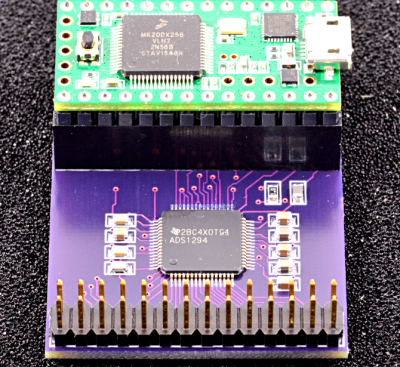
[Paul Stoffregen], father of the Teensy, is hard at work on Biopotential Signal Library, his entry in the 2015 Hackaday Prize. [Paul] isn’t just hacking his own mind, he’s creating a library and reference design using the Teensy 3.1. This library will allow anyone to read electroencephalogram (EEG) signals without having to worry about line noise filtering, signal processing, and all the other details that make recording EEG signals hard. [Paul] is making this happen by having the Teensy’s cortex M4 processor perform interrupt driven acquisition and filtering in the background. This leaves the user’s Arduino sketch free to actually work with the data, rather than acquiring it. The initial hardware design will collect data from TI ADS129x chips, which are 24 bit ADCs with 4 or 8 simultaneous channels. [Paul] plans to add more chips to the library in the future.
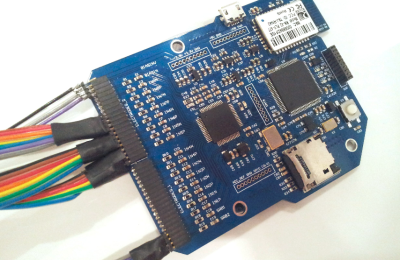
Next up is [Jae Choi] with Lucid Dream Communication Link. [Jae] hopes to create a link between the dream world and the real world. To do this, they are utilizing BioEXG, a device [Jae] designed to collect several types of biological signals. Data enters the system through several active probes. These probes use common pogo pins to make contact with the wearer’s skin. [Jae] says the active probes were able to read EEG signals even through their thick hair! Communication between dreams and the real world will be accomplished with eye movements. We haven’t heard from [Jae] in awhile – so we hope they aren’t caught in limbo!
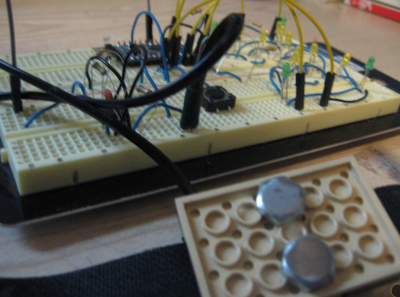
[Qquuiinn] is working from a different angle to build bioloop, their entry in the 2015 Hackaday Prize. Rather than using EEG signals, [Qquuiinn] is going with Galvanic Skin Response (GSR). GSR is easy to measure compared to EEG signals. [Qquuiinn] is using an Arduino Pro Mini to perform all their signal acquisition and processing. This biofeedback signal has been used for decades by devices like polygraph “lie detector” machines. GSR values change as the sweat glands become active. It provides a window into a person’s psychological or physiological stress levels. [Qquuiinn] hopes bioloop will be useful both to individuals and to mental health professionals.
Finally we have [Marcin Byczuk] with Biomonitor. Biomonitor can read both EEG and electrocardiogram (EKG) signals. Unlike the other projects on today’s Hacklet, Biomonitor is wireless. It uses a Bluetooth radio to transmit data to a nearby PC or smartphone. The main processor in Biomonitor is an 8 bit ATmega8L. Since the 8L isn’t up to a lot of signal processing, [Marcin] does much of his filtering the old fashioned way – in hardware. Carefully designed op-amp based active filters provide more than enough performance when measuring these types of signals. Biomonitor has already found it’s way into academia, being used in both the PalCom project, and brain-computer interface research.
If you want more brain hacking goodness, check out our brain hacking project list! Did I miss your project? Don’t be shy, just drop me a message on Hackaday.io. That’s it for this week’s Hacklet, As always, see you next week. Same hack time, same hack channel, bringing you the best of Hackaday.io!
Speak with those who consider themselves hardcore engineers and you might hear “Arduinos are for noobs” or some other similar nonsense. These naysayers see the platform as a simplified, overpriced, and over-hyped tool that lets you blink a few LEDs or maybe even read a sensor or two. They might say that Arduino is great for high school projects and EE wannabes tinkering in their garage, but REAL engineering is done with ARM, x86 or PICs. Guess what? There are Arduino compatible boards built around all three of those architectures. Below you can see but three examples in the DUE, Galileo, and Fubarino SD boards.
Arduino DUE uses Atmel ARM
Arduino Galileo uses Intel x86
Fubarino SD uses PIC32
This attitude towards Arduino exists mainly out of ignorance. So let’s break down a few myths and preconceived biases that might still be lurking amongst some EEs and then talk about Arduino’s ability to move past the makers.
Arduino is NOT the Uno
When some hear “Arduino”, they think of that little blue board that you can plug a 9v battery into and start making stuff. While this is technically true, there’s a lot more to it than that.
An Arduino Uno is just an AVR development board. AVRs are similar to PICs. When someones says “I used a PIC as the main processor”, does that mean they stuck the entire PIC development board into their project? Of course not. It’s the same with Arduino (in most cases), and design is done the same way as with any other microcontroller –
Use the development board to make, create and debug.
When ready, move the processor to your dedicated board.
What makes an Arduino an “Arduino” and not just an AVR is the bootloader. Thus:
An Atmega328P is an AVR processor.
An Atmega328P with the Arduino bootloader is an Arduino.
The bootloader allows you to program the AVR with the Arduino IDE. If you remove the bootloader from the AVR, you now have an AVR development board that can be programmed with AVR Studio using your preferred language.
There Is No Special Arduino Language
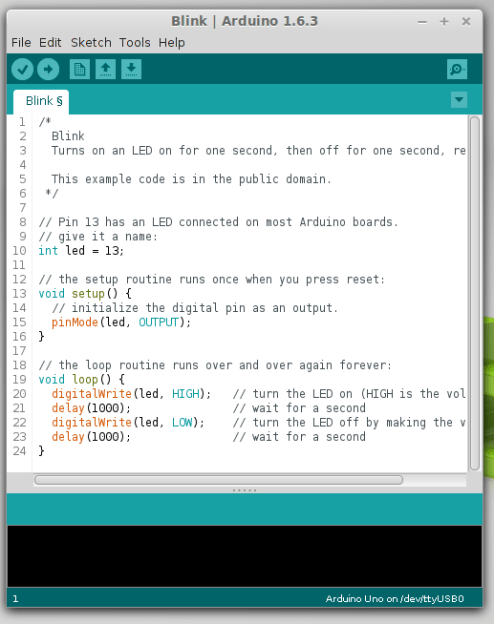
Arduino “blink” sketch should run on any Arduino compatible board.
Yes, I know they call them sketches, which is silly. But the fact is it’s just c++. The same c++ you’d use to program your PIC. The bootloader allows the IDE to call functions, making it easy to code and giving Arduino its reputation of being easy to work with. But don’t let the “easy” fool you. They’re real c/c++ functions that get passed to a real c/c++ compiler. In fact, any c/c++ construct will work in the Arduino IDE. With that said – if there is any negative attribute to Arduino, it is the IDE. It’s simple and there is no debugger.
The strength comes in the standardization of the platform. You can adapt the Arduino standard to a board you have made and that adaptation should allow the myriad of libraries for Arduino to work with your new piece of hardware. This is a powerful benefit of the ecosystem. At the same time, this easy of getting things up and running has resulted in a lot of the negative associations discussed previously.
So there you have it. Arduino is no different from any other microcontroller, and is fully capable of being used in consumer products along side PICs, ARMs etc. To say otherwise is foolish.
What is the Virtue of Arduino in Consumer Products?
This is Ask Hackaday so you know there’s a question in the works. What is the virtue of Arduino in consumer products? Most electronics these days have a Device Firmware Upgrade (DFU) mode that allows the end user to upgrade the code, so Arduino doesn’t have a leg up there. One might argue that using Arduino means the code is Open Source and therefore ripe for community improvements but closed-source binaries can still be distributed for the platform. Yet there are many products out there that have managed to unlock the “community multiplier” that comes from releasing the code and inviting improvements.
What do you think the benefits of building consumer goods around Arduino are, what will the future look like, and how will we get there? Leave your thoughts below!
The J-57 afterburner engine appeared in many airplanes of notable make, including the F-101, -102, and -103. This USAF training film shows the parts of the J-57, explains the complex process by which the engine produces thrust, and describes some maintenance and troubleshooting procedures.
The name of this game is high performance. Precision thrust requires careful rigging of the engine’s fuel control linkage through a process called trimming. Here, the engine fuel control is adjusted with regard to several different RPM readings as prescribed in the manual.
One of the worst things that can happen to a J-57 is known as overtemping. This refers to high EGT, or exhaust gas temperature. If EGT is too high, the air-fuel ratio is not ideal. Troubleshooting a case of high EGT should begin with a check of the lines and the anti-icing valve. If the lines are good and the valve is closed, the instruments should be checked for accuracy. If they’re okay, then it’s time for a pre-trimming inspection.
In addition to EGT, engine performance is judged by RPM and PP7, the turbine discharge pressure. If RPM and PP7 are within spec and the EGT is still high, the engine must be pulled. It should be inspected for leaks and hot spots, and the seals should be examined thoroughly for cracks and burns. The cause for high EGT may be just one thing, or it could be several small problems. This film encourages the user to RTFM, which we think is great advice in general.
Around this time last year we first heard of the ESP8266 WiFi module. It’s still a great little module, providing WiFi connectivity for all those Internet of Things things at a price point of just $5. It’s an attractive price for a great module with a huge community pumping out a lot of projects for the platform.
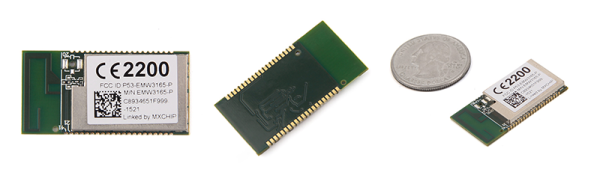
Now there’s a new kid on the block. It’s called the EMW3165, and like the ESP it provides WiFi connectivity for a bunch of wireless projects. It’s much, much more capable with an STM32F4 ARM Coretex M4 microcontroller, a ‘self hosted’ networking library, more RAM, more Flash, and more GPIOs. How much, you’re probably asking yourself. It’s a dollar more than the ESP8266.
The datasheet for the module goes over all the gritty details. While this chip has 3.6V I/Os, there are some 5V tolerant pins – a boon for the Arduino crowd. It’s also surprisingly low power for something that connects to an 802.11n network. The real bonus here is the STM32F4 core – that’s a very, very powerful microcontroller, and if you want a 2-component WiFi webcam build, this is the part you should use. There will be a lot of interesting builds using this part. It’s also passed FCC certification. Very cool.
Adafruit is working on a series of videos that’s basically Sesame Street for electronics. G is for Ground is out, where [Adabot] discovers pipes and lightning rods are connected to ground. Oh, the rhyming. Here’s the rest of the videos so far. We can’t wait for ‘Q is for Reactive Power’.
Think you’re good enough to build an airlock 70 cubic meters in volume that can cycle once every thirty seconds? How about building a 500 mile long steel tube with zero expansion joints across active fault lines? Can you stop a 3 ton vehicle traveling at 700 miles per hour in fifteen seconds? These are the near-impossible engineering challenges demanded of the hyperloop. The fact that no company will pay for this R&D should tell you something, but that doesn’t mean you still can’t contribute.
Calling everyone that isn’t from away. [Paul] lives near Augusta, Maine and can’t find a hackerspace. Augusta is the capital of the state, so there should be a hackerspace nearby. If you’re in the area, go leave a message on his profile.
Last week we found memristors you can buy. A few years ago, [Nyle] found them while hiking. They were crudded up shell casings, and experiments with sulfur and copper produced a memristor-like trace on a curve tracer.
The Arduino is too easy. It must be packaged into a format that is impossible to breadboard. It should be shaped like a banana. Open source? Don’t need that. The pins are incorrectly labelled, and will be different between manufacturing runs.