3D Printering: The Problem Of Thingiverse

Most makers, I’m sure, enter into the 3D printing world with a goal in mind. Whether that’s printing enclosures for projects, Warhammer figurines, robot chassis, or even a mechanical computer, there is usually some obvious utility in having a 3D printer at home. 3D printers are a machine tool, though, and any time it’s not being used means it’s an investment with a lower return, or at the very least a really cool toy gathering dust.

Where then do you find new stuff to print that you don’t design yourself?

For the longest time now, Thingiverse has been the largest repository to share, browse, and download object other people have made. Even I have some very stupid stuff up on Thingiverse and have made use of a few random objects I found on there. This does not mean the 3D printer community particularly likes Thingiverse, however: Last year, Makerbot, the people behind Thingiverse, changed the terms of use so (allegedly) Thingiverse owns everything uploaded to their service. Couple this with completely unsubstantiated rumors of things being removed from Thingiverse that compete with Makerbot products, and you have a perfect storm of people unsatisfied with an online repository of 3D objects.

There is a huge market for an online repository of user-submitted 3D objects that isn’t controlled by Makerbot, and many have attempted to enter the fray. Defense Distributed, the guys behind the 3D printed AR lowers and all-plastic handguns launched DEFCAD, a Thingiverse clone, made an attempt by mirroring thousands of Thingiverse objects, removing the attribution in violation of these object’s licenses. Shady, yes, but at least it’s an option. There are other repos such as Cubehero and the newly launched YouMagine, a repo developed by Ultimaker. the Luke Skywalker to Makerbot’s Darth Vader.

But here is the problem with Thingiverse: even if you would like to get away from using this Makerbot service, it’s still the largest collection of 3D printed objects on the Internet. It has the most users, and is growing more each day than any of its competitors. Putting your objects anywhere else only means fewer people will see them, and fewer still will incorporate your designs into their new designs.

There are a few tools for you to ‘roll your own’ object repository. Github has a great new tool for viewing diffs between different versions of objects. There’s even a lot of work in making the Github landing page more like a Thingiverse page. This doesn’t address the core value of Thingiverse – if all the objects aren’t catalogued in one database, searchable by anyone, it’s just not as useful a site as Thingiverse.

I’m simply not smart enough to offer up a solution to this problem. Therefore, I’m turning it on to you: how should the 3D printer community retain the great value Thingiverse offers while still making something as usable as the now-malagined site? Should any new site mirror objects already on Thingiverse a la DEFCAD, only with proper attribution? Who should control the portal to all the objects, if anyone?

If you have any ideas on how to solve the problem of Thingiverse, drop a note in the comments.

Retrotechtacular: Building BART

Sometimes it’s fun to take a step back from the normal electronics themes and feature a marvelous engineering project. This week’s Retrotechtacular looks at a pair of videos reporting on the progress of the Bay Area Rapid Transit system. Anyone who’s visited San Francisco will be familiar with the BART system of trains that serve the region. Let’s take a look at what went into building the system almost half a century ago.

Continue reading “Retrotechtacular: Building BART” →

Hackaday Links: September 29, 2013

hackaday-links-chain

We would be remiss if we didn’t mention that all of SparkFun’s open source hardware is now on Upverter.

Not wanting to tie up an iPad as a mini-gaming cabinet [Hartmut] hacked an Arcadi cabinet to use EUzebox instead.

Time travel happens in the bedroom as well. But only if you have your very own Tardis entrance.  [AlmostUseful] pulled this off with just a bit of word trim and a very nice paint job. [via Reddit]

[Pierre] tricks an iPhone fingerprint scanner by making a replica out of hot glue.

Some of the guys from our parent company were over in Shanghai on business. [Aleksandar Bradic] made time to visit the Shanghai hackerspace while in town and wrote about the experience over on their engineering blog.

[Gregory Charvat] is a busy guy. In fact we’ve got a juicy hack of his saved up that we still need to wrap our minds around before featuring. In the mean time check out the Intern-built coffee can radar that he took over and tested on a  multi-million dollar Spherical Near Field Range.

And finally, everyone loves coffee hacks, right? Here’s what [Manos] calls a Greek style instant coffee machine.

Fail Of The Week: Capturing Data From A Laser Rangefinder

fotw-laser-measuring-tape

We’re changing it up this week with a reverse engineering fail which [Itay] pointed out to us. A couple of years ago [Nate] over at Sparkfun agreed to help a friend with a project that required precise distance measurement. He knew that laser rangefinders are a good way to go and mentions their use in golfing and the building trades. He picked up this handheld version billed as a laser tape measure. He put up a valiant effort to reverse engineer the PCB in hopes of finding a hook for the measurement data.

Obviously his endeavor failed or we wouldn’t be talking about it in this column. But there’s a lot to learn about his methods, and a few of the comments associated with his original post help to shed light on a couple of extra things to try.

Continue reading “Fail Of The Week: Capturing Data From A Laser Rangefinder” →

3D Printering: Advances In 3D Printing At Maker Faire

printering

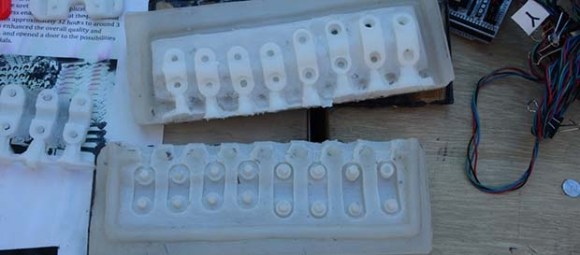
mould

Needless to say, the World Maker Faire had a ton of 3D printers. It’s really becoming an obligatory fixture of any booth, whether you’re Microsoft announcing to the world Windows 8 now supports 3D printer drivers (don’t ask), or you just have a Makerbot Replicator on your table for some street cred.

Even the 3D Printing section of the faire wasn’t without a lot of what we’ve all seen before. Yes, the RepRap Morgan and Simpson made a showing, but 3D printing to most people attending the faire is just plastic trinkets, Minecraft figures, and single-thickness vases and jars.

Deep in the outskirts of the faire, right by the Porta Potties and a generator, one booth showed everyone how 3D printing should be done. It was AS220 Labs‘ table, and they’re doing their best to make 3D printers more than just printing out owl sculptures and plastic octopodes.

Continue reading “3D Printering: Advances In 3D Printing At Maker Faire” →

Retrotechtacular: Fundamentals Of AM And FM Radio Communication

How radios send and receive information can seem magical to the uninformed. For some people, this week’s Retrotechtacular video, “Frequency Modulation – Part 1 Basic Principles”, from the US Army Department of Defense 1964 will be a great refresher, and for others it will be their first introduction into the wonderful world of radio communications.

The stated objective is to teach why FM radio communication reduces interference which normally afflicts AM radio communications. Fundamentals of AM and FM is a better description, however, because the first part of the video nicely teaches the principles of AM and FM radio communications. It isn’t until later in the clip that it delves into interference, advantages of FM modulation, and detailed functioning of FM radio. The delivery is slow at times and admittedly long, yet the pace is perfect for a young ham to follow along with plenty of time to soak in the knowledge. If you’re still on the fence about becoming a ham here’s some words or encouragement.

Though the video isn’t aimed at ham radio users it does address core knowledge needed by amateur radio hobbyists. Amateur radio is full of many exciting communication technologies and you should have a clear understanding of AM and FM communication methodologies before getting on Grandpa’s information super highway. Once you have your ham license (aka ticket) you have privileges to create and test amazing ham related hacks, like [Lior] implementing full programmable control of a Baofeng UV5R ham radio using an Arduino.

Join us after the break to watch the video.

Continue reading “Retrotechtacular: Fundamentals Of AM And FM Radio Communication” →

Hackaday Links: September 22, 2013

hackaday-links-chain

First we start with some protection… for your USB charged devices. Here’s a USB Condom which acts as a pass-through for the power rails but not the data lines. This prevents untrusted charger security exploits. [Thanks Markus]

[OutKastz] seems to think he’s uncovered a price matching conspiracy at Best Buy. His post references an HDTV video wall he has built. But he also discovered that there are two different version of the same television sold as the same SKU. His theory is that this prevents the big box from matching prices on half of their inventory.

When you’re in need of some breadboarding action with your Raspberry Pi and want to make it as painless as possible you need to build your own Pi Cobbler. This is the diy version of an Adafruit product, built using a couple of pin headers, stripboard, and an IDE cable.

Speaking of Adafruit, did you see Ladyada’s teardown of an ICEdot crash sensor?

[Phineas] is showing off a really really small hexacopter. Check out the maiden flight, as well as first indoor and first outdoor tests.

Perhaps this coded entry system will inspire a future project for you. It uses piezo elements to enter a code which unlocks the back door to the company. The glass door already had a series of large dots painted on it. This turns out to be a nice interface for a four button code system.

Many projects use a Raspberry Pi as a web server. But there is more than just one flavor available. [Jeremy Morgan] performed a variety of Pi server benchmarks using Nginx, Monkey, Lighttpd, and Apache. [Thanks Walter]

Can an old TV antenna reflector be used to boost the range of a WiFi dongle? We’re a bit skeptical. Let us know what you think in the comments.

And finally, we do wish there was more information on this upright piano used to play Doom [Thanks Itay].