Retrotechtacular: New York City’s Secret Computer

Over 750,000 people pass through New York City’s Grand Central Terminal each day. Located in the heart of the city, it’s one of the largest train stations in the world. Its historic significance dates back to 1913, when it opened its doors to the public. At the time, few were aware of the secret computer that sat deep in a sub basement below the hustle and bustle of the city’s busy travelers. Its existence was kept secret all the way into the 1980’s.

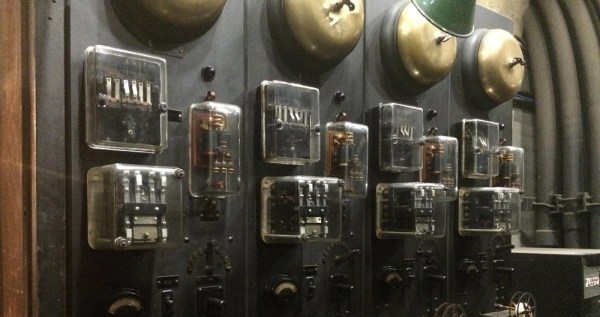
Westinghouse had designed a system that would allow authorities to locate a stuck train in a tunnel. There were cords stretched the length of the tunnels. If a train stalled, the operator could reach out and yank on the cord. This would set off an alarm that would alert everyone of the stuck train. The problem being that even though they knew a train was down, they did not know exactly where. And that’s where the computer come in. Westinghouse designed it to calculate where the train was, and write its location on some ticker tape.

So this is the part of the post where we tell you how the computer established where exactly the train breakdown occurred. Although the storyteller in the video is admirably enthusiastic about telling the story, our depth of detail on the engineering that went into this seems nowhere to be found. Let us know in the comments below if you have a source of more information. Or just post your own conjecture on how you would have done it with the early 20th century tech.

The invention of the two way radio made the whole thing obsolete not long after is was built. Never-the-less, it remains intact to this day.

Thanks to [Greg] for the tip!
Retrotechtacular: Weston Electrical Instruments

A ‘meter is one of the most important tools on any electronics bench. After you’ve exhausted your five senses trying to figure out what’s happening in a circuit, firing up the old ‘meter is usually the next step. Meters are largely digital nowadays, but their analog ancestors are still widely available. We have a chemist and inventor named [Edward Weston] to thank for the portability and ubiquity of DC measuring equipment.

After immigrating to the United States from England with the degree in medicine his parents wanted him to earn, [Edward Weston] asserted that he was more interested in chemistry. His career began in electroplating, where he soon realized that he needed a reliable, constant current source to do quality plating. This intense interest in power generation led him to develop a saturated cadmium cell, which is known as the Weston cell. Its chemistry produces a voltage stable enough to be used for meter calibration. The Weston cell is also good for making EMF determinations.

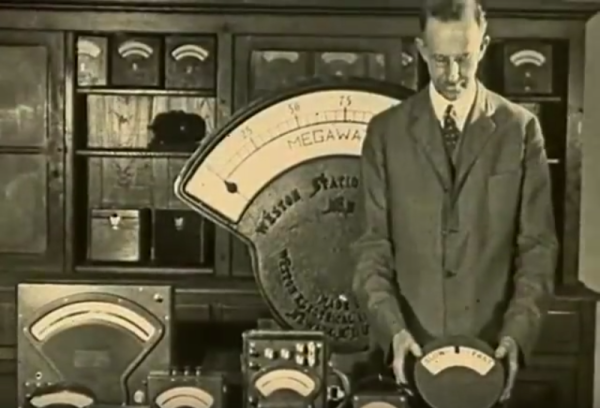
Within a few years, he co-founded the Weston Electrical Instrument Corporation. The company produced several types of meters along with transformers and transducers known for their portability and accuracy. In 1920, [Weston & Co.] created this 1920 educational film in cooperation with the United States Navy as part of a series on the principles of electricity.

The viewer is invited to consider the importance of measurement to civilization, most notably those fundamental measurements of length, mass, and time. [Weston] positions his electrical measuring instruments at this level, touting them as the international favorite. We get the full tour of a Weston meter, from the magnet treated for permanence to the specially designed pole pieces that correctly distribute lines of magnetic force. What education film about electromagnetism would be complete without an iron filings demonstration? This one definitely delivers.

Continue reading “Retrotechtacular: Weston Electrical Instruments”

Retrotechtacular: So You Want To Be A Weldor

Welding is one of those things that takes minutes to learn and years to master. It requires coordination, strength, and a good pair of eyes. This vocational guidance video from the early 1940s touches on these points and more for those considering careers in welding. The narrator jumps right in, discussing welding types, equipment operation, and employment opportunities in both the welding field itself and other fields that use welding techniques.

Oxy-acetylene welding is one of the oldest methods of fusing metal. A flame fueled by a specific mixture of pure oxygen and acetylene gas heats the metal welding rod and the work piece to plasticity, which allows them to join together. An oxy-acetylene setup can also be used to cut metal, though a special cutting torch with a kind of oxygen turbo boost lever is required. The work piece is heated to red-hot at the point along the edge where the cut will start. The oxygen-rich flame will cut right through the piece.

Continue reading “Retrotechtacular: So You Want To Be A Weldor”

Retrotechtacular: Häfla Hammerforge Healed

Visit any renaissance fair across the United States this fall and you’ll undoubtedly find a blacksmith. He’ll be sweating away in a tent, pounding on a piece of glowing steel set against an anvil. While the practice of the single blacksmith endures today, high-production ‘works of days past required increasing amounts of muscle. The more tireless the muscle, the better. The manual efforts of the blacksmith were replaced by huge hammers, and the blacksmith needed only to turn the piece between impressions and maintain a healthy respect for the awesome crushing power of the machine.

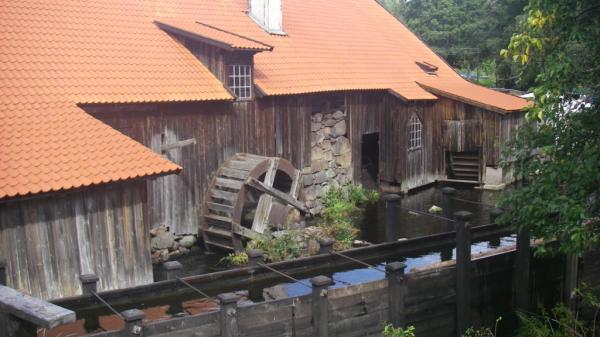
Last week, blacksmith enthusiasts completed restoration work on the Häfla hammer in Finspang, Sweden. The 333 year old hydraulic hammer hadn’t been used since 1924, when operations ceased at the Häfla Hammerforge. The ‘works was built in 1682 and used the German method of forging, which had been introduced to Sweden in the 1500s. Steel production was revolutionized in the 1800s by the Bessemer process, which resulted in a much stronger product. Continue reading “Retrotechtacular: Häfla Hammerforge Healed”

Retrotechtacular: The Hammond Novachord

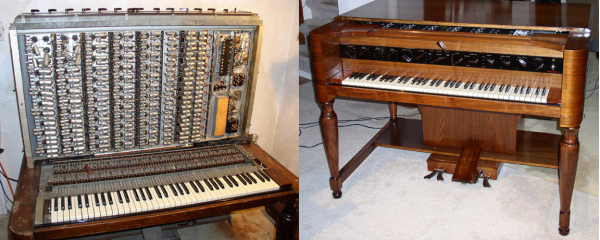
Just when we thought we’d heard of all the cool early synthesizers, a tipster rattled our jar with news that someone completely restored a Novachord. These spinet piano-shaped prototypical synthesizers were made by Hammond for only four years. About a thousand of them were built before sales sagged and parts became scarce in 1942. It is estimated that only 200 or so are still around today.

The Novachord’s sounds are generated by a bank of twelve monostable vacuum tube oscillators. Each one is tuned to a pitch of the chromatic scale in what is called divide-down architecture. [Hammond] and his co-creators [John Hanert] and [C.N. Williams] used the property of dividing a frequency in half to generate the same tone, but one octave lower. This design means that all 72 notes can be played at the same time. Adjustable formant filters shape the often otherworldly sounds, which are then passed through flexible tube-based envelopes.

[Phil] knew it would be a big job to restore a Novachord in any condition. Thousands of passive components all had to be replaced. The cabinet bore all the hallmarks of a well-used parlor instrument—water rings from cocktails, scratches, and cigarette burns galore. [Phil] says that woodworking really isn’t his thing, but he did an outstanding job nonetheless of sanding every nook and cranny and applying several coats of stain. There are tons of drool-inducing pictures on his project site, and several clips of [Phil] really putting it through its paces.

Thanks for the tip, [Mike]!

Retrotechtacular is a weekly column featuring hacks, technology, and kitsch from ages of yore. Help keep it fresh by sending in your ideas for future installments.

Retrotechtacular: One Does Not Simply String Up A Half-Million VDC Transmission Line

It takes strong and determined population to build a lasting civilization. If the civilization includes electricity and the inhabitants live in a hilly place with an often-unforgiving climate, the required strength and determination increases proportionally. Such is the case of the gentlemen who strung up the first half-million VDC transmission line across New Zealand, connecting the country’s two main islands.

Construction for the line known as the HVDC Inter-Island link began in 1961. It starts at the Benmore hydroelectric plant on the south island and runs north to Cook Strait via overhead cables. Then it travels 40km underwater to the north island and ends near Wellington. This is the kind of infrastructure project that required smaller, preliminary infrastructure projects. Hundreds of miles of New Zealand countryside had to be surveyed before breaking ground for the first tower support hole. In order to transport the materials and maintain the towers, some 270 miles of road were laid and ten bridges were built. Fifteen camps were set up to house the workers.

The country’s hilly terrain and high winds made the project even more challenging. But as you’ll see, these men were practically unfazed. They sent bundles of steel across steep canyons on zip lines and hand-walked wire haulage rope across gullies because they couldn’t otherwise do their job. Six of these men could erect a tower within a few hours, which the filmmakers prove with a cool time-lapse sequence.

Splicing the mile-long conductors is done with 100-ton compressors. Each connection is covered with steel sleeve that must be centered across the joint for optimum transmission. How did they check this? By taking a bunch of x-rays with a portable cesium-137 source.

Continue reading “Retrotechtacular: One Does Not Simply String Up A Half-Million VDC Transmission Line”

Retrotechtacular: Robots, Robots Everywhere, With Kitschy Pronunciation

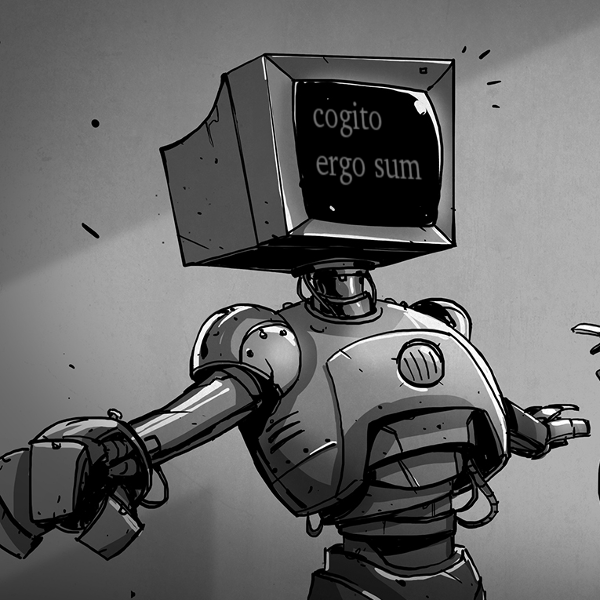
One of the great things about the human intellect is that we have the ability to build machines of varying complexity to do our bidding. As a major proponent of technology, the Chevrolet automobile corporation once dreamed of a future where the American housewife’s most mundane tasks are handled with the push of a button—one that sets a robot butler into action.

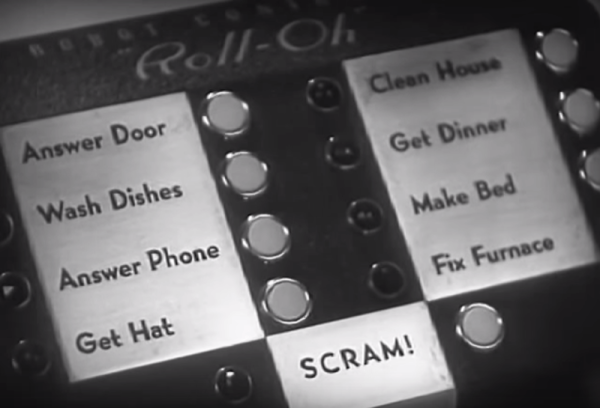
Chevy shows us what this future might look like in this short film, which they presented at the 1940 World’s Fair. A housewife’s faithful ‘robot’, pronounced throughout the picture as ‘robe-it’, has gone on the fritz. Naturally, she calls for a repairman. We see from the console controller that Roll-Oh the Robe-it can take care of all kinds of housewifely duties: he can answer the door and the phone, wash dishes, clean house, make beds, fetch hats, get dinner, and fix the furnace (and only the furnace). And that SCRAM! function? That’s never explained. We like to think it has to do with getting kids off the lawn, or could be used in conjunction with ‘get door’ to chase away would-be burglars. We get a glimpse of this when Roll-Oh answers the door and scares the daylights out of a young [Gary Sinise*] delivering flowers in a cop uniform.

Roll-Oh’s upper limbs have several Swiss Army knife-like implements in them. He uses a sharp one to cut the ribbon off of the flower box. Upon seeing the flowers, he gives them a gentle misting with his sprayer attachment. Dropped petals are no problem for Roll-Oh. He promptly vacuums them up from the thin industrial sound stage carpet with his big metal feet. Roll-Oh is then tasked with getting dinner. This amounts to him painstakingly opening a couple of cans and lighting candles with the torch hidden in his face.

While Roll-Oh the large ductwork butler is only a dream, Chevy wants you to know that smaller robe-its are all around us already. They’re regulating the heat in our stoves, browning our bread without burning it, and brewing our coffee in cool double-globe glass percolators. These tiny servants are capable of performing other tasks, like shutting off machinery when humans are too close, or sensing heat and engaging fire suppression systems. There is brief mention of something called the Petomat, an automatic dog feeding system which is essentially a bowl of food hidden in a latched box. The latch opens rather violently when the alarm clock connected to it goes off.

Robe-its are also performing more serious tasks, like keeping airplanes level and headed in the right direction. Of course, they’re also abundant in Chevrolet automobiles. A small one in the carburetor administers the proper mix of “gasoline calories and fresh air vitamins” to the engine. It’s rare to get to this level of technical detail, you know. Others watch over the spark, the intake manifold, and the voltage regulation. Up in the cab, friendly robe-its will happily traverse the AM dial at the push of a pre-set.

*Probably not actually [Gary Sinise].

Continue reading “Retrotechtacular: Robots, Robots Everywhere, With Kitschy Pronunciation”