ESP Cookbook Goes Beyond Chips And DIPs

Are you putting ESP8266s in all your projects these days, whether they need one or not? We don’t blame you. These boards are cheap, tiny, oh and they have WiFi.

If you want to spend less time writing code and more time blinking RGB LEDs over Wi-Fi, then check out this ESP cookbook over on IO. [Turo Heikkinen] and team are writing a soup-to-nuts guide to these darlings of IoT. The cookbook leads off with pinouts and networking (of course) before moving into more intricate recipes involving popular sensors and displays.

This cookbook is funny, it’s helpful, and it’s really well-organized. We love that they used the details section to create a linked table of contents. The links all drive to a specific Instructions page where each group of code snippets and explanations can be found. It’s still a work in progress, so you might want to follow it for updates. We have a feeling they’re going to expand the dessert section next.

Love the ESP8266, but hate programming them in that wonky form factor? Here’s a handy programming jig you can build.

Held Captive By Arduino And Multiple RFID Readers

If you’re the kind of person who has friends, and/or leaves the confines of the basement from time to time, we hear that these “Escape Rooms” are all the rage. Basically you get locked into a room with a couple other people and have to solve various problems and puzzles until you’ve finally made enough progress that they let you out. Which actually sounds a lot like the working conditions here at Hackaday HQ, except they occasionally slip some pizza rolls under the door for us which is nice.

Whichever side you find yourself on in one of these lighthearted hostage situations, knowledge of this multi-tag RFID lock created by [Annaane] may come in handy. By connecting multiple MFRC522 RFID readers to an Arduino Uno, she’s come up with a method of triggering a device (like an electronic door lock) only when the appropriate combination of RFID tags have been arranged. With a little imagination, this allows for some very complex puzzle scenarios which are sure to keep your prisoners enthralled until you can lower the lotion down to them.

Her code allows you to configure the type and number of RFID cards required to trigger one of the Arduino’s digital pins, which usually would be connected to a relay to fire off whatever device you want. The Arduino sketch is also setup to give “hints” to the player by way of a status LED: fast blinking let’s you know the tag scanned is wrong, and slow blinking means you don’t have enough scanned in yet.

The video after the break shows some highlights of the build, as well as a quick demonstration of how both the RFID “combination” and manual override can be used to trigger the attached relay.

Hackers do love RFID. Using them for physical access control is a fairly common project around these parts, and we’ve even seen similar setups for the digital realm.

Continue reading “Held Captive By Arduino And Multiple RFID Readers”

The Incredible Shrinking Rework Station

Anyone who’s ever tried setting up a workbench in a tight space knows the struggle: you want to have all your test equipment and tools out and within arm’s reach, but you just don’t have enough surface area. If you fill the whole bench with your tools, there’s not going to be anywhere left to work. So you either have a bench full of tools that’s uncomfortable to use, or you’re forced to choose what stays out and what gets packed away. Neither is conducive to actually getting work done, which is why you are trying to set up a proper bench in the first place. It’s a vicious cycle.

When faced with that very problem recently, [EEpromChip] decided to take the nuclear option. His Kendal 853D was already a great choice for a small-scale work area since it’s not just a hot air rework station but also offers a soldering iron and bench power supply in one unit. But it was still just a little too long for his bench. The solution? Just run the thing through the bandsaw and cut it in half. Seriously.

Upon opening the 853D up, [EEpromChip] realized the internal layout wasn’t terribly efficient. There was plenty of extra room inside the case to begin with, but if the transformer was removed from the bottom of the case and mounted to the rear it would really cut down the device’s footprint.

After making sure he documented where everything connected, he took all the electronics out of the sheet metal case and cut it down to size on a bandsaw. He then reinstalled circuit boards, and this time mounted the beefy transformer so it hangs over the board rather than sits next to it. The end result is a version of the Kendal 853D which is several inches shorter than before with no impact on functionality.

Turning closets small spaces into dens of Hackerdom has been a topic we’ve discussed previously. Saving every inch is important if you ever hope to move into a grain silo or CNC’d plywood house.

Scotty Allen Builds A USB Drive From An IPhone

What happens when you come across a mysterious, partially populated circuit board in the Huaqiangbei electronics market in Shenzhen? If you’re [Scotty Allen], the only answer is to make your own USB drive from iPhone parts.

[Scotty] made a name for himself through his YouTube channel Strange Parts where he built his own iPhone from scratch, added a headphone jack to an iPhone, and other various exploits involving hot air in Shenzhen. This latest build is no different. It begins with a random PCB [Scotty] found at the electronics market. It has a USB port on one end, it has pads for an iPhone memory chip, and it has an IC that looks like a USB to Flash converter.

The build involved finding a few broken iPhones, desoldering and reballing their Flash chips, and when those didn’t work, finding the correct Flash chips for this tiny little USB adapter board. Here, [Scotty] ran into trouble. The first Flash chip didn’t have the right pins, there was blue smoke, and the toolchain for initializing the USB to Flash IC was a mess.

In the end, [Scotty] managed to create a USB Flash drive after five or six visits to the electronics market, two stencils to reball Flash chips, and finding the OEM software for the USB to Flash chip on this very special PCB. That, itself, required Windows (the horror!), and finding the right version of the software.

Is this technically building a Flash drive purely from disposed iPhone components? We’d quibble. But is it a cool build, regardless? Absolutely. And the real story here is how quickly [Scotty] could iterate on his engineering. When the greatest electronics market is right around the corner, you can do anything with a microscope and a hot air gun.

Retrotechtacular: Synchros Go To War (and Peace)

Rotation. Motors rotate. Potentiometers and variable capacitors often rotate. It is a common task to have to rotate something remotely or measure the rotation of something. If I asked you today to rotate a volume control remotely, for example, you might offer up an open loop stepper motor or an RC-style servo. If you wanted to measure a rotation, you’d likely use some sort of optical or mechanical encoder. However, there’s a much older way to do those same tasks and one that still sees use in some equipment: a synchro.

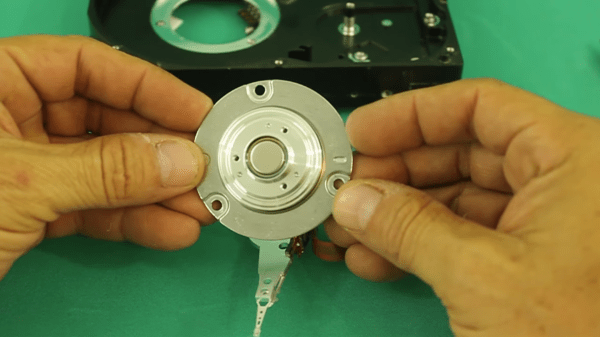
The synchro dates back to the early 1900s when the Panama Canal used them to read and control valves and gates. These devices were very common in World War II equipment, too. In particular, they were often part of the mechanisms that set and read gun azimuth and elevation or — like the picture to the left — a position indication of a radar antenna. Even movie cameras used these devices for many years. Today, with more options, you don’t see them as much except in applications where their simplicity and ruggedness is necessary.

Continue reading “Retrotechtacular: Synchros Go To War (and Peace)”

First Lithographically Produced Home Made IC Announced

It is now six decades since the first prototypes of practical integrated circuits were produced. We are used to other technological inventions from the 1950s having passed down the food chain to the point at which they no longer require the budget of a huge company or a national government to achieve, but somehow producing an integrated circuit has remained out of reach. It’s the preserve of the Big Boys, move on, there’s nothing to see here.

Happily for us there exists a dedicated band of experimenters keen to break that six-decade dearth of home-made ICs. And now one of them, [Sam Zeloof], has made an announcement on Twitter that he has succeeded in making a dual differential amplifier IC using a fully lithographic process in his lab. We’ve seen [Jeri Ellsworth] create transistors and integrated circuits a few years ago and he is at pains to credit her work, but her interconnects were not created lithographically, instead being created with conductive epoxy.

For now, all we have is a Twitter announcement, a promise of a write-up to come, and full details of the lead-up to this momentous event on [Sam]’s blog. He describes both UV lithography using a converted DLP projector and electron beam lithography using his electron microscope, as well as sputtering to deposit aluminium for on-chip interconnects. We’ve had an eye on his work for a while, though his progress has been impressively quick given that he only started amassing everything in 2016. We look forward to greater things from this particular garage.

Assemble Your Own Modular Li-Ion Batteries

Low-voltage DC power electronics are an exciting field right now. Easy access to 18650 battery cells and an abundance of used Li-Ion cells from laptops, phones, etc. has opened the door for hackers building their own battery packs from these cheap cells. A big issue has been the actual construction of a pack that can handle your individual power needs. If you’re just assembling a pack to drive a small LED, you can probably get by with spring contacts. When you need to power an e-bike or other high power application, you need a different solution. A spot welder that costs $1000 is probably the best tool, but out of most hackers’ budget. A better solution is needed.

Vruzend v2 Battery Caps.

Enter [Micah Toll] and his Vruzend battery connectors, whose Kickstarter campaign has exceded its goal several times over. These connectors snap onto the ends of standard 18650 cells, and slot together to form a custom-sized battery pack. Threaded rods extend from each plastic cap to enable connection to a bus bar with just a single nut. The way that you connect each 18650 cell determines the battery pack’s voltage and current capability. There are a couple of versions of the connector available through the campaign, and the latest version 2.0 should allow some tremendously powerful battery pack designs. The key upgrade is that it now features corrosion-resistant, high-power nickel-plated copper busbars allowing current up to 20A continuous. A side benefit of these caps instead of welded tabs is that you can easily swap out battery cells if one fails or degrades over time. Continue reading “Assemble Your Own Modular Li-Ion Batteries”