Piezoelectric Transformers Are A Thing, Have You Used One?

Cheap piezo buzzers are everywhere. They’re so cheap that they can be used in novelty birthday cards. Applying an alternating voltage across a piezo crystal makes it expand and contract, and fixing this crystal to a metal disk gives the piezo speaker its characteristic tinny sound that is anything but pleasant.

The piezoelectric effect works the other way too, and piezo elements are very useful as vibration sensors. Simply put one of your voltmeter leads on each of the piezo element’s wires and touch the element with your hand or knock it against your bench. You should see a voltage spike on your voltmeter which will change in magnitude with the amount of force you use when touching the element.

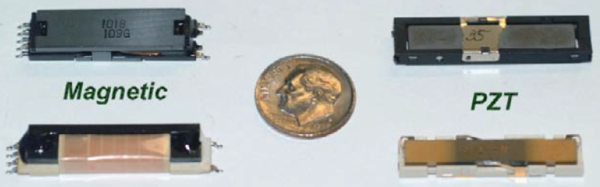
This ability to change shape when a voltage is applied and to create a voltage when they’re deformed is the basis of the piezoelectric transformer (PZT). While searching for a high voltage/low current transformer, Hackaday reader [Josh] was surprised to find a piezoelectric solution. He didn’t say whether he decided to use a PZT in his project but he did link us to a decent PDF on the subject.

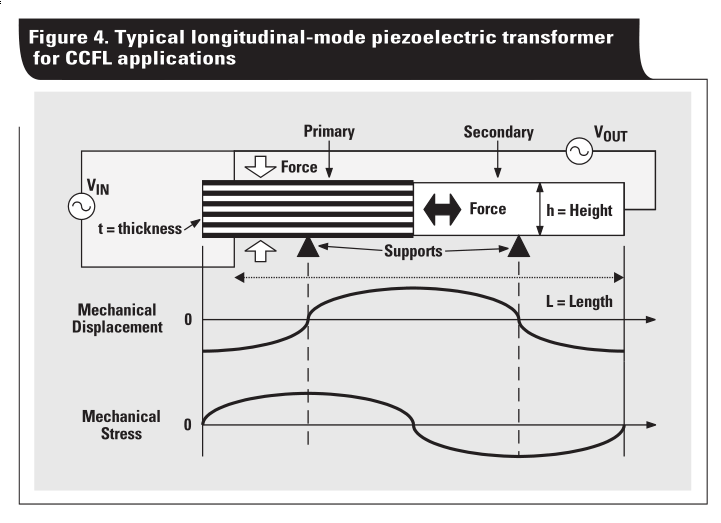
piezo_transformerIn a PZT, two piezo elements sit next to each other. The primary is made up of multiple thin layers that expand horizontally and press on a single secondary piezo element. The more and the thinner the primary layers, the more force is exerted on the secondary, and the more voltage it develops. There are a few equations involved which you can check out in the PDF linked above that go over this concept in painful detail if you’re into that sort of thing.

If you have never played with piezo element you should add one to your next parts order. They are cheap and easy to experiment with. We have seen piezo elements used in DIY speakers, sonar projects, and even as the sensor for an atomic force microscope, but we have yet to see a piezoelectric transformer in a hack. Surely someone has used one in a project they worked on, leave us a link in the comments if you’re the person we’re talking about.

Deployable By Design With Bunnie Huang, Nadya Peek, And Joi Ito

We follow [bunnie]’s blog as he posts interesting and usable information quite regularly. [bunnie] posted about a video of a recent talk he did at MIT Media Lab with Nadya Peek and Joi Ito. This was in lieu of his monthly “name that ware” competition, which is worth looking into as well.

The talk is focused on small volume manufacturing and the experiences that the speakers have under their collective belt is large enough that the conversation takes a turn from how to do things in practice, to the theory and technique of manufacturing on a philosophical level.

[bunnie] prefaces the conversation with an explanation of some of the design and manufacturing processes involved when working on the circuit stickers project. He talks about the importance of testing the product and the complex test jig that is required to quality check a simple (in comparison to the test jig) product. [bunnie] shares an overview of the project timeline and where some extended design stages might be found in unexpected places.

The design and manufacturing process is discussed on many levels throughout the talk. Among the points that are insightful, we certainly found ourselves a little jelly of all the time [bunnie] gets to spend in Shenzhen.

If you’re not familiar with [bunnie]’s blog you can check it out at www.bunniestudios.com. Pro Tip: you can spend the better part of your workday browsing topics in the sidebar on the right.

We have covered the MIT Media Lab before, including a trip to Shenzhen that is discussed in the Media Lab talk by [Joi] and [bunnie]. Another interesting interview at SXSW earlier this year by [Sophi Kravitz] who spoke with [Sunanda Sharma] about mediated matter.

Amazon Dash Button Pwn3d

If you haven’t heard about the Amazon dash button yet we’re glad you quit watching cat videos and have joined us. Just to get you up to speed: the Amazon dash button is a small wireless device that lets your lazy ass order more laundry soap by pushing the “dash button” which should be affixed to something near your washing machine. The pushing of the button will set in motion the gut wrenching process that we used to know as “buying things we ran out of” but thanks to Amazon we can now just cover our entire lives with an assortment of buttons that take zero credentials to physically push. We can’t see that being a problem whatsoever.

Needless to say we as a community set out to find an actual use for these fantastic little devices. [maximus64] has done quite a nice job at enabling this hardware in a most usable way. Most of the hacks we have seen for the dash button remove the physical push button and add a sensor of some kind. Replacing the button with a sensor still uses the WiFi connection to send data from the button to the cloud. Instead of the button ordering more <<product>> from Amazon, a sensor might trigger the dash to increment a counter on your website letting you know that your dog went through the doggy door +1 more times.

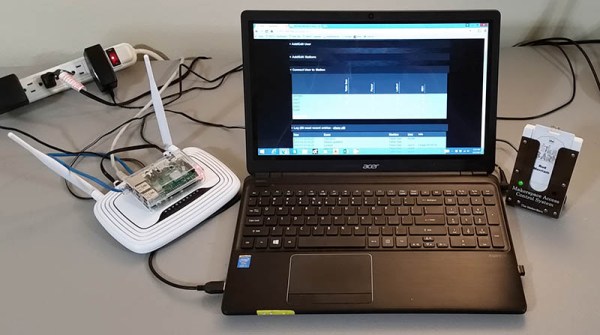
[maximus64] has the dash button working in the reverse manner by porting the Broadcom IoT WICED SDK to the button. He is using the dash button as a receiver and when [maximus64] sends the “all good” signal from his laptop to the dash button his garage door opens which you can see in the video after the break. We find this extremely more useful than the dash button’s original intended use. [maximus64] has instructions in the readme.md file of the github repo so that you too can hack your dash button in this way.

Continue reading “Amazon Dash Button Pwn3d”

Keeping The LiPo Smoke Where It Belongs

Nothing brings joy to a hacker’s heart like taking a cheap gizmo and making it useful. Over at Hackaday.io [AndyHull] popped open some cheap LiPo battery power packs to see if he could power a Canon Powershot camera. The entire shebang would be left in the wilderness for photography so keeping it inexpensive was a big goal since it might be destroyed or lost.

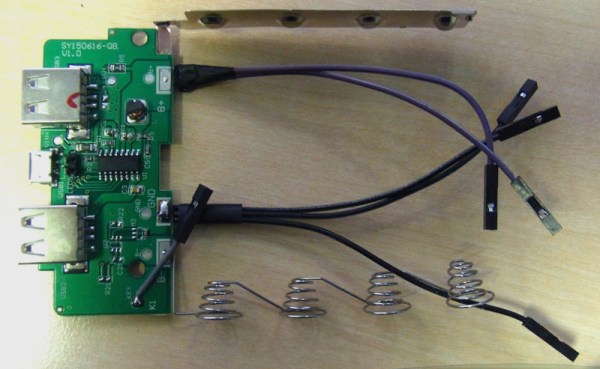
The power packs [Andy] looked at have a TP4221 controlling the charge cycle for up to four 18650 LiPo cells connected in parallel. The controller also boosts the voltage to 5 volts for one or two USB ports while providing automatic shutdown if the LiPo cell voltage drops below 3.2v. Below that voltage the cells can be damaged and might possibly cause a fire.

The packs [Andy] used also had a torch output to drive an LED almost directly from the cells. That output is a nominally 3.8 V at 100 mA which is just what he needed to power the Canon Powershot. It could be used to power small micros or other low power devices.

The LED was removed and replaced by a connection to outside the pack. The torch output is triggered by two quick presses on a switch that was also replaced with a connector to allow remote control.

If you’re looking for powerful battery options, give LiPo a try and have a look at [Andy]’s LiPo battery safety issues post, also on Hackaday.io. For a broader LiPo overview, see this obsessive rundown of various batteries.


Winning The Console Wars – An In-Depth Architectural Study

From time to time, we at Hackaday like to publish a few engineering war stories – the tales of bravery and intrigue in getting a product to market, getting a product cancelled, and why one technology won out over another. Today’s war story is from the most brutal and savage conflicts of our time, the console wars.

The thing most people don’t realize about the console wars is that it was never really about the consoles at all. While the war was divided along the Genesis / Mega Drive and the Super Nintendo fronts, the battles were between games. Mortal Kombat was a bloody battle, but in the end, Sega won that one. The 3D graphics campaign was hard, and the Starfox offensive would be compared to the Desert Fox’s success at the Kasserine Pass. In either case, only Sega’s 32X and the British 7th Armoured Division entering Tunis would bring hostilities to an end.

In any event, these pitched battles are consigned to be interpreted and reinterpreted by historians evermore. I can only offer my war story of the console wars, and that means a deconstruction of the hardware.

Continue reading “Winning The Console Wars – An In-Depth Architectural Study”

Fail Of The Week: OpenMV Kickstarter Project Hits Manufacturing Snag

Making stuff is hard, especially when you are making lots of stuff. The OpenMV Cam project knows this, because it has hit a problem while putting together their cheap machine vision module. The problem is with the BGA solder balls that connect the image sensor to the main board.

openmv-thumbWe’ve covered this intriguing project before: the aim is to build a small, cheap module that can run image processing algorithms to easily give robots sight. The sensor is a Ball Grid Array (BGA) package, which means there are a grid of small solder balls on the back that form the electrical connections. It seems that some of these solder balls are oxidized, preventing them from melting and fusing properly with the board. This is called a head-in-pillow defect, because the ball behaves like your head when you lie down in bed. Your head squishes the pillow, but doesn’t merge into it. There are 38 balls on the OV26040 image sensor and even a single bad link means a failure.

The makers of the project have tried a number of solutions, but it seems that they may have to remake the ball links on the back of each sensor. That’s an expensive process: they say it will cost $7 for each, more than the actual sensor cost initially.

A few people have been posting suggestions in the comments for the project, including using solvents and changing the way the sensors are processed before mounting. We’d like to see them overcome this hurdle. Anybody have any suggestions to quickly and cost effectively move the manufacturing process forward?

Continue reading “Fail Of The Week: OpenMV Kickstarter Project Hits Manufacturing Snag”

Developed On Hackaday – HaDge Is Back To The Drawing Board

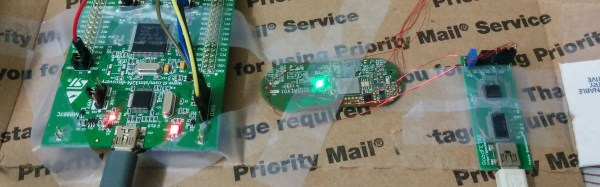
A couple of days back, we wrote about the HACK – a prototyping platform designed by [Michele Perla] based on the Atmel SAM R21 MCU. It’s one of the new breed of devices consisting of an ARM Cortex-M0 MCU + IEEE 802.15.4 Wireless radio bundled together. This was exciting since we could pack a lot of punch in the HaDge hardware. We planned to use the same design later to power the HaDge. Building HACK would have allowed us to get it in the hands of the software team, while the hardware folks worked on the real HaDge layout.

The HACK design was ready for review and we asked around to verify the antenna layout, which was the part we were not too sure about.  We asked Atmel for help with verifying the layout. That’s when we had the facepalm moment. They asked us – “What about FCC certification?” Since we plan to build the badges in quantities of a few hundred at the very least, it’s obvious we cannot escape from FCC certification. A design based around the R21 is ruled out – the cost of obtaining approval is pretty high. This means we need to punt the R21 and instead use an off-the-shelf radio module which is already FCC certified. Sigh.

Now the good news. This is a setback in terms of time, and effort put in by [Michele]. But beyond that, we’re good to go back to the drawing board and start afresh. First off, we decided to revert back to the Atmel D21 as the main controller. It’s a fairly decent MCU, and there’s a fairly robust tool chain available that a lot of people are familiar with. For the Radio, we are looking at some of these available options :

The last one from Microchip looks quite promising. But we’re open for better and cheaper suggestions, so please chime in with your comments.