Retrofitting Smoke Alarms With Bluetooth

Everybody should have a few smoke alarms in their house, and everyone should go check the battery in their smoke alarm right now. That said, there are a few downsides to the traditional smoke alarm. They only work where you can hear them, and this problem has been solved over and over again by security companies and Internet of Things things.

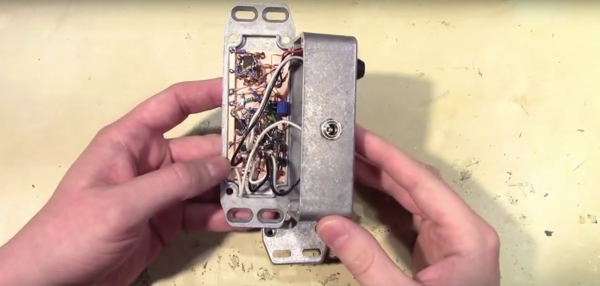
Instead of investing in smart smoke alarms, [Johan] decided to build his own IoT smoke alarm. It’s dead simple, costs less than whatever wonder gizmo you can buy at a home improvement store, and reuses your old smoke alarm. In short, it’s everything you need to build an Internet-connected smoke alarm.

Smoke alarms, or at least ionization-based alarms with a tiny amount of radioactive americium, are very simple devices. Inside the alarm, there’s a metal can – an ionization chamber – with two metal plates. When smoke enters this chamber, a few transistors sound the alarm. If you’ve ever taken one apart, you can probably rebuild the circuit from memory.

Because these alarms are so simple, it’s possible to hack in some extra electronics into a design that hasn’t changed in fifty years. For [Johan]’s project, he’s doing just that, tapping into one of the leads on the ionization chamber, measuring the current through the buzzer, and adding a microcontroller with Bluetooth connectivity.

For the microcontroller and wireless solution, [Johan] has settled on TI’s CC2650 LaunchPad. It’s low power, relatively cheap, allows for over the air updates, and has a 12-bit ADC. Once this tiny module is complete, it can be deadbugged into a smoke alarm with relative ease. Any old phone can be used as a bridge between the alarm network and the Internet.

The idea of connecting a smoke alarm to the Internet is nothing new. Security companies have been doing this for years, and there are dozens of these devices available at Lowes or Home Depot. The idea of retrofitting smarts into a smoke alarm is new to us, and makes a lot of sense: smoke detectors are reliable, cheap, and simple. Why not reuse what’s easy and build out from there?

Converting A TP Link Router To Mission Control For Cheap 433MHz Home Automation

[Jean-Christophe Rona] found himself with some free time and decided to finish a project he started two years ago, reverse engineering cheap 433MHz home automation equipment. He hopes to control his space heaters remotely, in preparation for a cold and, now, robotic winter.

In a previous life, he had reverse engineered the protocol these cheap wireless plugs, garage doors, and electric window shutters all use. This eventually resulted in a little library called rf-ctrl that can toggle and read GPIO pins in the correct way to control these objects. He has a few of the more popular protocols built into the library and even wrote a guide on how to do the reverse engineering yourself if you have need.

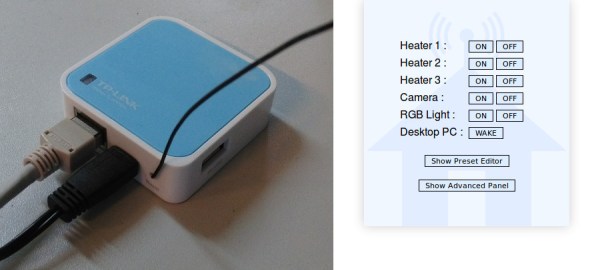
Having successfully interfaced with the plugs to use with his space heaters, [Jean-Christophe] went about converting a cheap TP Link router into a command center for them. Since TP Link never expected anyone to hammer their square peg into a mismatched hole, it takes a careful hand at soldering and some enamel wire to break out the GPIO pins, but it’s well within the average skill set.

The end result is a nicely contained blue box with a little antenna hanging out of it, and we hope, a warm abode for the coming winter.

Faux-AI Clapper Almost Seems To Be Listening

When a job can be handled with a microcontroller, [devttys0] likes to buck the trend and build a circuit that requires no coding. Such was the case with this “Clapper”-inspired faux-AI light controller, which ends up being a great lesson in analog design.

The goal was to create a poor man’s JARVIS – something to turn the workshop lights on with a free-form vocal command. Or, at least to make it look that way. This is an all-analog circuit with a couple of op amps and a pair of comparators, so it can’t actually process what’s being said. “Aziz! Light!” will work just as well as any other phrase since the circuit triggers on the amplitude and duration of the spoken command. The AI-lite effect comes from the clever use of the comparators, RC networks to control delays, and what amounts to an AND gate built of discrete MOSFETs. The end result is a circuit that waits until you finish talking to trigger the lights, making it seems like it’s actually analyzing what you say.

We always enjoy [devttys0]’s videos because they’re great lessons in circuit design. From block diagram to finished prototype, everything is presented in logical steps, and there’s always something to learn. His analog circuits that demonstrate math concepts was a real eye-opener for us. And if you want some background on the height of 1980s AI tech that inspired this build, check out the guts of the original “Clapper”.

Continue reading “Faux-AI Clapper Almost Seems To Be Listening”

Pulley Lamp Stands Up With You

Standing desks are either the best thing since sliced bread, or the fastest way to make your legs tired and get you ridiculed by your coworkers in the bargain. This leads some folks to compromise and make standing desks that can be re-lowered to sitting height when you need to take a break. But now the distance from your desktop to the light source that illuminates it has changed. We can’t have that!

fo6i703itw44bt1-medium[John Culbertson] came up with a very elegant solution to the “problem”. He made lights that are suspended on pulleys that raise and lower with the desk itself. We’re not sure that you’re in the same situation he is, but we’re sure that you’ll agree that he did a nice job.

Besides the pulley mechanism, the light shades are a work of art. [John] clearly wanted a retro feel, so he used low-voltage lightbulbs, but augmented them with LED strips to pump out the lumens. All in all, there’s a tremendous attention to detail in the project, and it shows.

Disclaimer: your humble author is writing you this missive from a standing desk. Ours is just a regular desk put up on bricks — a temporary solution that’s become permanent. We’re always keeping our eyes out for mechanisms to make the desk convertible, but everything that we’ve seen is either overkill or ridiculously overpriced or both. It’s hard to beat 24 bricks at $0.35 apiece. Anyone have any suggestions?

Of course, with an adjustable desk come the problems of moving your lighting along with it, but [John] has solved that one for us.

Bike Saddle As Workshop Stool

It is not uncommon for parts from a particular hobby or pursuit to be repurposed by enthusiasts as furniture. Car nuts will make sofas from the rear bodywork of a saloon car, for example, or coffee tables from engine blocks as you might have seen in the Top Gear studio.

A cycling enthusiast asked [Quinn Dunki] to produce a workshop stool using a bicycle seat, and the resulting piece of furniture is both elegant and functional, if probably comfortable only to those used to a racing saddle.

The stool itself rests on a vertical tube with a tripod at the bottom, each leg of which is fitted with a caster. We are taken through the steps to make the metalwork, in particular the rather tricky 45 degree tubular joint required for each leg. We see the unexpectedly high forces above the casters cracking the initial tack welds, and the resulting more substantial joint. And finally we’re treated to the stool being elegantly modelled by Sprocket the cat, as you can see below the break.

Continue reading “Bike Saddle As Workshop Stool”

64×16 LED MQTT Laundry Display

When you have an MQTT broker receiving messages, you want to be able to see them. [Xose Pérez] already had a system set up that sent him notifications, but he had a pair of 32×16 LED matrices, so he decided to make a big, bright sign to let him know when he got an important message sent to the broker.

[Xose Pérez] had already built a laundry monitor which was sending messages to an MQTT broker so he wouldn’t forget his laundry sitting in the washing machine. To communicate with the broker, he used an ESP-12. He had already ported an Arduino library for the Holtek HT1362C display drivers used by the matrices to work with his driver board.

mqtt-led-matrix-driver-boardHe wanted to try out SMD soldering so he built a custom PCB to hold the ESP-12, power supply, passive components, and a connector and he describes his methods and results. Instead of hardcoded messages, he wanted the system to be configurable and display messages coming in, not only from his laundry system, but also from other sensors. A web interface, built with jQuery and WebSockets, running on the ESP-12 allows the user to subscribe to a topic on the broker and show a customized name and value on the display when a payload is available.

All-in-all, [Xose Pérez] has posted a great tutorial in which he goes over the hardware he built, the libraries he used, SMD soldering, how he made the enclosure, and even his choice in IDE (PlatformIO). He also posted the software, board designs and enclosure models software and hardware on bitbucket. The end result is a great looking LED matrix that displays not only his laundry’s status, but also anything else he wants to from his MQTT broker.

If you want to try your hand with MQTT, the ESP8266 is a wonderful device for sensor nodes, and any Linux box (like the Raspberry Pi) makes an easy broker. Check out [Elliot Williams’] Minimal MQTT series and you will be up and running in no time.

Basement 3D Printer Builds Are Too Easy. Try Building One On Mars.

[Tony Stark Elon Musk] envisions us sending one million people to Mars in your lifetime. Put aside the huge number or challenges in that goal — we’re going to need a lot of places to live. That’s a much harder problem than colonization where mature trees were already standing, begging to become planks in your one-room hut. Nope, we need to build with what’s already up there, and preferably in a way that prepares structures before their inhabitants arrive. NASA is on it, and by on it, we mean they need you to figure it out as part of their 3D Printed Hab Challenge.

The challenge started with a concept phase last year, awarding $25k to the winning team for a plan to use Martian ice as a building material for igloo-like habs that also filter out radiation. The top 30 entries were pretty interesting so check them out. But now we’re getting down to the nitty-gritty. How would any of these ideas actually be implemented? If you can figure that out, you can score $2M.

Official rules won’t be out until Friday, but we’d love to hear some outrageous theories on how to do this in the comments below. The whole thing reminds us of one of the [Brian Herbert]/[Kevin J. Anderson] Dune prequels where swarms of robot colonists crash-land on planets throughout the universe and immediately start pooping out building materials. Is a robot vanguard the true key to planet colonization, and how soon do you think we can make that happen? We’re still waiting for robot swarms to clean up our oceans. But hey, surely we can do both concurrently.