From EPaper Badge To Weather Station

ePaper Weather Station

[Jeremy Blum] converted his 2013 Open Hardware Summit badge, also known as the BADGEr, into an ePaper weather station. We’ve looked at the 2013 OHS badge in the past, and the included open source RePaper display makes it an interesting platform to hack.

To fetch weather data, the badge is connected to a Raspberry Pi using an FTDI cable. A Python script uses the Python Weather API to poll for weather data. It then sends a series of commands to the BADGEr using pySerial which selects the correct image, and inserts the current weather data. Finally, a cronjob is used to run the script periodically, providing regular weather updates.

If you happen to have one of the badges, [Jeremy] has provided all of the files you’ll need to build your own weather station on Github. Otherwise, you can take a look at the RePaper project and WyoLum’s eReader Arduino Library to build your own ePaper project.

Doggy DVR Alarm Sensor

2014-01-05-13.22.20

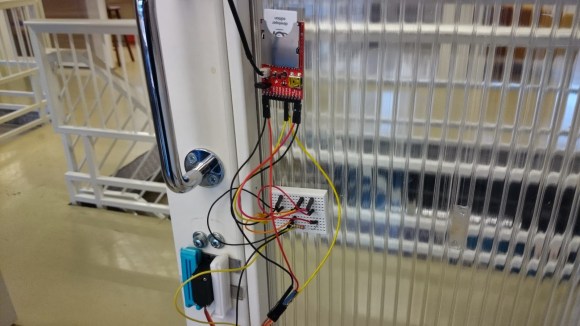
[Martin] lives in a small village about 25km from his job in a major city. Occasionally his home alarm system will trip and he will rush home to make sure everything is okay. So he decided to buy a DVR system instead… and he turned his dog’s collar into one of the main sensors.

As you may know, DVR’s also have sensor inputs in addition to loads of video cameras. These can be very handy to tell you other things that a small video clip will not, such as moisture, humidity, temperature etc. [Martin’s] DVR has 8 sensor inputs which he has configured to be the normally open type of sensors. By using a Sharp 817 optocoupler and a Funky v3 wireless module he made one of the sensor inputs wireless.

On the other end of the Funky wireless setup is a Kinder Surprise shell attached to his dog’s collar. In addition to the wireless module, it also contains a rudimentary 2-axis shock sensor consisting of a small spring that floats over a metal pin — when moved violently (when the dog is running about) it makes contact and [Martin’s] DVR alerts him by email and sends him pictures from the system.

He suspects he’ll be getting lots of pictures of the dog getting spooked by cats wandering by.

Wireless Thermostat

thermostat0104

The thermostat in [Tom’s] 100-year-old house is two floors up from where the furnace is located, so a broken wire in the wall was just the catalyst needed to design a wireless thermostat.

The system is based on a customized PCB [Tom] designed called the Magic Mote. The board contains an MSP430 microcontroller, a low power NRF24l01+ wireless transceiver, and various sensor interfaces. The wireless thermostat project uses two of these boards; one monitors the temperature on the second floor and the other controls the furnace in the basement.

The temperature sensing is done using a DHT22/AM2303 temperature and humidity sensor, which is a convenient choice, since the part is calibrated and handles the analog digital conversion; you just need one digital pin to retrieve the temp/humidity data. To control the furnace, [Tom] used the local 24VAC and a latching relay to drive the heater signal. The 24VAC also powers the board, so a door-bell transformer steps the voltage down to something more usable; about 11VAC or so, which is then rectified, filtered, and regulated down to what the control electronics like to see (3.3V/5V).

This project is actually still in the early stages of what [Tom] has planned; a network of sensors and appliances with a beagle bone base station. We can’t wait to see what’s next for this project; maybe we’ll even see some voice control, like in this epic Siri controlled home automation project.

[via Dangerous Prototypes]

Recliner Sofa Given The Power Of The Pi

pi-sofa

If you go to buy a sofa these days you’ll not only be greeted with the option of one or more reclining positions, but a fully modern unit comes with motorized reclining. That simply wasn’t convenient enough for [Nicki] and [Kevin] who wanted to control the feature from a smartphone rather than a physical interface (buttons) on the side of the furniture. What resulted is the PiSofa, a Raspberry Pi connected to the furniture’s electronics with the help of a relay board.

This is most certainly a hack, but no doubt one with a lot of finesse. Check out that white PCB. That’s right, it’s a factory spun board to keep things nice and neat. They went with one of our favorite tricks by housing everything inside of a food storage container. After some Ruby coding the Pi now has complete control of the sofa. We’re not overstating this. It literally is the only way to control it because the original buttons no longer work. But that’s okay, turns out not only does it work with their smartphones, but with a [Kevin’s] Pebble watch as well.

We can’t think of any past hacks that specifically targeted the couch. But here’s a hammock that you can drive down the street.

Hacking A Heating Pad

HeatingPadBreadboardS

[Bob] and his wife use a bed heating pad. In the winter, they typically turn it on about an hour before bedtime so the bed is nice and warm. The problem is, if they accidentally leave it on, they’ll wake up a few hours later: overheated. What they needed was an advanced timer system.

A normal outlet timer wouldn’t fit his needs: most of the year the pad should shut off after a slight delay, but in the winter they prefer to leave the heating pad on at a much lower temperature. [Bob] decided to create a custom timer with a microcontroller to provide adjustable duration and heating levels.

The circuit is simple. It consists of a microcontroller, a 2-digit LED display, two buttons, and two wires that connect to the heating pad’s original controller. The final build allows you to set the time the pad turns on, turns off, and/or down a few levels. It’s a fantastic hack, and you can see how the interface works in the video following the break.

Continue reading “Hacking A Heating Pad”

A New Way To Heat People

[Leigh Christie] is a researcher at MIT, and he’s developed an interesting solution to heating people, not buildings.

His TEDx talk, “Heating Buildings is Stupid,” demonstrates the MIT SENSEable City Laboratory’s efforts to tackle energy issues. Their research focuses on finding an alternative to the staggering waste of energy used to heat large spaces. Although TED talk articles are a rarity at Hackaday, we think this idea is both simple and useful. Also, [Leigh] is the same guy who brought us the Mondo Spider a few years ago for the Burning Man exhibition. He’s a hacker.

Anyway, what is it? The system he’s devised is so simple that it’s brilliant: a person-tracking infrared heat spotlight. Using a Microsoft Kinect, the lamp follows you around and keeps the individual warm rather than the entire space. [Leigh] has grand plans for implementing what he calls “Local Heating” in large buildings to save on energy consumption, but smaller-scale implementations could prove equally beneficial for a big garage or a workshop. How much does your workspace cost to heat during the winter? Hackerspaces seem like the perfect test environment for a cobbled-together “Local Heating” system. If anyone builds one, we want to hear about it.

Check out the full TEDx talk after the break.

Continue reading “A New Way To Heat People”

Raspberry Pi Wall Calendar

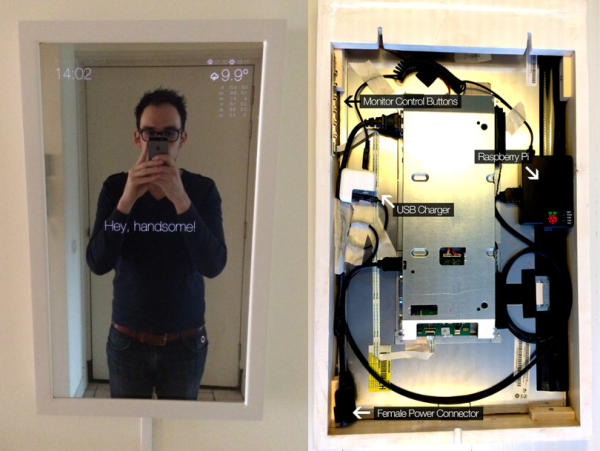
Do you let Google know every aspect of your personal and social life? Do you have a spare LCD monitor kicking around? Why not make your own Raspberry Pi Wall Calendar?

[Alex] recently bought his first home (congratulations!), which happened to have a TV wall mount in the kitchen. Personally, we don’t think TVs belong in the kitchen, and neither did [Alex]. Not wanting to tear the mount out of the wall (and thus require home renovations too soon), he devised a clever solution: why not make a digital calendar?

[Alex] connected a Raspberry Pi model B to the LCD monitor, which provides convenient access to his Google Calendar. His Instructable is both meticulous and approachable, so novice hackers should have no trouble replicating this build. The only improvement we can think to suggest is substituting a touchscreen LCD, which would allow him to interact with the schedule.

Whether you “let” Google know about your life— or it just knows—this is certainly a handy hack for the 21st century home!