Make Your Own Cookie Cutters This Year

In case you needed another reason to build, borrow, or buy a 3D printer, here’s one way to design and print your own cookie cutters. [Nikolaus Gradwohl] put together a processing app that aims to make the design process a bit easier. So if you’ve never designed a printable object before, but can get your hands on a MakerBot or similar device through a friend or your local hackerspace, this is for you. Check out the video after the break to see the process of making a cutter in the shape of a mushroom, or just download the app and give it a go.

Continue reading “Make Your Own Cookie Cutters This Year”

Bluetooth Temperature Module

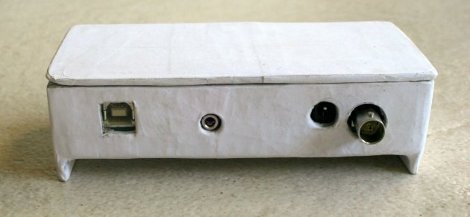
Wanting to know the outside temperature, [Jamie Maloway] built his own temperature sensor that can be read with a Bluetooth device. Let’s take a tour of the hardware above from right to left. There’s a linear voltage regulator with two filtering caps and a terminal block to attach a 9V battery or other power source. Next there’s an 8 MHz crystal and it’s capacitors, followed by a programming header on top and a 1-wire temperature IC, the DS18B20 we’re all familiar with hanging off the bottom. These both connect to the 8-pin PIC 12F675 that drives the system, and transmits using a Bluetooth module from Sure Electronics. Since this is using a serial protocol and transmitting ASCII data, it can be read using an automated script, or simply by using a terminal program.

Now, who’s going to be the first to get rid of the battery and leech off of the mains through inductance?

Home Brew Coffee Machine

There are already a lot of different ways to brew up a decent coffee at home, from the humble saucepan to the elegant vacuum flask. In an office environment the choice of coffee-making technique can have a major impact on workplace harmony—how can people be expected to work happily when the kitchen is filthy with grounds and the coffee is always stale? “Someone have mercy,” [Christian Finger] lamented, “and boil a pot of fresh.”

In the end he took extreme measures, building a machine that grinds whole beans, measures out a dose, brews a cup and self-cleans. He used all sorts of odds and ends to put the thing together, detailed in his long and hilarious build log (english translation—and check out the dude’s sweet ride). Refer to his shockwave animation for a summary of the intended operation.

The end result is an extremely impressive Goldbergian contraption—download the video from the build log. It is pretty noisy and probably energy- and water-hungry, but that wouldn’t stop us from using it every day, if given the chance. Hell, this here could form a major part of your next breakfast machine.

We’re sure that there is further potential in this, because to get the really freshest possible cup of coffee you’d want to roast the coffee beans just before grinding them. Then you’d be well on your way towards something else entirely: a delicious breakfast machine.

Christmas Tree Low-water Monitor

The end of the year is rapidly approaching and there’s a good chance you have a slowly dying tree in your living room. Help it hold on a little longer by using [Eric Ayars’] Christmas Tree water monitor. He’s built a sensor out of a piece of strip board. Three bus strips on the board allow for a variety of alerts. When all three are submerged everything is ok. When the two longer traces are still under water but the third is not an LED will blink to let you know it’s time. If you don’t pay attention and there’s no water left, a piezo buzzer makes noise until you add water (or the coin cell runs out of juice).

This project centers around an ATtiny85 that [Eric] programmed using an Arduino, one of the methods we covered in our AVR Programming Tutorial. But if this simple circuit isn’t high-tech enough for you, we saw a similar method last year that will send an alert to your iPhone.

Knitting Machine Hack By Keypad Emulation

[Travis Goodspeed] and Hackaday alum [Fabienne Serriere] joined forces to develop an alternative interface for a knitting machine. They’re working with the Brother KH-930E machine. We saw [Becky Stern] use the same model by manipulating data on an emulated floppy drive for the device. [Travis] and [Fabienne] went a different route, and are emulating the keypad using an Arduino and a set of transistors.

They started by reverse engineering the keypad matrix using a continuity tester. Once they worked out the column and row layout they connected each to an NPN transistor. The Arduino sketch simulates button presses to set knitting bits for each row, with just one reset button for user input. This can be used to send data from a PC, or as a standalone system. Either way, it’s not only a great way to add functionality to the kitting machine, but a good example of how to interface with the keypad on just about any device.

Star Trek Inspired Pocket Doors

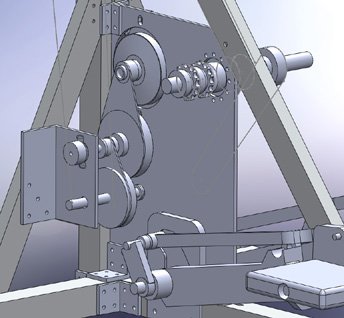
Do you have enough confidence in your hacking abilities to build a project into the walls of your home? [Marc] used his skills to build an air-powered sliding door for his bedroom. It is similar to the sliding door you’d find on the Enterprise, two sections that slide nicely into the wall to let you pass. Although the picture above shows the internals, he followed through and ended up with a fully finished room that looks fantastic. A compressor in the attic provides the pressure necessary to move the door sections. It is automated, but uses a button press or keypad combination to run instead of detecting motion. Of course, since he’s using a PIC microcontroller to drive the system there’s always room for future changes. Check out how great the finished look is in the video after the break.

Continue reading “Star Trek Inspired Pocket Doors”

Fake Christmas Tree Makes It Fake Snow

Let it snow inside your house this Christmas by building your own snow making tree. [Trey] was inspired by a snowing lamp-post he came across in a story. He looked around the house and came up with all the stuff necessary to make this happen with a Christmas tree. The snow is loose Styrofoam like you’d find in a bean bag chair. At the bottom of the tree there’s an inverted umbrella to collect the snowfall and funnel it into a blower salvaged from an inflatable Halloween yard ornament. The blower shoots the Styrofoam up through a PVC pipe, which also serves as the trunk of the fake tree, and it erupts from the top bringing Christmas cheer to an otherwise quiet room. See for yourself.