Homemade Bulletproof Glass, Built And Tested

Hackers tend to stash away lots of stuff that seems useless, right up until it saves the day. This includes not just junk in our parts bin but brains full of tips and tricks for the shop. With that in mind, you might want to file away a few of the tips in [AvE]’s video of how he made bulletproof glass for a rainy day.

By his own admission, [AvE]’s video is a little disjointed, and the topic of the bulletproof glass is only covered at the beginning and again briefly at the end. Most of the video concerns the machining of a stout stand for the glass for testing on the range. There’s plenty to learn from the machining, though, and [AvE] is always good for a laugh, so the video is worth a watch. The bulletproof glass itself is part of a long-term project that [AvE] is releasing first to his Patreon patrons – a ridiculously over-built flashlight dubbed “The Midnight Sun”. His first two tries at laminating the Lexan discs were less that optimal, as both brands of cyanoacrylate glue clouded the polycarbonate. Stay tuned to the end of the video for the secret of welding Lexan together into an optically clear sandwich.

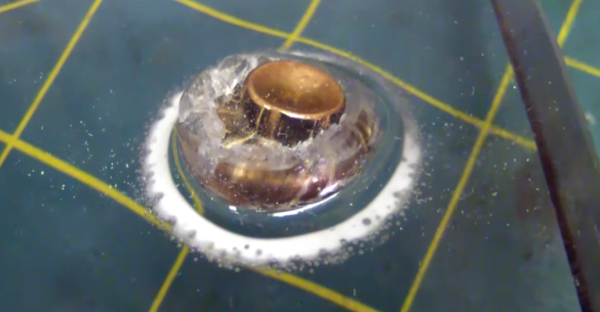
As for testing under fire, [AvE] sent the rig off to buddy [TAOFLEDERMAUS] for the hot lead treatment. The video after the break shows that the glass is indeed bulletproof, as long as the bullet in question is a .22LR. Not so much for the 9mm, though – that was a clear punch-through. Still, pretty impressive performance for homebrew.

If you want something that can stop an arrow, there’s a lot of materials science to be learned from the ancient Greeks.

Continue reading “Homemade Bulletproof Glass, Built And Tested”

Whiskey Tango Foxtrot Is The Phonetic Alphabet?

Sometimes words just have to be spelled for others. I’ve been on phone conversations where the person on the other end is spelling for me and it’s painful. “Was that a ‘b’ or a ‘p’?” Sometimes they’ll try on the fly to use words with the beginning letter trying to convey the letter: “B as in boy”. Then they’ll get stumped mumbling while they think desperately for ‘k’ words… ‘ketchup’. Okay, but is that really ketchup or catsup? Now think how much easier spelling is on a phone than over a poor quality radio channel. What we say, and how we say it is the key to our brain’s ability to error correct human speech. It’s a solved problem that was built into radio etiquette long ago.

Continue reading “Whiskey Tango Foxtrot Is The Phonetic Alphabet?”

How To Use Lidar With The Raspberry Pi

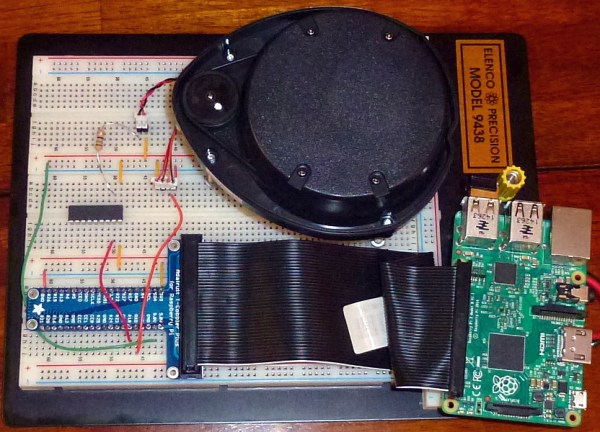
The ability to inexpensively but accurately measure distance between an autonomous vehicle or robot and nearby objects is a challenging problem for hackers. Knowing the distance is key to obstacle avoidance. Running into something with a small robot may be a trivial problem but could be deadly with a big one like an autonomous vehicle.

My interest in distance measurement for obstacle avoidance stems from my entry in the 2013 NASA Sample Return Robot (SRR) Competition. I used a web camera for vision processing and attempted various visual techniques for making measurements, without a lot of success. At the competition, two entrants used scanning lidars which piqued my interest in them.

Continue reading “How To Use Lidar With The Raspberry Pi”

Finally, An Upgrade For The TI-86

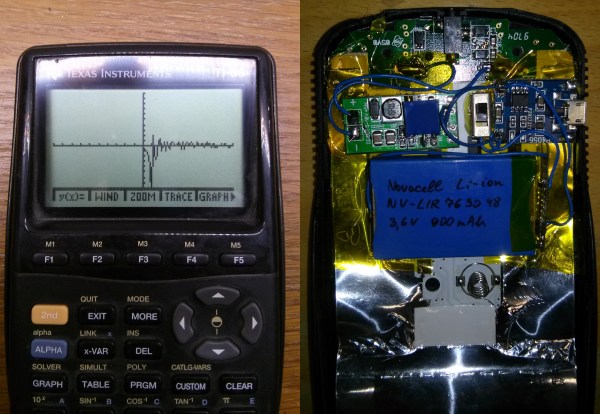
The eternal and everlasting TI-86 graphing calculator is a great calculator: first made back in 1997, and still used by students today. But its battery life kinda sucks. So [Dalius] decided to bring his TI-86 into the 21st century.

If you’re not familiar, the TI-86 runs off of 4 AAA batteries, preferably alkaline. If you use rechargeable NiMH they don’t last very long since they have a lower voltage per cell, which means it ends up draining even faster to a voltage level the TI-86 cannot operate at.

Continue reading “Finally, An Upgrade For The TI-86”

FM 101 And Transmitter Build With Afroman

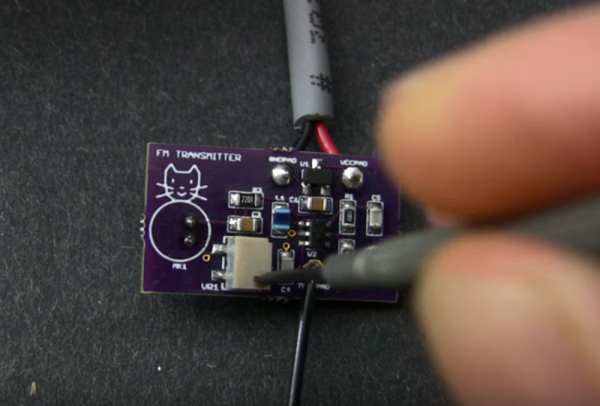
One of our favorite purveyors of electronics knowledge is at it again. This time, [Afroman] explains how frequency modulation works while building up a short-range FM transmitter on a board he has available at OSH Park.

The design is based on a MAX2606 voltage-controlled oscillator (VCO) chip that can do 70-150MHz. [Afroman] sets it up to oscillate at about 100MHz using a 390nH inductor. He also put a potentiometer voltage divider on the 2606’s tuning pin. Voltage changes issued through the pot alter the transmitting frequency in small increments, making it easy to dial in a suitable channel for your broadcast. Add an electret mic and about a meter’s worth of solid-core wire and you have yourself an FM transmitter that is good for around 20 meters.

There are plenty of ways to build a small FM transmitter that allow for some experimentation and don’t involve placing SMD components. We covered a build last summer that uses a couple of 3904s and rides a 9V connector salvaged from a dead battery. The downside is that transistor-based transmitters tend to be less frequency-stable than a VCO chip.

Continue reading “FM 101 And Transmitter Build With Afroman”

Extreme Wire Buzz Game

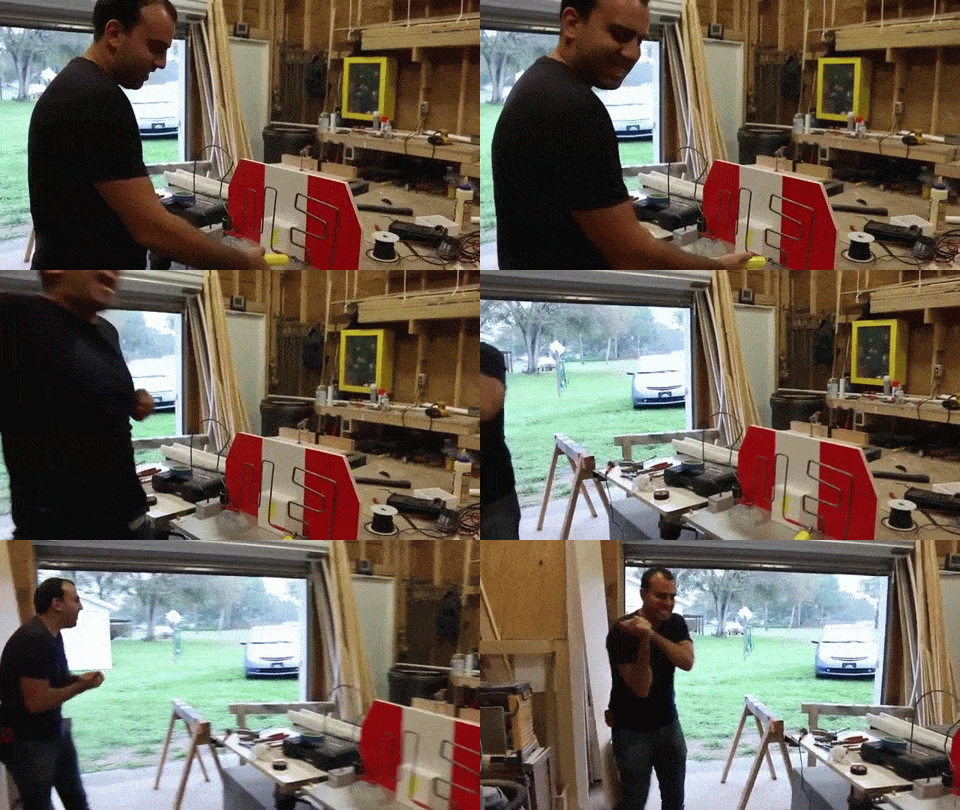
Remember that old buzz wire game? Kinda like Operation, where you have to do a dexterous task without touching the walls… Well here’s a fun twist on it — what if you throw a 4 million volt stun gun into the mix?

That’s right, [Mike] was given a taser flashlight, and he had this brilliant idea to make a game out of it. The game features three metal wire sections which get progressively harder, with higher risk too! Using the handle, you have to guide an eye-bolt along the wire sections. But be careful — the circuit is live, and if you touch the metal, you’re going to get quite the shock!

Continue reading “Extreme Wire Buzz Game”

32C3: 20 Oscillators In 20 Minutes

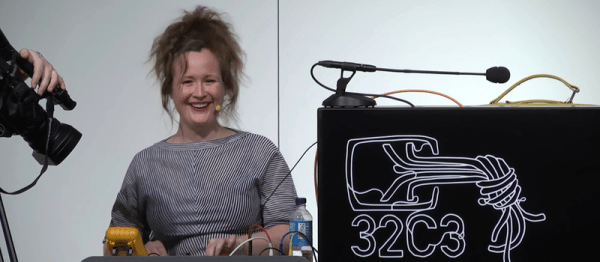
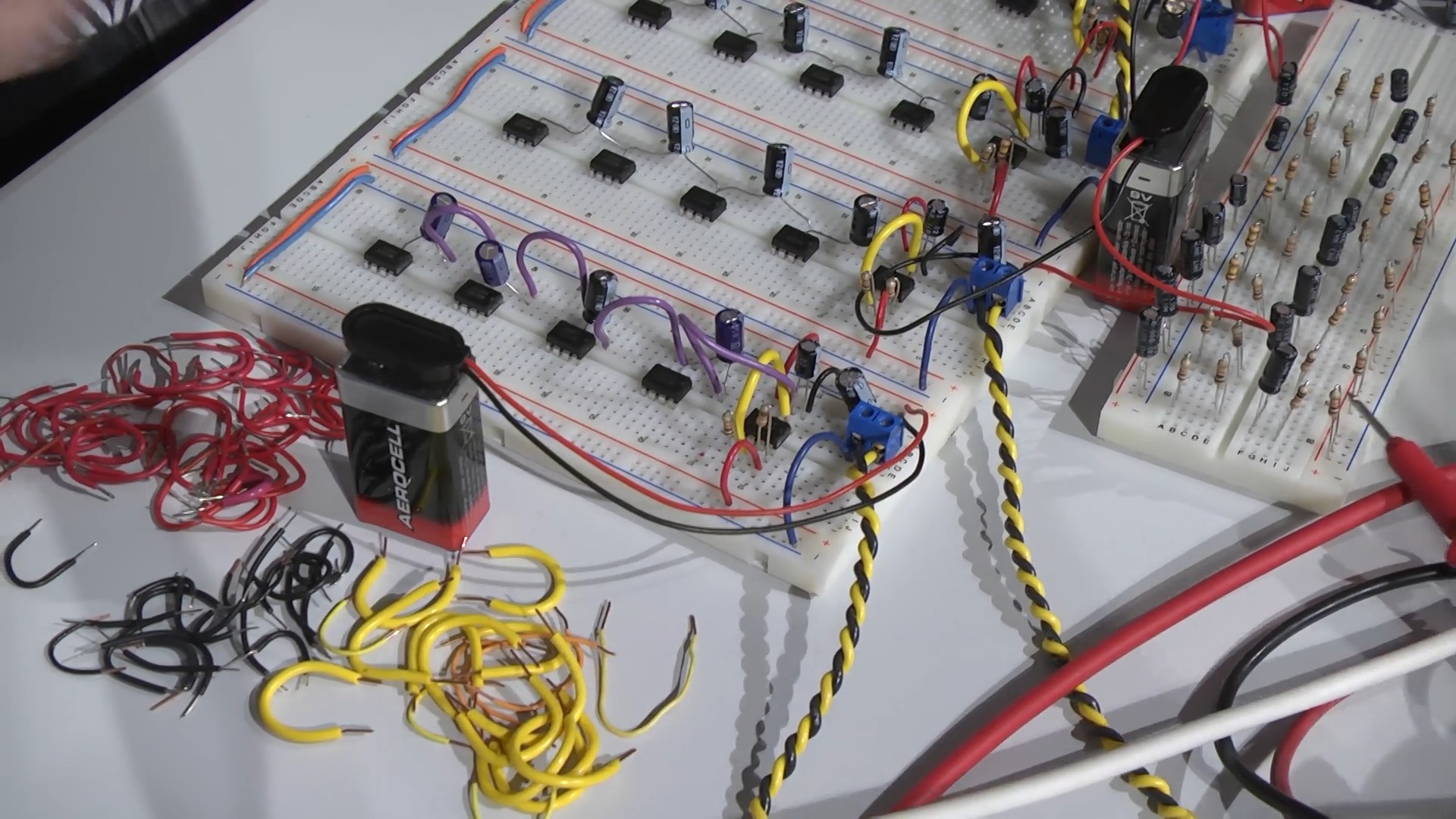
In terms of implausible stand-up comedy, [Darsha]’s “20 Oscillators in 20 Minutes” is pretty far out there. First of all, she’s sitting down, with googly eyes on her multimeter, and five breadboards and a mess of 9V batteries laid out in front of her. “Has anybody built electronics before? Has anybody built electronics in front of this many people before? Yeah, so you’d better f**king be nice.” And she’s off!

twenty_oscillators-shot0012“Square waves are really good for your speakers.” And a few seconds later, a lub-dub beat-frequency oscillator filled the hall. And then there’s the stand-up clichés: “Anyone in the audience from Norway?!” And “Anyone know what chip I’m using here?” (The 555.) A heckler, or participant, shouts up “What are you doing?” She responds “Building this!” and shows a sketch of the basic layout.

She baits the audience — “Do you want to ask me about duty cycles?” — and tells stories: “And then one time the solder fell in my lap and burned through my crappy jeggings. Who knows what jeggings are? Whooo!!” All the while the clicking gets louder and more complicated.

Then there’s the suspense. “11 minutes left? Shit, I dunno if I’m going to make it this time!” She’s visibly panicked. A question: “How do you protect the outputs from overvoltage?” “I don’t. (pause, laughter) I use some filter caps and just, well, hope that you guys have good insurance.”

Nearing the home stretch, there’s this quasi-rhythmic ticking and pulsing slowly building up in the background. She plugs in another capacitor, and the crowd spontaneously applauds. A little bit later, she shouts “Is it loud enough?” over the din and turns it down. At the end, the timing’s getting really tight, and she calls up someone to help from the audience.

We won’t spoil it, naturally. You’ll just have to watch it run to the end. We laughed, we cried. It was better than Schroedinger’s cats.

(We’d use hex inverters.)