Simplest Electricity Monitoring Solution Yet

Monitoring your home’s energy use is the best way to get a handle on your utility bills. After all, you can’t manage what you can’t measure! The only problem is that most home energy monitoring systems are cumbersome, complicated, or expensive. At least, until now. [Kevin] has created a new electricity meter based on Particle Photons which should alleviate all of these problems.

The Particle Photon (we get confused on the naming scheme but believe this the new version of what used to be called the Spark Core) is a WiFi-enabled development board. [Kevin] is using two, one to drive the display and one to monitor the electricity usage. This part is simple enough, each watt-hour is accompanied by a pulse of an LED on the meter which is picked up by a TLS257 light-to-voltage sensor. The display is a Nextion TFT HMI (touch screen) which is pretty well suited for this application. The data is corralled by emoncms, part of the OpenEnergyMonitor platform, which ties everything together.

For a project that has been done more than a few times, this one does a great job of keeping the price down while maintaining a great aesthetic. Make sure to check out the video below to see it in action.

Continue reading “Simplest Electricity Monitoring Solution Yet”

ARM Programming On Mars

Before you overreact to the title, keep in mind the latest version of Eclipse is code named “Mars.” It is always a bit of a challenge to set up a generic ARM tool chain. If you don’t mind sticking to one vendor, shelling out a lot of money, or using Web-based tools, then you might not have this problem. But getting all the tools together can be annoying, at best.

[Erich Styger] works with students and knows they often stumble on just this step so he’s provided clear documentation for getting Eclipse, the ARM gcc compiler, and a full set of tools installed. He focuses on Windows and the Kinetis platform, but the steps are virtually the same regardless. Just get the right tools for your operating system and skip the Kinetis-specific parts if you don’t need them.

Continue reading “ARM Programming On Mars”

Pulse Density Modulation

[esot.eric] was trying to drive a motor and naturally thought of using pulse width modulation (PWM) to control the motor speed. However, he found that even with a large capacitor, his underpowered power supply would droop before the PWM cycles were complete. So instead of PWM he decided to experiment with pulse density modulation.

The idea is to use smaller pulses over a longer period of time and make the average power equal to the percentage motor speed desired. With a PWM system, for example, if the time period is T, a 50% PWM drive would have the  drive high for T/2 and low for the other half of the cycle. With pulse density, each pulse might be T/10 (as an example) and then the output would be on for 1/10, off for 1/10, on for 1/10 and so on, until by time T you’d still get to 50%. The advantage is the output capacitor gets a kick more often and has less opportunity to droop.

Continue reading “Pulse Density Modulation”

Embed With Elliot: Practical State Machines

Raindrops on roses, and whiskers on kittens. They’re ok, but state machines are absolutely on our short list of favorite things.

There are probably as many ways to implement a state machine as there are programmers. These range from the terribly complex, one-size-fits-all frameworks down to simply writing a single switch...case block. The frameworks end up being a little bit of a black box, especially if you’re just starting out, while the switch...case versions are very easy to grok, but they don’t really help you write clear, structured code.

In this extra-long edition of Embed with Elliot, we’ll try to bridge the middle ground, demonstrating a couple of state machines with an emphasis on practical coding. We’ll work through a couple of examples of the different ways that they can be implemented in code. Along the way, we’ll Goldilocks solution for a particular application I had, controlling a popcorn popper that had been hacked into a coffee roaster. Hope you enjoy.

Continue reading “Embed With Elliot: Practical State Machines”

Stuffing Everything On A DIP32 Package

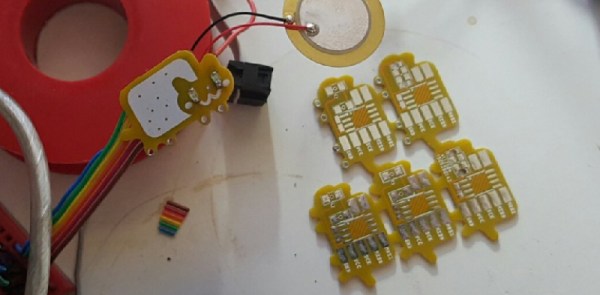
Putting an full microcontroller platform in a DIP format is nothing new – the Teensy does it, the Arduino nano does it, and a dozen other boards do it. [Alex] and [Alexey] aren’t content with just a simple microcontroller breakout board so they’re adding a radio, an OLED, an SD card reader, and even more RAM to the basic Arduino platform, all in a small, easy to use package.

The DIPDuino, as [Alex] and [Alexy] are calling it features an ATmega1284 processor. To this, they’re adding a 128×32 pixel OLED, a micro SD slot, and 1Mbit of SRAM. The microcontroller is a variant that includes a 2.4 GHz Zigbee radio that allows for wireless connections to other DIPDuinos.

What are [Alex] and [Alexey] going to do with their cool little board? They’re planning on using the OLED for a watch, improve their software so the firmware can be updated from the SD card, and one of [Alex]’s friends wants to build a RepRap controller with one of these. There’s a lot of potential with this board, and we’re interested in seeing where the guys take the project from here.

Wii MotionPlus Gyro To Microchip PIC

Sometimes the most mundane products have surprisingly sophisticated internals. What’s in a game controller? If it is a Wii remote, you’ll find a lot inside–an IR sensor, Bluetooth, an accelerometer, and EEPROM. It also has a six pin expansion port that allows I2C peripherals connect to the controller.

[DotMusclera] wanted to experiment with a gyroscope and decided to hook up to the Wii MotionPlus to a Microchip PIC. Using information from the WiiBrew wiki, [DotMusclera] connected a PIC18F4550, an LCD, and a handful of components (mostly to do 3.3V level conversion), he set up the hardware on a breadboard. The only odd part you might have to work around is a Wii breakout board that converts from the breadboard to the Wii interface.

The software is easy to follow since it is written in Hi-TECH C and well-commented. The hardware lacks a schematic, but from the parts list and the video, you can probably figure it out. The setup works well and shows roll, pitch, and yaw on the LCD screen.

The project log is very detailed, with a lot of information about gyroscopes and the communication format the gyro uses. The video demo is worth watching as well.

Continue reading “Wii MotionPlus Gyro To Microchip PIC”

Before Arduino There Was Basic Stamp: A Classic Teardown

Microcontrollers existed before the Arduino, and a device that anyone could program and blink an LED existed before the first Maker Faire. This might come as a surprise to some, but for others PICs and 68HC11s will remain as the first popular microcontrollers, found in everything from toys to microwave ovens.

Arduino can’t even claim its prominence as the first user-friendly microcontroller development board. This title goes to the humble Basic Stamp, a four-component board that was introduced in the early 1990s. I recently managed to get my hands on an original Basic Stamp kit. This is the teardown and introduction to the first user friendly microcontroller development boards. Consider it a walk down memory lane, showing us how far the hobbyist electronics market has come in the past twenty year, and also an insight in how far we have left to go.

Continue reading “Before Arduino There Was Basic Stamp: A Classic Teardown”