Sony SmartWatch Hack Lets It Tell Time With A Teapot Animation

sony-smartwatch-wireframe

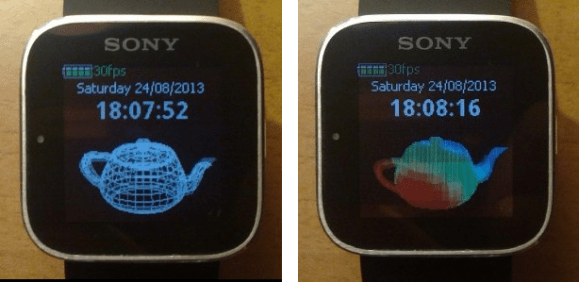
This hack turns the Sony SmartWatch into a wristwatch. Functionally it’s not all that impressive. But the journey to get to this point represents quite a bit more. This example features an animated tea pot using a 3D rendering engine ported over to the device.

[Federico] started work on the project soon after hearing that Sony had released details about developing for the hardware. He dug into the documentation but soon found it lacked the depth he needed to get a handle on bare metal work. He shelved the project for a while until coming across the Astrosmash project we featured in June. That used a wrapper that allows Arduino sketches to run on the watch. After studying how that’s done he had enough background to port this code.

We’re still waiting to see a really innovative hack for the watch. But we’re glad to see progress with each new proof of concept like this one!

Continue reading “Sony SmartWatch Hack Lets It Tell Time With A Teapot Animation”
Reaction Time Challenge

reactionChallenge

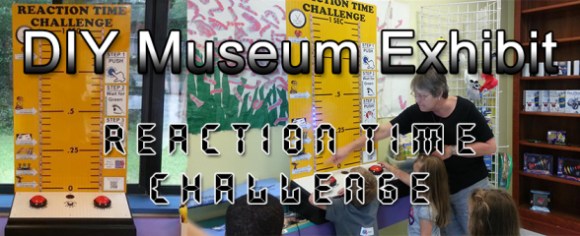
We’re not sure where [Bill Porter] finds all of his free time, but we’re glad he’s put it to such good use by building an exhibit piece for the local science museum: Reaction Time Challenge. It’s likely that we were all inspired to love science as kids in a museum like this, and [Bill’s] contribution is already fascinating its young audience. The challenge lets two participants test how fast they can smack a big red button after a randomly-generated countdown. The time taken for the players to react is translated into the RGB LED strips, measuring how fast they managed to hit the button.

Builds like this one need to clearly communicate how they should be used; you don’t want confused children bamming around on your cabinet. First, [Bill] guts the dim LEDs inside the big plastic buttons and replaces them with some brighter ones. To keep the connections clean, he takes the cannibalized ends of an Ethernet cable and hooks the speaker and buttons to an Ethernet jack. The jack sits snugly in a project box where it connects to an Arduino. Two RGB LED strips run from the opposite end of the box, daisy-chaining from the bottom of the cabinet to the top, then back down again. See it all come together in the video after the break.

[Bill’s] museum must be pretty lucky; he resurrected the “Freeze Frame” exhibit for them just over a year ago and has done a bunch of other projects for them over the years.

Continue reading “Reaction Time Challenge”

The Straddler Makes AVR Breadboarding Truly Plug And Play

the_straddler_avr_programmer

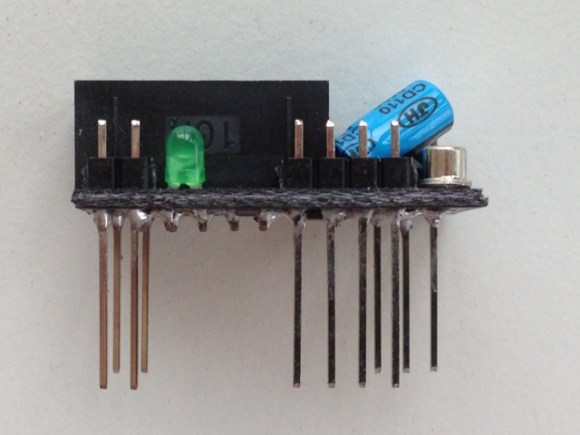
It’s not that breadboarding AVR circuits is difficult. But you have to admit that it takes some time to set everything up. We don’t label the top of our DIP chips so that you know what each pin does just by looking. Which means that wiring up the programmer involves pulling out the datasheet. [Vinnie] found the solution to this problem which is to make one of these interface PCBs for each AVR chip family. The long pins make it easy to drop over the top of your microcontroller, which is where the name comes from.

His first stab at the idea was just a hunk of home etched PCB which broke out the programming pins into the 6-pin ICSP standard. This second rendition uses the 10-pin standard and adds a few extras into the mix. He included decoupling capacitors which need to be used in every circuit anyway. There’s a crystal along with its load capacitors. This clock source is a snap to enable by burning some fuses. If you choose to use the internal oscillator instead this hardware won’t interfere. The LED is used to get you up and running with blinky firmware as quickly as possible. He plans to add jumper in the next revision which can disconnect this components from the I/O pin. Now you just need to add a 10-pin header to that USB keyboard AVR programmer and you’re in business.

Unplayable Holophonor Replica Is Unplayable

holophonor

You won’t find all that many props or homemade replica builds here at Hackaday, but [Harrison Krix’s] work is second to none, and his Futurama Holophonor replica is worth drooling over. [Harrison] sourced an old (and apparently grimy) clarinet from a local thrift store, which he strips clean of its keys and attachments. The body itself receives some subtle modifications from the lathe and epoxy to plug some holes. Custom-spun plastic pieces complete the rest of the body, including the meticulously crafted bell which houses 54 LEDs.

[Harrison] also whips up a breakout board for a mini Arduino Pro with 4 fading and 4 blinking channels, and some custom power supply options for the Holophonor’s base: a scratch-built fiberglass AAA battery holder and optional AC adapter jack. As an added bonus, he’s fitted the Holophonor’s stand with a set of Robot Devil hands that hold it in place. The only video is an illumination test, but it sure is pretty. You can see it below! It looks perfect, but alas is unplayable which actually makes it even more authentic.

The Holophonor is the latest in a slew of work from Volpin Props. You probably remember [Harrison’s] first Daft Punk helmet from a few years back, or the second one that followed shortly after.

Continue reading “Unplayable Holophonor Replica Is Unplayable”

Microcontrollers And Node.js, Naturally

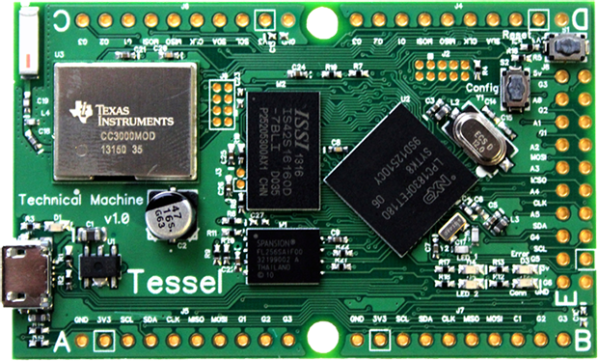
We see a surprising amount of projects using Node.js, but despite this we haven’t seen much JavaScript running microcontrollers, even the ARM powered Raspi or BeagleBone. The folks at Technical Machine want to change that with a very cool dev board designed to be an Internet-connected JavaScript running prototyping device from the very beginning. It’s called Tessel, and brings some very cool tools to any maker’s workbench.

On board this little… board is an ARM Cortex-M3 running at 180 MHz, 32 Megs of Flash, 32 Megs of SDRAM, and a TI CC3000 WiFi module that we’ve heard so much about. The 16-pin GPIO can connect to other Tessel modules that allow for servos, accelerometers, micro SD cards, and a whole bunch of other sensors for just about any project imaginable.

Aside from having WiFi built in from the get-go, Tessel also has some Arduino compatibility, allowing it to work with existing shields and code. It seems pretty cool, and we can’t wait to get our hands on one when it launches in September.

Bow Tie Kindly Suggests That You Back Off

personalSpaceBowtie

Everyone’s had their “personal space bubble” burst. You just wanted a friendly conversation, but now some overzealous blockhead is standing on your shoes and breathing in your face, making you guess what he had for lunch. Fortunately, [Grissini] has created this sylish bowtie solution. Stand too close (within 19 inches) and the LEDs come to life, flashing a warning that indicates a personal space violation. [Grissini’s] tie is 3D printed to accommodate most of the electronics, which snugly snap into place. The rest of the wiring appears to run through the neck strap and connect up to a battery pack hidden elsewhere. You can check out a brief description and demonstration in a video after the break.

We’ve seen this hack for the ladies: [Jeri’s] dress performs a similar function. We’re unsure, however, if these LEDs can deter your average socially-awkward space invader. What we’d really like to see is someone take these hacks to their logical conclusion and make a wearable out of the non-lethal dazzler clone…hopefully the victim would back up a step or two before they spewed.

If you’re lonely and want to encourage people to come closer, maybe this LED bow tie will help. Or, who knows, maybe it’s yet another way to scare people off.

Continue reading “Bow Tie Kindly Suggests That You Back Off”

The RPC: A Stand-alone MIDI Workstation

raspiMidiRPC

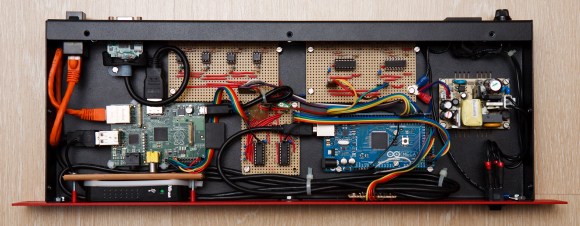
Not just another pretty enclosure, this shiny little red box is [Lauri’s] stand-alone MIDI workstation. The build uses an Arduino Mega 2560 to handle the MIDI inputs and outputs. It communicates via serial with a Raspberry Pi that acts as a sequencer and oversees all user interactions. The Pi’s SD card offers convenient storage for your work, though we wish it was easily ejectable from the front of the box and not trapped under the hood. [Lauri’s] RPC also squeezes in the necessary USB hub for the RasPi and an HDMI-to-VGA converter. As an all-in-one solution, this is a sleek little box that–once paired with some software for arpeggiators, chord harmonies, and scales–will be a handy MIDI sequencer with robust control ready to be conveniently mounted on your rack.

Now all you’ll need is something to plug in. Why not check out the custom MIDI recorder we featured last week, or the organ-to-MIDI keyboard conversion for inspiration.

[Thanks Teemu]