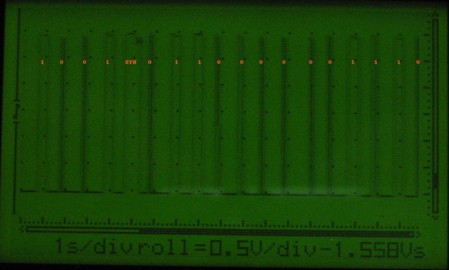
Reverse Engineering Silicon Logic

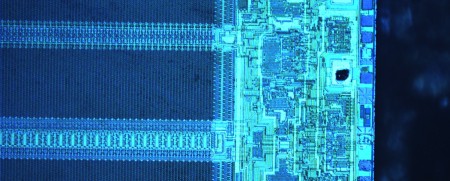
[Karsten Nohl] has recently joined the team on Flylogic’s blog. You may remember him as part of the team that reverse engineered the crypto in MiFare RFID chips. In his first post, he starts out with the basics of identifying logic cells. By studying the specific layout of the transistors you can reproduce the actual logic functions of the chip. The end of post holds a challenge for next week (pictured above). It has 34 transistors, 3 inputs, 2 outputs, and time variant behavior. Also, check out the Silicon Zoo which catalogs individual logic cells for identification.

LED Coffee Table

Spark Fun’s centerpiece at Maker Faire back in May was this LED coffee table. They just recently posted about how it was constructed. The surface is made from 64 8×8 RGB LED matrix boards totaling 4096 LEDs. The eight rows are connected to a custom router board so that one SPI line can control the entire display. The main microcontroller is an Olimex LPC2106 dev board. It runs a four player cooperative pong game where multiple balls are added over time. Each player gets a classic Atari paddle for control. You can see a video of the table running a screensaver after the break. Continue reading “LED Coffee Table”

A Console For Retro Games

Like many nerds, we have our share of retro video games and nonworking consoles lying around. Every so often we feel like dragging one out and hoping it works.. Luckily for us, the Super Genintari is available to fulfill our fantasies of beating Ghosts ‘N Goblins. The Super Genintari is an Atari 2600, NES, SNES and Sega Genesis all rolled into one; you can even put in four cartridges at once and hook it up to your television with a simple AV cable.

[via DVICE]

Large Hadron Collider Roundup

[youtube=http://www.youtube.com/watch?v=qQNpucos9wc]

The Large Hadron Collider was a success and it didn’t destroy the world. We have to admit, we were a little bit worried about the possibility of generating black holes but were soothed by scientists’ reassurances that we would still exist, and this self-explanatory website. We’re also kind of hoping to build our own. PHD Comics visits CERN to learn all about the experiment. Xkcd prepares for the end times with a new friend. The curious can explore some amazing imagery of the LHC, and read about the best-and-worst-case scenarios, and what scientists are hoping for, or monitor progress via webcam. The celebratory will listen to appropriate music, consume inspired science fiction, and drink to the Large Hadron Collider and its success.

Turn Your Playstation 3 Into Linux-based Lab Equipment

In a two-part series called “PS3 Fab-to-lab” on IBM’s awesome developerWorks website, [Lewin] explains how to use the Cell Broadband Engine in a PS3 to create an audio-bandwidth spectrum analyzer and function generator. The set up consists of Yellow Dog Linux, an NTSC television, and an external USB sound card to provide the inputs of the spectrum analyzer and the outputs of the function generator. The sound card driver is written to simply capture or send the info in question (audio range only) and the NTSC television as the graphical interface. This hack involves a lot of coding with hardly any example code provided. The article is more of a guide than anything. If anyone gets this working, let us know!

[via Digg]

[photo: Malcom Tredinnick]

PC Stands For “Patriotic Computer”

[vimeo http://vimeo.com/1709336%5D

On the seventh anniversary of the events of September 11, 2001, it’s important to reflect on patriotism, nationalism, and responsibility to your country and motherland. This USB memorial lets us think about our contributions to our great nation. Or it’s just a tribute to misguided nationalism and capitalism via insipid flag waving. Instructions are available at Instructables.

[via F.A.T.]

3D Mineral Printer

The last few days many people have been talking about the USC’s contour printer. It’s a device that prints concrete outlines with the hopes of eventually printing entire houses. Caterpillar has decided to back the initiative.

It reminded us of a project we came across at Maker Faire. [Leif Ames], [Matthew Bowman], [Marides Athanasiadis], and [Terrell Edwards] built a 3D Mineral Printer as their senior engineering design project at UC Santa Cruz. The printer works by first laying down a layer of dry concrete powder. It then selectively wets the powder where it wants a solid form. The reaction doesn’t require air to dry, so the next layer can be applied immediately. The printer only creates contours and the team imagines this being used to create temporary casting molds. The build envelop is nearly a cubic meter. When we talked to them, they were experimenting with many different types of material mixes. A video of the first test is after the break. Continue reading “3D Mineral Printer”