120 Second Shower Cap

Do you have a couple of minutes? Literally and precisely, two minutes. That’s how long these ten songs play. So what? A short song is not new, but these ten songs are part of a campaign to encourage residents of Cape Town, South Africa to cap their showers at one-hundred-twenty seconds. Some of us do not have to worry about droughts or water bills, but most of us are concerned about one or both of those, and this ingenious campaign alerted people to the problem, gave them the means to time themselves, and made it pleasant, not oppressive. The songs are freely available, and one might even pique your listening tastes from the biggest stars in South Africa.

So, where is the hack? Some of us have experimented with egg timers on the towel rack, timers on the showerhead, servos on the faucet knobs, or occupancy sensors, but those are strong-arm techniques or only for measuring, not regulating water use. These songs attack the most viable vector, the showerer. Or is it showeree? Telling people there is a drought is one thing, but giving them the ability to regulate themselves in such a way that they comply is a hacker’s approach. The songs on the site do not autoplay so there will be no hanging out under the water spray to find the best song. Which is your favorite?

You Can’t Build A Roland TR-808 Because You Don’t Have Faulty Transistors

That headline sounds suspect, but it is the most succinct way to explain why the Roland TR-808 drum machine has a very distinct, and difficult to replicate noise circuit. The drum machine was borne of a hack. As the Secret Life of Synthesizers explains, it was a rejected part picked up and characterized by Roland which delivers this unique auditory thumbprint.

Pictured above is the 2SC828-R, and you can still get this part. But it won’t function the same as the parts found in the original 808. The little dab of paint on the top of the transistor indicates that it was a very special subset of those rejected parts (the 2SC828-RNZ). A big batch of rejects were sold to Roland back in the 1970’s — which they then thinned out in a mysterious testing process. What was left went into the noise circuit that gave the 808 its magical sizzle. When the parts ran out, production ended as newer processes didn’t produce the same superbly flawed parts.

This is an incredible story that was highlighted in 808, a documentary premiered at SXSW back in 2015. The film is currently streaming on Amazon Prime (and to rent everywhere else) and is certainly worth your time just to grasp how seminal this drum machine has been in hip hop and several other music genres.

For modern product developers, betting your production on a batch of reject parts is just batty. But it was a very different time with a lot fewer components on the market. What worked, worked. You do have to wonder how you stumble upon the correct trait in an obscure batch of reject parts? Looks like we’ll be adding Ikutar Kakehashi’s book I Believe in Music: Life Experiences and Thoughts on the Future of Electronic Music by the Founder of the Roland Corporation to our reading list.

[via EMSL]

The Boldport Cordwood And Cuttlefish, Together As A Guitar Tuner

As regular readers will know, here at Hackaday we are great enthusiasts for the PCB as an art form. On a special level of their own in that arena are the Boldport kits from [Saar Drimer], superlative objets d’art that are beautifully presented and a joy to build.

The trouble some people find with some of their Boldport kits though is that they are just too good. What can you do with them, when getting too busy with hacking them would despoil their beauty? [Paul Gallagher] has the answer in one case, he’s used not one kit but two of them as for a guitar tuner project.

At its heart is a Boldport Cuttlefish ATmega328 development board, and for its display it uses a Cordwood Puzzle as an LED array. All the details are available on a GitHub page, and it’s a modified version of an Arduino guitar tuner he found on Instructables. In particular he’s using a different pre-amp for an electret microphone, and a low-pass filter with a 723Hz cut-off to reduce harmonic content that was confusing the Arduino’s algorithm.

The result is a simple-to-use device with an LED for each string of his guitar, which you can see in the very short YouTube clip below. It joins many other tuners we’ve featured over the years, of which just one is this ATmega168-powered project with MIDI-out.

Continue reading “The Boldport Cordwood And Cuttlefish, Together As A Guitar Tuner”

PiPod: A Raspberry Pi Zero Portable Music Player

[Bram] wasn’t satisfied with the portable music playback devices that were currently available. He craved an offline music player that had a large storage capacity but found that this was only available in high-end, off-the-shelf options, which were far too expensive. [Bram] decided to make his own, powered by a Raspberry Pi zero. After building an initial prototype, the design was iterated a few times, with the latest version featuring a BOM cost of roughly €80.

The whole project is open source, with hardware and software files available on the project GitHub. A 2.2″ TFT displays the UI, which is of course completely customisable. Everything is squashed into a 3D printed case, which has the smallest form factor possible whilst retaining a decent amount of battery life. The electronics are what you’d expect: a boost converter to produce 5 V for the Pi from the 3.7V battery, a charge controller and a battery protection circuit. As a bonus, the battery voltage is monitored with a 12-bit ADC which reports to the Pi, enabling it to do a safe shutdown at low voltage, and display battery level on the UI.

Since the whole purpose of the device is to play audio, onboard filtered PWM wasn’t going to cut it, so instead a 24-bit DAC talks to the Pi via I2S. The audio player backend is VLC, so there’s support for plenty of different file types. A disc image of the whole system is available with everything pre-configured, and you can even buy the assembled PCB from Tindie.

Want to keep the look and feel of your old iPod? We covered an impressive restoration of a 6th gen model, upgrading the storage and battery significantly.

Let The Musical Instrument Challenge Begin!

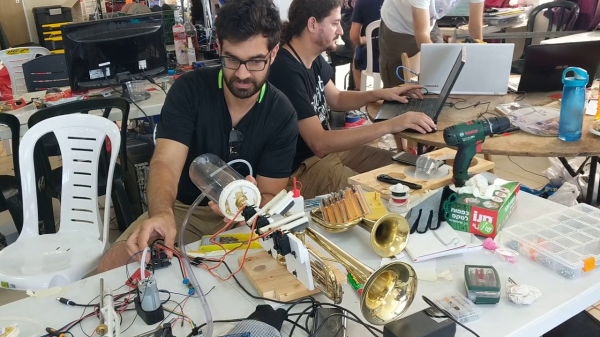
Today is the start of the Musical Instrument Challenge. This newest part of the 2018 Hackaday Prize asks you to go far beyond what we’re used to seeing from modern musical instrumentation. Twenty entries will be awarded $1,000 each and go on to compete in the final round of the Hackaday Prize.

Imagine music without the electric guitar amp, violin, two turntables and a microphone, the electric drum pad, or in the absence of autotune. Maybe that last one made you groan, but autotune is a clever use of audio manipulation and when used to augment the music (rather than just to correct off-key voices) it shows its value as a new tool for creativity.

Musicians have always been hackers. The story of Brian May’s handmade guitar — the Red Special — is one of not being able to buy it, so he built it. Unlocking emotion in the listener has always meant finding new and different ways to use sound. This is a natural motivator to re-imagine and invent new ways of doing that. That first hand-built guitar got him in the door, but iterative improvements to the tremolo bar, the pickups, and even just the mechanical engineering of the neck made it a new instrument that you’ve heard in every Queen performance since.

So what’s next? What does a brand new instrument, interface, tool, or trick look like? That’s what we want to see from this Hackaday Prize challenge. From instrument makers to the people who write software for sampling, synthesizing, sequencing, and manipulating sound, we’re looking for things that let others make music. These creations are the tools of the trade that help more people unlock their musical creativity. Show off your work by sharing all the details of your design, and demonstrate the music you can make with it.

You have until October 8th to put your entry up on Hackaday.io. The top twenty entries will each get $1,000 and go on to the finals where cash prizes of $50,000, $20,000, $15,000, $10,000, and $5,000 await.

MIDI Association Releases Spec For TRS Jacks

The MIDI spec was released in 1983, and for more than thirty years every synthesizer, drum machine, and piece of computer hardware with MIDI has sported an enormous DIN-5 jack on the back. Why did they choose such a large connector? Well, MiniDIN connectors hadn’t even been invented yet, and today even MiniDIN connectors are rarely-seen, obsolete connectors.

In the last decade, MIDI has found its way into some very small machines. Those Pocket Operators have MIDI sync, you can control a Game Boy with MIDI using the right hardware, and the cute little Korg synths also have MIDI tucked away in there somewhere. You can’t put a DIN-5 jack on those things, leading to some weird implementations of MIDI over non-standard connectors.

Now the MIDI Association has weighed in on the situation. There’s now a spec for MIDI over 2.5mm and 3.5mm TRS jacks. In just a few short decades, you’ll be able to connect MIDI gear with an audio aux cable.

Although there are five connectors in a DIN-5 jack, most implementations use only two connectors to send and receive data. Synth manufacturers have capitalized on this fact and cheap TRS connectors to build their own implementation of MIDI using smaller connectors, sometimes with incompatable pinouts.

Now, though, there’s a standard. For TRS connectors, the tip is pin 5 on the DIN-5, the ring is pin 4, and the sleeve is pin 2. It sends and receives data to synths and drum machines from 1983, and it doesn’t use gigantic connectors.

The only caveats to the new MIDI standard is that 2.5mm TRS connectors are recommended, and that protection circuitry is strongly recommended in the case a headphone driver is inevitably connected to a MIDI device. Other than that, everything’s coming up roses, and this opens up the door to MIDI jacks that are much, much easier to source.

Ask Hackaday Answered: The Tale Of The Top-Octave Generator

We got a question from [DC Darsen], who apparently has a broken electronic organ from the mid-70s that needs a new top-octave generator. A top-octave generator is essentially an IC with twelve or thirteen logic counters or dividers on-board that produces an octave’s worth of notes for the cheesy organ in question, and then a string of divide-by-two logic counters divide these down to cover the rest of the keyboard. With the sound board making every pitch all the time, the keyboard is just a simple set of switches that let the sound through or not. Easy-peasy, as long as you have a working TOG.

I bravely, and/or naïvely, said that I could whip one up on an AVR-based Arduino, tried, and failed. The timing requirements were just too tight for the obvious approach, so I turned it over to the Hackaday community because I had this nagging feeling that surely someone could rise to the challenge.

The community delivered! Or, particularly, [Ag Primatic]. With a clever approach to the problem, some assembly language programming, and an optional Arduino crystalectomy, [AP]’s solution is rock-solid and glitch-free, and you could build one right now if you wanted to. We expect a proliferation of cheesy synth sounds will result. This is some tight code. Hat tip!

Squeezing Cycles Out of a Microcontroller

Let’s take a look at [AP]’s code. The approach that [AP] used is tremendously useful whenever you have a microcontroller that has to do many things at once, on a rigid schedule, and there’s not enough CPU time between the smallest time increments to do much. Maybe you’d like to control twelve servo motors with no glitching? Or drive many LEDs with binary code modulation instead of primitive pulse-width modulation? Then you’re going to want to read on.

There are two additional tricks that [AP] uses: one to fake cycles with a non-integer number of counts, and one to make the AVR’s ISR timing absolutely jitter-free. Finally, [Ag] ended up writing everything in AVR assembly language to make the timing work out, but was nice enough to also include a C listing. So if you’d like to get your feet wet with assembly, this is a good start.

In short, if you’re doing anything with hard timing requirements on limited microcontroller resources, especially an AVR, read on!

Continue reading “Ask Hackaday Answered: The Tale Of The Top-Octave Generator”