Taking A Guitar Pedal From Concept Into Production

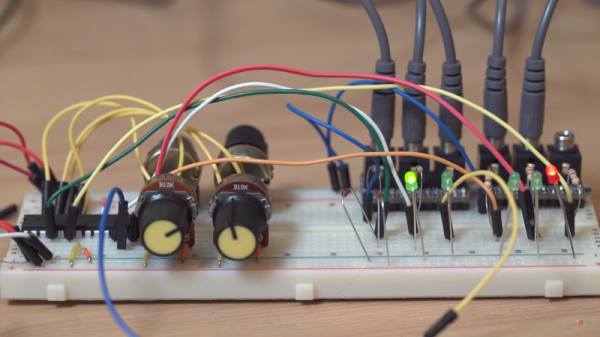
Starting a new project is fun, and often involves great times spent playing with breadboards and protoboards, and doing whatever it takes to get things working. It can often seem like a huge time investment just getting a project to that functional point. But what if you want to take it to the next level, and take your project from a prototype to a production-ready form? This is the story of how I achieved just that with the Grav-A distortion pedal.

Why build a pedal, anyway?

The author, shown here with bandmates.

A long time ago, I found myself faced with a choice. With graduation looming on the horizon, I needed to decide what I was going to do with my life once my engineering degree was squared away. At the time, the idea of walking straight into a 9-5 wasn’t particularly attractive, and I felt like getting back into a band and playing shows again. However, I worried about the impact an extended break would have on my potential career. It was then that I came up with a solution. I would start my own electronics company, making products for musicians. Continue reading “Taking A Guitar Pedal From Concept Into Production”

Guitar Game Plays With Enhanced Realism

There’s a lot more to learning how to play the guitar than just playing the right notes at the right time and in the right order. To produce any sound at all requires learning how to do completely different things with your hands simultaneously, unless maybe you’re a direct descendant of Eddie Van Halen and thus born to do hammer ons. There’s a bunch of other stuff that comes with the territory, like stringing the thing, tuning it, and storing it properly, all of which can be frustrating and discouraging to new players. Add in the calluses, and it’s no wonder people like Guitar Hero so much.

[Jake] and [Jonah] have found a way to bridge the gap between pushing candy colored buttons and developing fireproof calluses and enough grip strength to crush a tin can. For their final project in [Bruce Land]’s embedded microcontroller design class, they made a guitar video game and a controller that’s much closer to the experience of actually playing a guitar. Whether you’re learning to play for real or just want to have fun, the game is a good introduction to the coordination required to make more than just noise.

Continue reading “Guitar Game Plays With Enhanced Realism”

The Tiniest Of 555 Pianos

The 555 timer is one of that special club of integrated circuits that has achieved silicon immortality. Despite its advanced age and having had its functionality replicated and superceded in almost every way, it remains in production and is still extremely popular because it’s simply so useful. If you are of A Certain Age a 555 might well have been the first integrated circuit you touched, and in turn there is a very good chance that your project with it would have been a simple electric organ.

If you’d like to relive that project, perhaps [Alexander Ryzhkov] has the answer with his 555 piano. It’s an entry in our coin cell challenge, and thus uses a CMOS low voltage 555 rather than the power-hungry original, but it’s every bit the classic 555 oscillator with a switchable resistor ladder you know and love.

Physically the piano is a tiny PCB with surface-mount components and physical buttons rather than the stylus organs of yore, but as you can see in the video below the break it remains playable. We said it was tiny, but some might also use tinny.

Continue reading “The Tiniest Of 555 Pianos”

A Bluetooth Speaker For Babies

[Mike Clifford] of [Modustrial Maker] had not one, not two, but five friends call him to announce that their first children were on the way, and he was inspired to build them a Bluetooth speaker with a unique LED matrix display as a fitting gift. Meant to not only entertain guests, but to audio-visually stimulate each of their children to promote neurological development.

Picking up and planing down rough maple planks, [Clifford] built a mitered box to house the components before applying wood finish. The brain inside the box is an Arduino Mega — or a suitable clone — controlling a Dayton Bluetooth audio and 2x15W amp board. In addition to the 19.7V power supply, there’s a step down converter for the Mega, and a mic to make the LED matrix sound-reactive. The LED matrix is on a moveable baffle to adjust the distance between it and a semi-transparent acrylic light diffuser. This shifts the light between sharp points or a softer, blended look — perfect for the scrolling Matrix text and fireplace effects! Check it out!

Continue reading “A Bluetooth Speaker For Babies”

Rock Out With The Nod Bang

In our years here on Hackaday, we’ve seen our fair share of musical hacks. They even have their own category! (Pro Tip – you can find it under the drop down menu in the Categories section). But this one takes the cake. [Andrew Lee] is a student at New York University who had a task of creating a project for his physical computing class. In about 60 days time; he went from dinner napkin sketch to working project. The project is quite interesting – he’s made an instrument that plays music as you move your head.

It works as you would expect. An accelerometer in the user’s headphones feed data to an arduino. There are four (3D printed of course) buttons that are used to select the the type of audio being played. The operation goes as such:

  1. Press button.
  2. Bang head.

[Andrew] speaks of a particular satisfaction of hearing the music play in sync with the rhythm of head movement.  Be sure to check out the video below to see the Nod Bang in action.

Continue reading “Rock Out With The Nod Bang”

FrankenKorg: The Modern Remote Keyboard

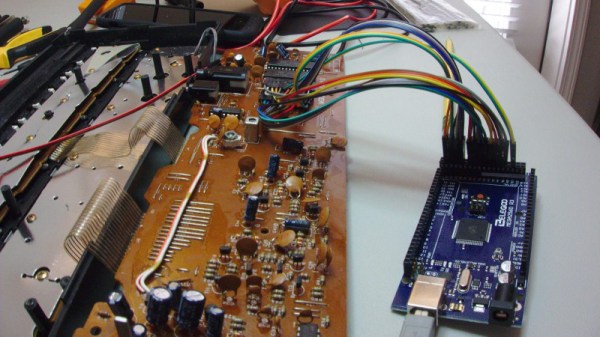
On a dreary night in November, [Smecher] collected the instruments of electronic life around him to infuse a musical spark into FrankenKorg — a resurrected keytar.

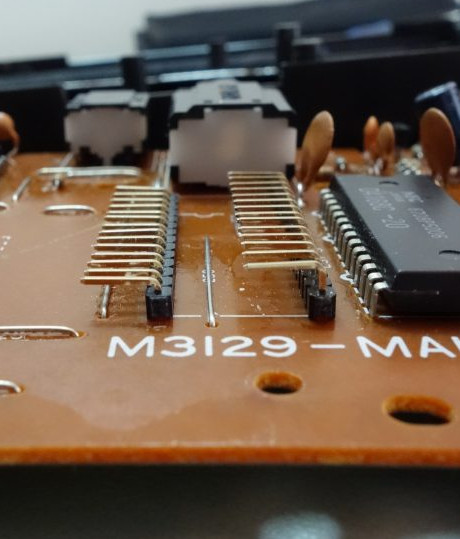
This hack is a “re-braining” of a RK-100 Korg Keytar, replacing the original circuits with an ATMega32 — the original functionality and appearance are preserved allowing any restored version of the original boards to be seamlessly re-integrated. In light of that, the original boards were ditched after a brief investigation, and a haphazard building process on a protoboard began. Three LS138 3-8 demuxers that accompany the ATMega handle scanning the keys since there weren’t enough pins on the ATMega alone for all the Korg’s features. Check out [Smecher]’s breakdown of his process in the video after the break!

Continue reading “FrankenKorg: The Modern Remote Keyboard”

Bluetooth Speaker In A Bag

[VanTourist] — irked by what he sees as complicated project videos — has demonstrated that you can build a high quality, multi-function Bluetooth speaker inside three hours.

Using simple hand tools — primarily a crimper, wire stripper, razor cutter and some glue — he’s packed this repurposed GoPro accessory bag with quite a bit of tech. The main components are a Bluetooth amplifier with a spiffy knob, and a pair of 15W speakers, but he’s also added a 1W LED flashlight, 1A and 2.1A charging ports, a battery charge monitor display, and pilot cover toggle switches for style points. Despite all that crammed into the bag, there’s still a bit of room left to pack in a few possessions! You can check out the build pictures here, or the video after the break.

Continue reading “Bluetooth Speaker In A Bag”