Hackaday Prize Entry: Zappotron Super Sequencer

If you fancy a go at circuit bending, where do you start? Perhaps you find a discarded musical toy at a junk sale and have a poke around, maybe you find the timing circuit and pull it a little to produce a pitch bend. Add a few wires, see what interesting things you can do connecting point A to point B, that kind of thing.

Many of us have spent an entertaining afternoon playing in this way, though it’s probable few of us have achieved much of note. [Russell Kramer] however must have persevered to become a circuit bender par excellence, as his latest project is one of the most accomplished circuit bending projects we’ve seen.

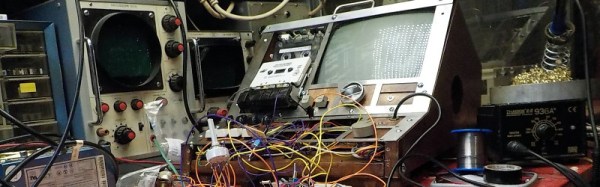
Zappotron Super Sequencer is an analog sequencer. Except that sentence simply doesn’t convey what it really is, it’s an analog sequencer with four sound sources: two tape decks, a 4046 oscillator, and a circuit-bent spelling tutor toy, and its sequencer component is controlled with a Nintendo light gun and a CRT screen.

You might be thinking that you could do all that with relative ease on a modern single board computer, but what makes this project so special is that he’s achieved it using only logic chips and diode logic gates, not a microprocessor in sight save for the one in the spelling toy. The build log goes through all the circuitry in detail, and we have to tell you it’s a work of art that demonstrated his mastery of both analog circuitry and digital logic.

To cap it all off he’s mounted it in a gloriously retro console, complete with retro embossed labeling. This is a high-quality item that we’d suggest you take a while to read about in detail. He’s posted a video demonstration if you’d like to see it in action, we’ve posted it below the break.

Continue reading “Hackaday Prize Entry: Zappotron Super Sequencer”
Musical string shooter

Musical String Shooter Makes Sound Visible

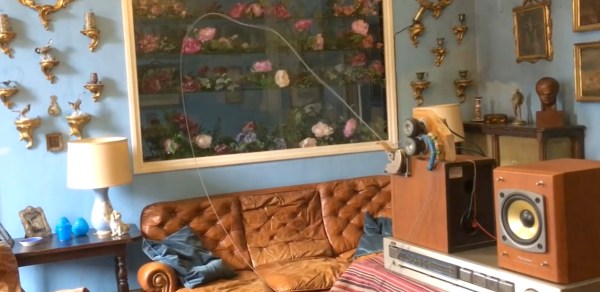
One reason we really like [Rulof]’s hacks is that he combines the most unlikely things to create something unexpected. This time he makes a fast-moving loop of cotton string undulate in time to music.

To do this he uses cotton string, hard drive parts, two wheels from a toy Ferrari, two DC motors, a plastic straw,  a speaker, and an amplifier.  The loop of string sits in the air by being rapidly rotated in between the two wheels. The hard drive parts, driven by the amplifier, give the string a tap with an amplitude, and at a time determined by the music. The result is music made visible in the air in front of you, or in his living room in this case. Check out how he made it, and see it in action in the video below the break.

Continue reading “Musical String Shooter Makes Sound Visible”

The Smallest Wave Blaster Card

In the early 90s, the Creative Sound Blaster was the soundcard. It wasn’t the absolute best sounding card on the market, but it quickly became the defacto standard and delivered good sound at the right price. It relied primarily on the Yamaha OPL-3 FM synthesis chip, but if you were feeling spendy, you could pimp it out with a Wave Blaster add-on card, which essentially bolted a sample synthesis engine onto the card. This gave the card a broad palette of sampled instruments with which to play MIDI tunes all the sweeter, so you could impress your grade school chums who came over to play DOOM.

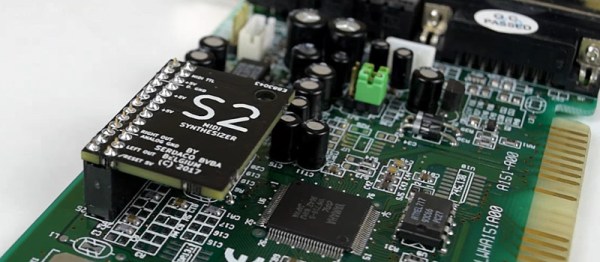
It’s now 2017, if you hadn’t checked the calendar, and Sound Blasters from yesteryear are only going to go further upward in price. It goes without saying that add-on daughterboards and accessories are even rarer and are going to be priced accordingly. So, if you’re building a vintage gaming rig and are desperate for that sample-synth goodness, [Serdashop] are here to help with their latest offering, the Dreamblaster S2.

It’s reportedly the smallest Wave Blaster add-on board available, which is awesome. If you’re sticking it on top of your Sound Blaster 16, yes, it’s pointless – you’re not exactly short on room. But if you want to integrate this with a compact microcontroller project? Size matters. Yes, you can feed this thing MIDI signals and it’ll sing for you. A hot tip for the uninitiated: MIDI speaks serial, just like everything and everyone else. Your grandma learned to speak it in the war, you know.

Your options for hooking this up are either slotting it into a Wave Blaster compatible card, or buying the carrier board that allows you to use it with a Game Port, in addition to custom-wiring it to your own hardware. We’d love to see this as a HAT for the Raspberry Pi Zero. Do it, send it in and we’ll write it up.

We’ve seen [Serdashop]’s hardware here before – namely, the earlier Dreamblaster X2. Video below the break.

Continue reading “The Smallest Wave Blaster Card”

[Joe Grand’s] Toothbrush Plays Music That Doesn’t Suck

It’s not too exciting that [Joe Grand] has a toothbrush that plays music inside your head. That’s actually a trick that the manufacturer pulled off. It’s that [Joe] gave his toothbrush an SD card slot for music that doesn’t suck.

The victim donor hardware for this project is a toothbrush meant for kids called Tooth Tunes. They’ve been around for years, but unless you’re a kid (or a parent of one) you’ve never heard of them. That’s because they generally play the saccharine sounds of Hannah Montana and the Jonas Brothers which make adults choose cavities over dental health. However, we’re inclined to brush the enamel right off of our teeth if we can listen to The Amp Hour, Embedded FM, or the Spark Gap while doing so. Yes, we’re advocating for a bone-conducting, podcasting toothbrush.

[Joe’s] hack starts by cracking open the neck of the brush to cut the wires going to a transducer behind the brushes (his first attempt is ugly but the final process is clean and minimal). This allows him to pull out the guts from the sealed battery compartment in the handle. In true [Grand] fashion he rolled a replacement PCB that fits in the original footprint, adding an SD card and replacing the original microcontroller with an ATtiny85. He goes the extra mile of making this hack a polished work by also designing in an On/Off controller (MAX16054) which delivers the tiny standby current needed to prevent the batteries from going flat in the medicine cabinet.

Check out his video showcasing the hack below. You don’t get an audio demo because you have to press the thing against the bones in your skull to hear it. The OEM meant for this to press against your teeth, but now we want to play with them for our own hacks. Baseball cap headphones via bone conduction? Maybe.

Update: [Joe] wrote in to tell us he published a demonstration of the audio. It uses a metal box as a sounding chamber in place of the bones in our head.

Continue reading “[Joe Grand’s] Toothbrush Plays Music That Doesn’t Suck”

How To Play The Bass With Marbles

Stringed instruments make noise from the vibrations of tuned strings, using acoustic or electronic means to amplify those vibrations to the point where they’re loud enough to hear. The strings are triggered in a variety of ways – piano strings are hit with hammers, guitar strings are plucked, while violin strings are bowed. Meanwhile, [Martin] from the band [Wintergatan] is using marbles to play a bass guitar.

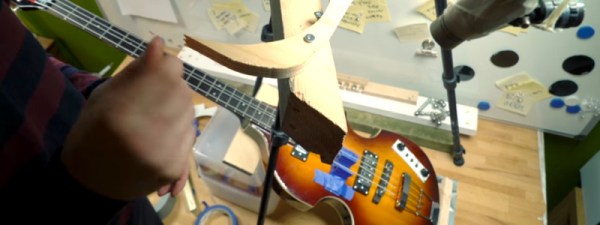
[Martin] starts out with a basic setup. The bass guitar is placed on the workbench, while a piece of wood is taped to a tripod. The wood has a hole drilled through it, and marbles are dropped through the aperture in an attempt to get them to land on the string. Plastic containers are used to easily alter the angle the bass guitar sits at, relative to the bench, while an acrylic guide sits around the string to try to guide the marbles in the desired direction. These guides are important to make sure the marbles hit the top of the string, and bounce cleanly in the desired direction afterwards.

The initial setup is too inconsistent, so [Martin] places a notch in the wood and builds a lever system to hold the marbles and then release them in a controlled manner. [Martin] then checks that the system works by analysing footage of the marble drop with slow motion video.

The video covers the CAD design of an eight-slot guide so the four strings of the bass can be played more rapidly than in their previous build. Two guides per string allow each string to play two notes in quick succession without having to worry about marble collisions from playing too quickly.

It’s a great build, and we’ve seen [Wintergatan]’s work before – namely, the incredible build that was the original Marble Machine.

Thanks to [Tim Trzepacz] for the tip!

MIDI Drawings Paint With Piano Keyboards

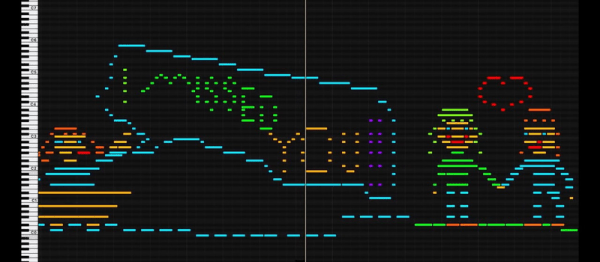
Musician [Mari Lesteberg] is making music that paints pictures. Or maybe she’s making pictures that paint music. It’s complicated. Check out the video (embedded below) and you’ll see what we mean. The result is half Chinese scroll painting, and half musical score, and they go great together.

Lots of MIDI recorders/players use the piano roll as a model for input — time scrolls off to the side, and a few illuminated pixels represent a note played. She’s using the pixels to paint pictures as well: waves on a cartoon river make an up-and-down arpeggio. That’s a (musical) hack. And she’s not the only person making MIDI drawings. You’ll find a lot more on reddit.

Of course, one could do the same thing with silent pixels — just set a note to play with a volume of zero — but that’s cheating and no fun at all. As far as we can tell, you can hear every note that’s part of the scrolling image. The same can not be said for music of the black MIDI variety, which aims to pack as many notes into a short period of time as possible. To our ears, it’s not as beautiful, but there’s no accounting for taste.

It’s amazing what variations we’re seeing in the last few years on the ancient piano roll technology. Of course, since piano rolls are essentially punch-cards for musical instruments, we shouldn’t be too surprised that this is all possible. Indeed, we’re a little bit surprised that new artistic possibilities are still around. Has anyone seen punch-card drawings that are executable code? Or physical piano rolls with playable images embedded in them?

Continue reading “MIDI Drawings Paint With Piano Keyboards”

Teensy Laser Harp Has Big Sound

[Johan] has slipped down the rabbit hole of making musical instruments. His poison? Laser harp MIDI controllers. Having never made one before, he thought he would start small and then iterate using what he learned. Fortunately for us, [Johan] documented the process over on .io, essentially creating a step-by-step guide for building a simple but powerful 16-note laser harp.

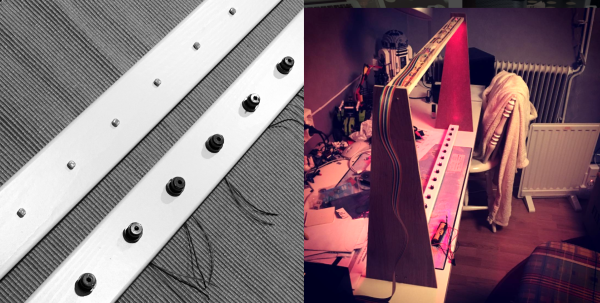
Laser Harp I is built around a Teensy 3.2 and, of course, lasers pointed at LDRs. [Johan] used fairly low-power laser modules, which are slightly less blinding if you accidentally look at them for a second, but should still be taken seriously. He added four potentiometers to control the sensitivity, scale, octave, and the transposition. The sensitivity pot essentially accounts for the ambient light in the room. Although it only has 16 notes, Laser Harp I is ready to rock with over 30 different scales to choose from. Check out the brief demo that [Johan] put up on his Instagram.

If you try to build your own laser harp and get lost trying to follow [Johan]’s instructions, don’t worry. His well-commented code and lovely schematic will undoubtedly save you. Then you can move on to open-beam designs.