Tiny-TS: Just How Small Can A Playable Synethesiser Get?

The early electronic synthesizers were huge machines, racks of electronic modules that filled entire rooms. Integration of electronics over time successively reduced them, first to the size of a large piece of furniture, then to  tabletop consoles, to standalone keyboards, and to small MIDI black boxes taking their instructions from another instrument or a computer. The original mass of discrete electronics had been reduced to a pile of ICs, then chipsets, then finally single ICs and software implementations on microcomputers.

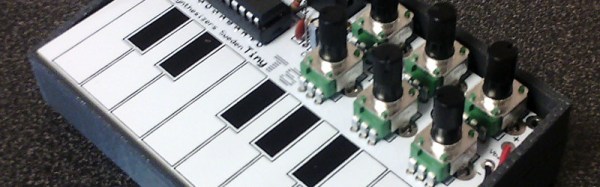
It’s thus possible to make a synthesizer these days that is pretty small. If you can fit a microcontroller in it, you can fit a synth into it. But how about a playable synthesizer? One with a keyboard, on which you can give a recital? How small can you make one of those? [Jan Ostman] has a contender for the smallest playable synthesizer prize with his Tiny-TS, a credit-card synthesiser with a one-octave capacitive keyboard and analog controls for synthesis parameters.

The heart of the synth is an ATMega328, for which he provides the software. The parameters adjustable by a series of pots are listed as DCO: Coarse pitch and Double, DCF: Filter peak and ENVmod, and ENV: Attack and Release affecting amplitude. You can build your own, or he tells us that he has the project up as a Kickstarter campaign if you fancy the chance of buying one ready-made.

In case you are wondering, it doesn’t sound too bad. Some minimalist synths sacrifice the breadth of sounds they can create, but not this one. He takes it through its paces in a YouTube video which we’ve put below the break.

Continue reading “Tiny-TS: Just How Small Can A Playable Synethesiser Get?”

The Nest: Album Release Hidden In A Rock

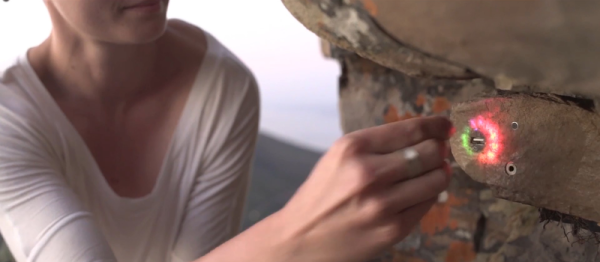
First there were vinyl records, then came cassettes, CDs, those failed audio-on-DVD formats, and then downloads. To quote the band, [Bateleur], “you can’t pay someone to take a CD these days.” So how do you release your new album? By hiding a Raspberry Pi in a semi-transparent fake rock on a mountainous cliff, and requiring a secret whistle to enable it, naturally.

Once activated, you’ll be able to plug into the USB port and download the album, or sit there on a remote hillside cliff overlooking the ocean and enjoy the new tunes. Because there’s a headphone jack in the rock, naturally. Besides being a cool hack, we think that putting people in the right physical and mental space for a serious listening is brilliant. Watch the video embedded below for an idea of the making of and a view from the site.

Continue reading “The Nest: Album Release Hidden In A Rock”

Quasimotor? A Robot Bell Ringer

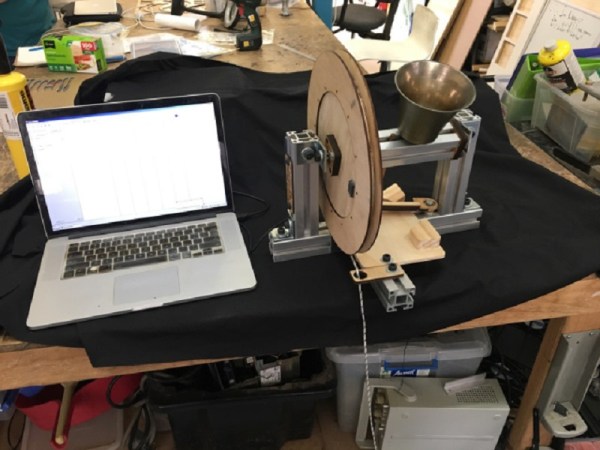
In large churches that still use real bells in their bell towers, a large number of them ring bells using a method called full circle ringing. In order to get the bells to sound at exactly the right time, the bells are rung by swinging the entire bell in an almost complete 360-degree arc. This helps to mitigate the fact that often times, the bells weigh more than the person ringing the bells. However, if you don’t have access to a belfry, you can practice ringing bells using this method with your own full circle bell simulator.

The frame for the bell was built from some leftover aluminum extrusion and allows the bell to easily swing on some old skateboard bearings. The mechanism is electrically controlled, too, using a hall effect sensor and a USB adapter so that it can be interfaced with a computer running a virtual bell ringing suite. Once some timing issues are worked out, the bell is all set up and ready to practice ringing changes.

If you’re as fascinated as we are to find that there are entire software suites available to simulate bell ringing, and an entire culture built around something that most of us, perhaps, wouldn’t have given a second thought to outside of walking past a church on a Sunday, there have been a surprising number of other bell-related projects over the years. Bells have been given MIDI interfaces and robotified, and other church instruments like a pipe organ have been created almost from scratch.

Salvaged Scope Lets You Watch The Music

Everyone likes a good light show, but probably the children of the 60s and 70s appreciate them a bit more. That’s the era when some stereos came with built-in audio oscilloscopes, the search for which led [Tech Moan] to restore an audio monitor oscilloscope and use it to display oscilloscope music.

If the topic of oscilloscope music seems familiar, it may be because we covered [Jerobeam Fenderson]’s scope-driving compositions a while back. The technique will work on any oscilloscope that can handle X- and Y-axis inputs, but analog scopes make for the best display. The Tektronix 760A that [Tech Moan] scrounged off eBay is even better in that it was purpose-built to live in an audio engineer’s console for visualizing stereo audio signals. The vintage of the discontinued instrument isn’t clear, but from the DIPs and discrete components inside, we’ll hazard a guess of early to mid-1980s.  The eBay score was a bargain, but only because it was in less that perfect condition, and [Tech Moan] wisely purchased another burned out Tek scope with the same chassis to use for spares.

The restored 760A does a great job playing [Jerobeam]’s simultaneously haunting and annoying compositions; it’s hard to watch animated images playing across the scope’s screen and not marvel at the work put into composing the right signals to make it all happen. Hats off to [Tech Moan] for bringing the instrument back to life, and to [Jerobeam] for music fit for a scope.

Continue reading “Salvaged Scope Lets You Watch The Music”

The Most Flexible Synthesizer Is DIY, Raspberry Pi

[Ivan Franco] sent us this great synthesizer project that he’s working on. Or maybe it’s more like a synthesizer meta-project: a synthesizer construction set. You see, what Pryth has is a Raspberry Pi inside that’s running a custom distribution that includes SuperCollider to generate the sound, OSC for the communication layer, and a Teensy with up to 80 (!) multiplexed analog inputs that you’ll connect up to whatever hardware you desire.

Continue reading “The Most Flexible Synthesizer Is DIY, Raspberry Pi”

Raspberry Pi Radio Makes The Sweet Music Of Bacteria

We’ve noticed a lot of musical groups are named after insects. Probably has something to do with the Beatles. (If you study that for a while you’ll spot the homophonic pun, and yes we know that the Crickets inspired the name.) There’s also Iron Butterfly, Adam Ant, and quite a few more. A recent art project by a Mexican team — Micro-ritmos — might inspire some musical groups to be named after bacteria.

The group used geobacter — a kind of bacteria found in soil — a Raspberry Pi, an Arduino, and a camera to build an interesting device. As it looks at the bacteria and uses SuperCollider to create music and lighting from the patterns. You can see a video of Micro-ritmos, below.

Continue reading “Raspberry Pi Radio Makes The Sweet Music Of Bacteria”

Fail Of The Week: Talking Chinese Calculator Synth Orchestra

There are times when you set out to do one thing, and though you do not achieve your aim you succeed in making something else that’s just a bit special. [TheKhakinator] sent us something he described as a fail, but even though we’re posting it as one of our Fail Of The Week series we think the result still has something of the win about it. It may not be the amazing hack he hoped it would become, but that really does not matter in this case.

On his travels in China his attention was caught by an everyday electronic gadget, an electronic calculator  that speaks the numbers and operations in Chinese as you use it. He bought a few of them, hoping that when he got them back to his bench he’d find an EEPROM containing the samples, which he could replace with his own for a cheap but low bitrate sampler.

Sadly this neat hack was not to be, for when he tore the surprisingly well-built calculators down he found only an epoxy blob concealing a single chip. All was not lost though, for while investigating the device’s features he discovered that as well as speaking Chinese numbers and operands it also had a selection of alarm tunes built-in, plus a mode in which it operated as a rudimentary electronic organ. He leaves us with a couple of videos we’ve posted below the break, first his teardown, and then a virtual orchestra of calculators playing dance music as he forgets the fail and concentrates on the win.

Continue reading “Fail Of The Week: Talking Chinese Calculator Synth Orchestra”