Community Testing Suggests Bias In Twitter’s Cropping Algorithm

With social media and online services are now huge parts of daily life to the point that our entire world is being shaped by algorithms. Arcane in their workings, they are responsible for the content we see and the adverts we’re shown. Just as importantly, they decide what is hidden from view as well.

Important: Much of this post discusses the performance of a live website algorithm. Some of the links in this post may not perform as reported if viewed at a later date. 

The initial Zoom problem that brought Twitter’s issues to light.

Recently, [Colin Madland] posted some screenshots of a Zoom meeting to Twitter, pointing out how Zoom’s background detection algorithm had improperly erased the head of a colleague with darker skin. In doing so, [Colin] noticed a strange effect — although the screenshot he submitted shows both of their faces, Twitter would always crop the image to show just his light-skinned face, no matter the image orientation. The Twitter community raced to explore the problem, and the fallout was swift.

Continue reading “Community Testing Suggests Bias In Twitter’s Cropping Algorithm”

SpaceX Sending Tom Cruise To The Space Station In 2021

Several months after NASA Administrator Jim Bridenstine confirmed the project was in the works, sources are now reporting that Tom Cruise and director Doug Liman will officially be making the trip to the International Space Station in October of 2021 to film scenes for an as of yet untitled movie. Cruise and Liman previously worked together on the science fiction spectacle Edge of Tomorrow in 2014, which may give us a hint at what the duo are planning for their trip to the final frontier.

Industry insiders claim that the two film makers and potentially a female co-star will fly aboard a SpaceX Crew Dragon capsule under the command of Michael López-Alegría, a veteran astronaut who currently holds the American record for number and duration of extra-vehicular activities (EVAs). The mission is being organized by Axiom Space, which previously announced they would perform a series of privately funded flights to the ISS as a precursor to constructing their own commercial expansion to the orbiting laboratory.

Mars One living units under regolith
This never happened.

Of course, with more than a year before liftoff, anything could happen. SpaceX has been linked, officially or otherwise, to several private trips to space that literally and figuratively never got off the ground.

Mars-One was touting concept art that showed a fleet of modified SpaceX Dragons on the Red Planet as far back as 2012, and Elon Musk himself once announced that the Falcon Heavy would send private passengers on a trip around the Moon by the end of 2018. But to date, a pair of NASA astronauts have been the only humans to actually fly on SpaceX hardware.

Undoubtedly, some will see this flight of fancy as a waste of valuable resources. After all, there’s no shortage of scientists and researchers who would be more deserving of trip to a space than Jerry Maguire. But according to Bridenstine, the hope is that a big budget Hollywood film featuring scenes shot on the ISS could do for NASA what Top Gun once did for the Navy:

There was a day when I was in elementary school and I saw Top Gun. From that day, I knew I was going to be a Navy pilot. If we can get Tom Cruise to inspire an elementary kid to join the Navy and be a pilot, why can’t we get Tom Cruise to inspire the next Elon Musk? That’s what we need.

While we might not all agree on who the next generation of engineers should look to for inspiration, the impact that Top Gun had on Navy recruitment in the 80s and 90s is well established. If sending Tom Cruise to space for a few weeks might help inspire more kids to look into a STEM education, it’s probably worth a shot. Though it seems like Tom Hanks and his fellow Apollo 13 crew mates did a respectable enough job celebrating the incredible engineering behind NASA’s greatest triumph without actually going into orbit themselves.

Second-Hand Television SHINEs, Takes Down Entire Village’s Internet

We occasionally get stories on the tips line that just make us want to know more. This is especially true with tech stories covered by the mass media, which usually leave out the juicy tidbits that would just clutter up the story for the majority of non-technical readers. That leaves us to dig a little deeper for the satisfying details.

The latest one of these gems to hit the tips line is the tale of a regular broadband outage in a Welsh village. As in, really regular — at 7:00 AM every day, the internet customers of Aberhosan suffered a loss of their internet service. Customers of Openreach, the connectivity arm of the British telco BT, complained about the interruptions as customers do, and technicians responded to investigate the issue. Nobody was able to find the root cause, and despite replacing nearly all the cables in the system, the daily outages persisted for 18 months.

In the end, Openreach brought in a crack team from their Chief Engineer’s office to investigate. Working against COVID-19 restrictions, the team set up a spectrum analyzer in the early morning hours, to capture any evidence of whatever was causing the problem. At the appointed hour they saw a smear of radio frequency interference appear, a high-intensity pulse of noise at just the right frequency to interfere with the village’s asymmetric digital subscriber line (ADSL) broadband service.

A little sleuthing led to the home of a villager and a second-hand TV, which was switched on every day at 7:00 AM. The TV was found to be emitting a strong RF impulse when it was powered up, strong enough to knock out the ADSL service to the entire village. Openreach categorized this as SHINE, or single high-level impulse noise. We’d never heard of this, but apparently it’s common enough that BT warns customers about it and provides helpful instructions for locating sources with an AM radio.

We’ll say one thing for the good people of Aberhosan: they must be patient in the extreme to put up with daily internet outages for 18 months. And it’s funny how there was no apparent notice paid by the offending television’s owner that his or her steady habit caused the outage. Perhaps they don’t have a broadband connection, and so wouldn’t have noticed the borking.

In any case, the owner was reportedly “mortified” by the news and hasn’t turned the TV on since learning of the issue. This generally seems to be the reaction when someone gets caught inadvertently messing up the spectrum — remember the Great Ohio Key Fob Mystery?

Thanks to [Kieran Donnelly] for spotting this for us.

Historical Satellite Tracker Saved From Scrap Heap

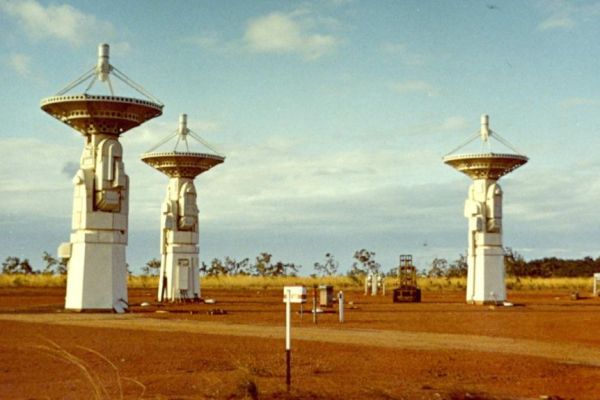
In a bit of rare Australian space news, the  Arnhemland Historical Society has managed to save one of the satellite trackers used during the 1960s and 1970s from the scrap heap. As the Space Race intensified during the 1950s and 1960s, every nation wanted a piece of this new technology. A number of European nations banded together in the form of ELDO, the European Launcher Development Organisation.

Australia was a partner in this program, with launches of the Europa-1 and Europa-2 rockets taking place from Woomera, South Australia. Initially the UK’s cancelled Blue Streak IRBM program provided the first stage for Europa-1, but this was later replaced with the French Diamant. France also provided the Coralie second stage in addition to the German-developed Astris third stage.

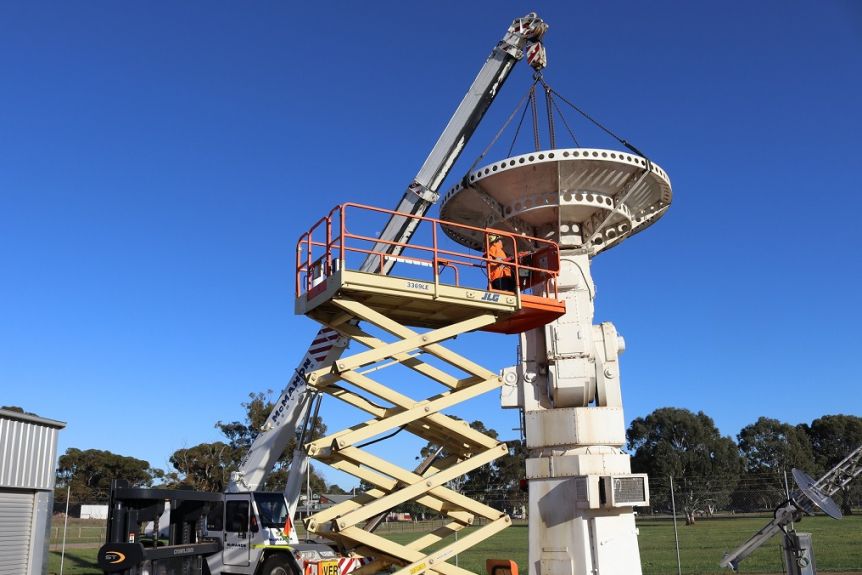
The satellite tracker being dismantled at the South Australian defence base before it was trucked north. (Photo: Arnhemland Historical Society)

The first launch of the Europa-1 took place in 1966, with the rocket performing well, but inaccurate readings from a radar station leading to the rocket to be wrongly instructed to self-destruct. Of nine launches, four were successful, with the satellite trackers at Arnhemland providing tracking support. Ultimately, the many technical setbacks led to the demise of ELDO, and it was merged by the 1970s into what is now the European Space Agency, with its main launch site in Kourou, French Guiana.

Despite the lack of success, these early days at Woomera were instrumental in getting Europe’s feet wet in the development of the Ariane rockets. Woomera’s rocketing days may also not be over yet, with NASA having announced  in 2019 plans to use Woomera for launches.

Maybe one day Arnhemland will have its own space port, with the old satellite track on display to remind of those early days.

[Top photo: The ELDO satellite trackers were state-of-the-art when they stood in Gove in the 1960s. (Supplied: Arnhemland Historical Society)]

(Thanks, David)

TI And Cadence Make PSpice Free

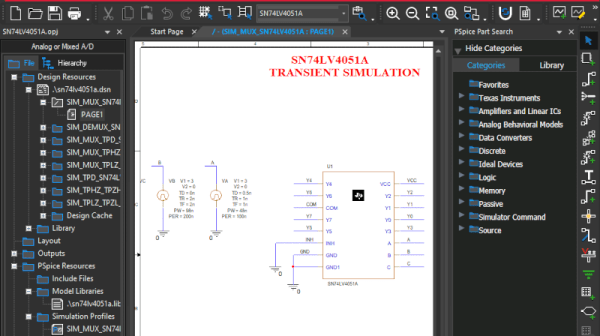
We like simulation software. Texas Instruments long offered TINA, but recently they’ve joined with Cadence to make OrCAD PSpice available for free with some restrictions. You’ve probably heard of PSpice — it’s widely used in academia and industry, but is usually quite costly. You can see a promotional overview video below.

The program requires registration and an approval step to get a license key. The downloaded program has TI models along with other standard models. There seem to be few limits as long as you stick to the supplied library. According to the datasheet, there are no size or simulation complexity limitations in that case. If you want to use other models, you can, but that’s where the limitations hit you:

There is no limitation of how many 3rd party models can be imported into the design. However, if 3rd party models are imported, a user will be able to plot a maximum of 3 signals at a time of their choice when any 3rd party model is imported from web.

We aren’t completely sure what “from web” means there, but presumably they just mean from other sources. In any event, you still get AC, DC, and transient analysis with plenty of options like worst-case timing analysis. Mixed signal designs are supported and there is a wealth of data plotting options, as you would expect.

This is a great opportunity to drive some serious software that is widely used in the industry. The only thing that bummed us out? It runs under Windows. We couldn’t get it to work under Wine, but a Windows 10 VM handled it fine, although we really hate running a VM if we don’t have to.

Still, the price is right and it is a great piece of software. We also liked the recent Micro-Cap 12 release, but we don’t expect any updates for that. Of course, LTSpice is quite capable, too.

Continue reading “TI And Cadence Make PSpice Free”

This Week In Security: AD Has Fallen, Two Factor Flaws, And Hacking Politicians

The big news this week is the huge flaw in Microsoft’s Active Directory, CVE-2020-1472 (whitepaper). Netlogon is a part of the Windows domain scheme, and is used to authenticate users without actually sending passwords over the network. Modern versions of Windows use AES-CFB8 as the cryptographic engine that powers Netlogon authentication. This peculiar mode of AES takes an initialization vector (IV) along with the key and plaintext. The weakness here is that the Microsoft implementation sets the IV to all zeros.

XKCD.com CC BY-NC 2.5

It’s worth taking a moment to cover why IVs exist, and why they are important. The basic AES encryption process has two inputs: a 128 bit (16 byte) plaintext, and a 128, 192, or 256 bit key. The same plaintext and key will result in the same ciphertext output every time. Encrypting more that 128 bits of data with this naive approach will quickly reveal a problem — It’s possible to find patterns in the output. Even worse, a clever examination of the patterns could build a decoding book. Those 16 byte patterns that occur most often would be guessed first. It would be like a giant crossword puzzle, trying to fill in the gaps.

This problem predates AES by many years, and thankfully a good solution has been around for a long time, too. Cipher Block Chaining (CBC) takes the ciphertext output of each block and mixes it (XOR) with the plaintext input of the next block before encrypting. This technique ensures the output blocks don’t correlate even when the plaintext is the same. The downside is that if one block is lost, the entire rest of the data cannot be decrypted Update: [dondarioyucatade] pointed out in the comments that it’s just the next block that is lost, not the entire stream. You may ask, what is mixed with the plaintext for the first block? There is no previous block to pull from, so what data is used to initialize the process? Yes, the name gives it away. This is an initialization vector: data used to build the initial state of a crypto scheme. Generally speaking, an IV is not secret, but it should be randomized. In the case of CBC, a non-random IV value like all zeros doesn’t entirely break the encryption scheme, but could lead to weaknesses. Continue reading “This Week In Security: AD Has Fallen, Two Factor Flaws, And Hacking Politicians”

Closely Examining How A PG&E Transmission Line Claimed 85 Lives In The 2018 Camp Fire

In 2018, the Camp Fire devastated a huge swathe of California, claiming 85 lives and costing 16.65 billion dollars. Measured in terms of insured losses, it was the most expensive natural disaster of the year, and the 13th deadliest wildfire in recorded history.

The cause of the fire was determined to be a single failed component on an electrical transmission tower, causing a short circuit and throwing sparks into the dry brush below – with predictable results. The story behind the failure was the focus of a Twitter thread by [Tube Time] this week, who did an incredible job of illuminating the material evidence that shows how the disaster came to be, and how it could have been avoided.

Mismanagement and Money

The blame for the incident has been laid at the feet of Pacific Gas and Electric, or PG&E, who acquired the existing Caribou-Palermo transmission line when it purchased Great Western Power Company back in 1930. The line was originally built in 1921, making the transmission line 97 years old at the time of the disaster. Despite owning the line for almost a full century, much of the original hardware was not replaced in the entire period of PG&Es ownership. Virtually no records were created or kept, and hardware from the early 20th century was still in service on the line in 2018.

Continue reading “Closely Examining How A PG&E Transmission Line Claimed 85 Lives In The 2018 Camp Fire”