The Deep Space Energy Crisis Could Soon Be Over

On the face of it, powering most spacecraft would appear to be a straightforward engineering problem. After all, with no clouds to obscure the sun, adorning a satellite with enough solar panels to supply its electrical needs seems like a no-brainer. Finding a way to support photovoltaic (PV) arrays of the proper size and making sure they’re properly oriented to maximize the amount of power harvested can be tricky, but having essentially unlimited energy streaming out from the sun greatly simplifies the overall problem.

Unfortunately, this really only holds for spacecraft operating relatively close to the sun. The tyranny of the inverse square law can’t be escaped, and out much beyond the orbit of Mars, the size that a PV array needs to be to capture useful amounts of the sun’s energy starts to make them prohibitive. That’s where radioisotope thermoelectric generators (RTGs) begin to make sense.

RTGs use the heat of decaying radioisotopes to generate electricity with thermocouples, and have powered spacecraft on missions to deep space for decades. Plutonium-238 has long been the fuel of choice for RTGs, but in the early 1990s, the Cold War-era stockpile of fuel was being depleted faster than it could be replenished. The lack of Pu-238 severely limited the number of deep space and planetary missions that NASA was able to support. Thankfully, recent developments at the Oak Ridge National Laboratory (ORNL) appear to have broken the bottleneck that had limited Pu-238 production. If it pays off, the deep space energy crisis may finally be over, and science far in the dark recesses of the solar system and beyond may be back on the table.

Continue reading “The Deep Space Energy Crisis Could Soon Be Over”
Arduino Enters The Cloud

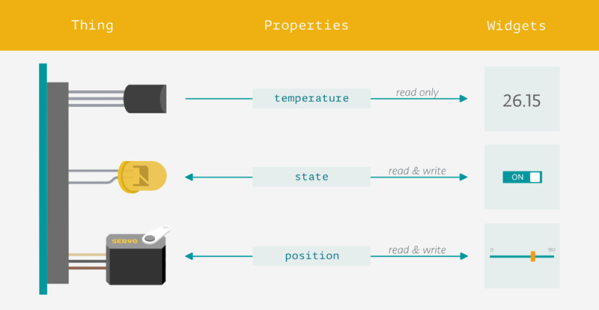
Love it or hate it, for many people embedded systems means Arduino. Now Arduino is leveraging its more powerful MKR boards and introducing a cloud service, the Arduino IoT Cloud. The goal is to make it simple for Arduino programs to record data and control actions from the cloud.

The program is in beta and features a variety of both human and machine interaction styles. At the simple end, you can assemble a dashboard of controls and have the IoT Cloud generate your code and download it to your Arduino itself with no user programming required. More advanced users can use HTTP REST, MQTT, Javascript, Websockets, or a suite of command line tools.

Continue reading “Arduino Enters The Cloud”

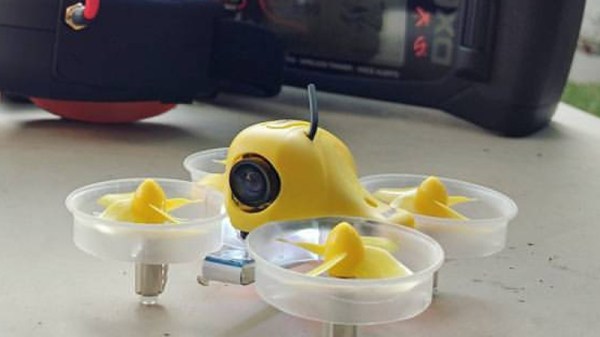
Can You Take Control Of A TinyWhoop?

Regular readers will have followed our series of posts looking at the issues surrounding reports of drones in proximity to aircraft, and will have noted that we recently asked our community how they would approach the detection and handling of marauding drones in controlled airspace. We are mere amateurs though by comparison to a team with its roots in Delft University of Technology’s Micro Air Vehicle Laboratory, because they have approached the problem through DroneClash, a spectacle best described as akin to a Robot Wars competition for drones. Their website states that “Anything goes, with one exception: no jamming“, and teams will do battle before an audience for a share in a considerable prize fund.

The fun is not however limited to team members. People in the audience will also be able to participate, by being invited to try their luck at bringing down a TinyWhoop that will periodically fly into the arena for a chance at their own prize. The ubiquitous cheap toy drone will be accessible through software, and would-be attackers are invited to register in advance to take a pop at it.

It looks as if DroneClash will be an unmissable event for anyone able to make it to the Netherlands on March 16th. We’ve mentioned it in past years, and we look forward to seeing what comes out of it this year too.

TinyWhoop header image: Dan Lundmark, (CC BY 2.0).

Hardware Developers Didactic Galactic Call For Talks

Hackaday is known for having the best community around, and we prove this all the time. Every month, we hold meetups across the United States. This, in addition to conferences and mini-cons across the globe mean Hackaday is the premiere venue for technical talks on a wide variety of hardware creation. Everything from Design for Manufacturing, to the implementation of blinky bling is an open topic.

Now, we’re looking for the talk you can give. The Hardware Developers Didactic Galactic is a monthly gathering hosted by Supplyframe, the Overlords of Hackaday. It’s filled with the technical elite of San Francisco, usually held on the last Thursday of the month. We’re looking for a talk you can give, whether it’s about your IoT irrigation system, or that time you created something out of transistors and capacitors.  We’re looking for speakers for all of 2019, and if you have a tale of the trials and tribulations of injection molding or Bluetooth pairing, we want to hear from you.

We have a sign-up form for presenters, and if you have something to present to a group of fantastic, technical people, we want to hear from you. All these talks are streamed and recorded, so if you’d like an idea of what we’re going for, just check out some of the previous talks. We have talks on how to start a decentralized space agency, wearable technology and fashion, optics and FPGAs, and System-in-Package tech. We’ve got a speaker travel stipend of up to $300, so there’s no excuse for you not to present your latest work.

There are thousands of people in the Hackaday community that have tons to contribute, and this is your chance. You are the best of the best, and we want to hear what you have to teach the rest of the community.

Tesla Eyes Ultracapacitor Future With Maxwell Acquisition

As reported by Bloomberg, Tesla has acquired the innovative energy storage company Maxwell Technologies for $218 Million. The move is a direct departure from Tesla’s current energy storage requirements; instead of relying on lithium battery technology, this acquisition could signal a change to capacitor technology.

The key selling point of capacitors, either of the super- or ultra- variety, is the much shorter charge and discharge rates. Where a supercapacitor can be used to weld metal by simply shorting the terminals (don’t do that, by the way), battery technology hasn’t yet caught up. You can only charge batteries at a specific rate, and you can only discharge them at a specific rate. The acquisition of an ultracapacitor manufacturer opens the possibility of these powerhouses finding their way into electric vehicles.

While there is a single problem with super- and ultra-capacitors — the sheer volume and the fact that a module of ultracaps will hold much less energy than a module of batteries of the same size — the best guess is that Tesla won’t be replacing all their batteries with caps in the short-term. Analysts think that future Teslas may feature a ‘co-battery’ of sorts, allowing for fast charging and discharging through a series of ultracapacitors, with the main energy storage in the car still being the lithium battery modules. This will be especially useful for regenerative braking, as slowing down a three thousand pound vehicle produces a lot of energy, and Tesla’s current battery technology can’t soak all of it up.

FAA Proposes Refined Drone Regulations

The wheels of government move slowly, far slower than the pace at which modern technology is evolving. So it’s not uncommon for laws and regulations to significantly lag behind the technology they’re aimed at reigning in. This can lead to something of a “Wild West” situation, which could either be seen as a good or bad thing depending on what side of the fence you’re on.

In the United States, it’s fair to say that we’ve officially moved past the “Wild West” stage when it comes to drone regulations. Which is not to say that remotely controlled (RC) aircraft were unregulated previously, but that the rules which governed them simply couldn’t keep up with the rapid evolution of the technology we’ve seen over the last few years. The previous FAA regulations for remotely operated aircraft were written in an era where RC flights were lower and slower, and long before remote video technology moved the operator out of the line of sight of their craft.

To address the spike in not only the capability of RC aircraft but their popularity, the Federal Aviation Administration was finally given the authority to oversee what are officially known as Unmanned Aerial Systems (UAS) with the repeal of Section 336 in the FAA Reauthorization Act of 2018. Section 336, known as the “Special Rule for Model Aircraft” was previously put in place to ensure the FAA’s authority was limited to “real” aircraft, and that small hobby RC aircraft would not be subject to the same scrutiny as their full-size counterparts. With Section 336 gone, one could interpret the new FAA directives as holding manned and unmanned aircraft and their operators to the same standards; an unreasonable position that many in the hobby strongly rejected.

At the time, the FAA argued that the repealing Section 336 would allow them to create new UAS regulations from a position of strength. In other words, start with harsh limits and regulations, and begin to whittle them down until a balance is found that everyone is happy with. U.S. Secretary of Transportation Elaine L. Chao has revealed the first of these refined rules are being worked on, and while they aren’t yet official, it seems like the FAA is keeping to their word of trying to find a reasonable middle ground for hobby fliers.

Continue reading “FAA Proposes Refined Drone Regulations”

Those Voices In Your Head Might Be Lasers

What if I told you that you can get rid of your headphones and still listen to music privately, just by shooting lasers at your ears?

The trick here is something called the photoacoustic effect. When certain materials absorb light — or any electromagnetic radiation — that is either pulsed or modulated in intensity, the material will give off a sound. Sometimes not much of a sound, but a sound. This effect is useful for spectroscopy, biomedical imaging, and the study of photosynthesis. MIT researchers are using this effect to beam sound directly into people’s ears. It could lead to devices that deliver an audio message to specific people with no hardware on the receiving end. But for now, ditching those AirPods for LaserPods remains science fiction.

There are a few mechanisms that explain the photoacoustic effect, but the simple explanation is the energy causes localized heating and cooling, the material microscopically expands and contracts, and that causes pressure changes in the sample and the surrounding air. Saying pressure waves in air is just a fancy way of explaining sound.

Continue reading “Those Voices In Your Head Might Be Lasers”