Mergers And Acquisitions: Broadcom, Qualcomm, And One Hundred Billion Dollars

Rumors have been circulating this last weekend of the largest semiconductor acquisition ever. Broadcom might buy Qualcomm for the princely sum of one hundred Billion dollars.

You will most likely be familiar with both Qualcomm and Broadcom for their wireless and cellphone chipsets. As far as the Maker community is concerned, Broadcom makes the chipset for the Raspberry Pi, but in the context of a two hundred Billion dollar company, a ‘maker’ focused Linux dev board is the equivalent of a rounding error on a balance sheet.

This news comes a little more than a year after the announcement that Qualcomm is snatching up NXP, and two years after the news of NXP is merging with Freescale. The industry is in a state of consolidation.

This proposed deal follows several other semiconductor mergers and acquisitions including NXP and Freescale, Intel and Altera, Avago and BroadcomOn Semiconductor and Fairchild, and the one we’re most befuddled with, Atmel and Microchip. Why are these companies merging? Because they’re sitting on mountains of cash. All of these mergers with the exception of Avago and Broadcom, have been for single-digit Billions of dollars. The merger of Broadcom and Qualcomm — if it happens — will be the largest merger of two semiconductor companies ever. That’s easy to do when both Broadcom and Qualcomm are on the top ten list of largest semiconductor companies, but it is evidence enough that the mergers and acquisitions in the industry are not slowing down.

Google’s Inception Sees This Turtle As A Gun; Image Recognition Camouflage

The good people at MIT’s Computer Science and Artificial Intelligence Laboratory [CSAIL] have found a way of tricking Google’s InceptionV3 image classifier into seeing a rifle where there actually is a turtle. This is achieved by presenting the classifier with what is called ‘adversary examples’.

Adversary examples are a proven concept for 2D stills. In 2014 [Goodfellow], [Shlens] and [Szegedy] added imperceptible noise to the image of a panda that from then on was classified as gibbon. This method relies on the image being undisturbed and can be overcome by zooming, blurring or rotating the image.

The applicability for real world shenanigans has been seriously limited but this changes everything. This weaponized turtle is a color 3D print that is reliably misclassified by the algorithm from any point of view. To achieve this, some knowledge about the classifier is required to generate misleading input. The image transformations, such as rotation, scaling and skewing but also color corrections and even print errors are added to the input and the result is then optimized to reliably mislead the algorithm. The whole process is documented in [CSAIL]’s paper on the method.

What this amounts to is camouflage from machine vision. Assuming that the method also works the other way around, the possibility of disguising guns (or anything else) as turtles has serious implications for automated security systems.

As this turtle targets the Inception algorithm, it should be able to fool the DIY image recognition talkbox that Hackaday’s own [Steven Dufresne] built.

Thanks to [Adam] for the tip.

Crystal radios from Jeri Ellsworth's museum tour

Jeri Ellsworth Tours A Radio And Tech Museum

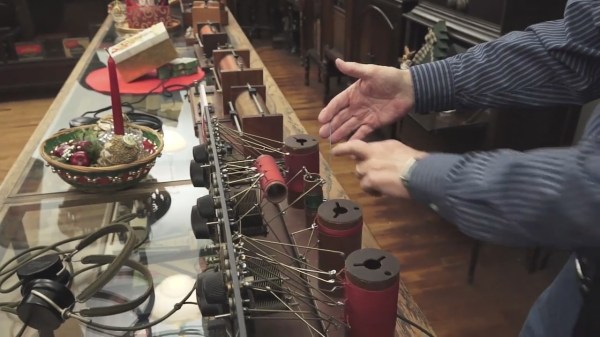
[Jeri Ellsworth] has done some YouTubing again (yes, that’s a word, just like YouTuber) after a four-year hiatus. She’s recently uploaded a very enjoyable four-part series touring the Museum of Radio and Technology in Huntington, West Virginia.

Part one contains radios spanning the ages, starting with a spark gap transmitter, some wonderful crystal sets, pocket radios from the 1940s, commercially available amateur radio transmitters and receivers from the 1930s to the 1950s, and more. There’s even a lovely hack of a transmitter built into an old refrigerator. Part two contains educational toys, three covers television sets and cameras, and four is about all types of record players and hi-fi. Each contains equipment as old as the spark gap transmitters in part one.

You may know of [Jeri] as co-founder of castAR, an augmented reality startup that recently shut its doors, but before that she was famous among hackers for her numerous projects ranging from a flexible electroluminescent display,  a centimeter wave scanner using hacked feed horns, to yours truly’s personal favorite, a Commodore 64 bass keytar.

So nuke some popcorn, sit back, and enjoy the tour following the break.

Continue reading “Jeri Ellsworth Tours A Radio And Tech Museum”

DUHK: Don’t Use Hard-Coded Keys

The title reads like the name of a lecture in cryptography 101 or the first rule of Crypto Club. ‘DUHK‘ is in fact neither of those but the name of a recently disclosed vulnerability in a pseudorandom number generating algorithm (PNRG) that was until recently part of the federal standard X9.31.

Random numbers are essential to viable cryptography. They are also hard to obtain leading to solutions like using the physical properties of semiconductors or decaying matter, that are governed by quantum effects. The next best solution is to log events that are hard to predict like the timing of strokes on a keyboard. The weakest source of randomness is math, which makes sense, because one of maths most popular features is its predictability. Mathematical solutions have the one redeeming quality of being able to produce a lot of numbers that look random to a human in a short time.

PNRGs require a starting point from which they begin to produce their output. Once this seed is known the produced sequence becomes predictable.

The X9.31 PNRG is an algorithm that is used in various cryptographic algorithms and has been certified in the Federal Information Processing Standards for decades until it was dropped from the list of approved standards in 2016. The researchers behind DUHK found out that the standard allowed the seed to be stored in the source code of its implementation. The next step was to look for software that did this and they found X9.31 in an older version of FortiOS running on VPN gateways.

Should I be Worried?

Probably, maybe not. The analysis (PDF) published by the team behind DUHK notes that the vulnerability is limited to legacy implementations and doesn’t allow to takeover the device running them, only to eavesdrop on ‘secure’ connections. The scope of this is much more limited than exploits like remote code execution via bluetooth. It is on the other hand providing a strong case for handling standards and technical certifications with extreme scrutiny. The teams conduct also gives insight into the best practises for white-hat hacking which are frequently discussed around here. And they have a great theme song.

MakerBot Really Wants You To Like Them Again

For the last couple years, a MakerBot press release has generally signaled that more pink slips were going to be heading out to the already shell-shocked employees at their NYC factory. But just last week something that could almost pass as good news came out of the once mighty 3D printer manufacturer, the unveiling of “MakerBot Labs”. A number of mainstream tech sites heralded this as MakerBot’s first steps back into the open source community that launched it nearly a decade ago; signs of a newer and more thoughtful MakerBot.

Reading the announcement for “MakerBot Labs”, you can almost believe it. All the buzz words are there, at least. In fact, if this announcement came from anyone else, in any other field, I’d probably be on board. Sharing knowledge and listening to the community is essential if you want to connect with hackers and makers. But this is MakerBot, and they’ve dug themselves into a very deep hole over the years.

The spectacular fall from grace that MakerBot has experienced, from industry leader to afterthought, makes this hat-in-hand peace offering hard to take seriously. It reads like a company making a last ditch effort to win back the users they were so sure they didn’t need just a few years ago. There is now a whole new generation of 3D printer owners who likely have never even seen a MakerBot printer, and it’s hard to imagine there’s still enough innovation and life in the company to turn that around before they completely fade into obscurity.

Continue reading “MakerBot Really Wants You To Like Them Again”

Artificial Intelligence At The Top Of A Professional Sport

The lights dim and the music swells as an elite competitor in a silk robe passes through a cheering crowd to take the ring. It’s a blueprint familiar to boxing, only this pugilist won’t be throwing punches.

OpenAI created an AI bot that has beaten the best players in the world at this year’s International championship. The International is an esports competition held annually for Dota 2, one of the most competitive multiplayer online battle arena (MOBA) games.

Each match of the International consists of two 5-player teams competing against each other for 35-45 minutes. In layman’s terms, it is an online version of capture the flag. While the premise may sound simple, it is actually one of the most complicated and detailed competitive games out there. The top teams are required to practice together daily, but this level of play is nothing new to them. To reach a professional level, individual players would practice obscenely late, go to sleep, and then repeat the process. For years. So how long did the AI bot have to prepare for this competition compared to these seasoned pros? A couple of months.

Continue reading “Artificial Intelligence At The Top Of A Professional Sport”

About That Giant Robot Battle Last Night

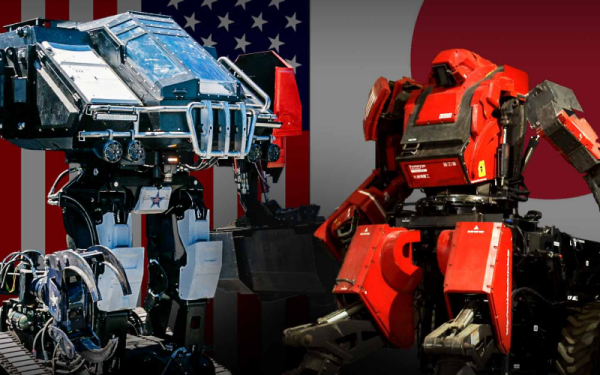
Two years ago we wrote about a giant robot battle between the USA and Japan. After two years in the making, MegaBots (team USA) and Suidobashi (team Japan) were finally ready for the first giant robot fight. If you are into battle bots, you probably did not miss the fight that happened around 7:00 pm PST. If you missed it, you can watch the whole thing here.

There were two duels. First it was Iron Glory (MkII) vs. Kuratas, and after that it was Eagle Prime (MkIII) vs. Kuratas.

Be warned, spoilers ahead.

Continue reading “About That Giant Robot Battle Last Night”