Fail Of The Week: GitLab Goes Down

Has work been a little stressful this week, are things getting you down? Spare a thought for an unnamed sysadmin at the GitHub-alike startup GitLab, who early yesterday performed a deletion task on a PostgreSQL database in response to some problems they were having in the wake of an attack by spammers. Unfortunately due to a command line error he ran the deletion on one of the databases behind the company’s main service, forcing it to be taken down. By the time the deletion was stopped, only 4.5 Gb of the 300 Gb trove of data remained.

Reading their log of the incident the scale of the disaster unfolds, and we can’t help wincing at the phrase “out of 5 backup/replication techniques deployed none are working reliably or set up in the first place“. In the end they were able to restore most of the data from a staging server, but at the cost of a lost six hours of issues and merge requests. Fortunately for them their git repositories were not affected.

For 707 GitLab users then there has been a small amount of lost data, the entire web service was down for a while, and the incident has gained them more publicity in a day than their marketing department could have achieved in a year. The post-mortem document makes for a fascinating read, and will probably leave more than one reader nervously thinking about the integrity of whichever services they are responsible for. We have to hand it to them for being so open about it all and for admitting a failure of their whole company for its backup failures rather than heaping blame on one employee. In many companies it would all have been swept under the carpet. We suspect that GitLab’s data will be shepherded with much more care henceforth.

We trust an increasing amount of our assets to online providers these days, and this tale highlights some of the hazards inherent in placing absolute trust in them. GitLab had moved from a cloud provider to their own data centre, though whether or not this incident would have been any less harmful wherever it was hosted is up for debate. Perhaps it’s a timely reminder to us all: keep your own backups, and most importantly: test them to ensure they work.

Thanks [Jack Laidlaw] for the tip.

Rack server image: Trique303 [CC BY-SA 4.0], via Wikimedia Commons.

These Five Hackaday.io Members Just Won Fancy New CircuitPython Boards

Just a few hours ago, we had a HackChat over on Hackaday.io with Adafruit discussing CircuitPython, their new extension to the MicroPython codebase. During the chat, the folks at Adafruit took questions and asked participants in the chat what they’d like to build with some cool new hardware. These CircuitPlayground M0 Express boards are brand new, unreleased hardware. Really cool stuff.

The winners of these unreleased boards, and the projects they’ll be using them for are: [RaidDude8] for a light painting system, [gelatinousslime] for a ‘magic wand’ for his daughter that reacts to gestures, [Neon22] for a multiuser game using Neopixels, [turbinenreiter] for a gravity demonstrator using Neopixels and the accelerometer, and [todbot] for a Powermate knob USB HID clone.

During the chat, The folks at Adafruit talked about their additions to MicroPython. It’s a rework of the API, provides better support for more platforms, and extends the entire thing to microcontrollers.  If you like Python and want to get into microcontrollers, this one is for you.

If you missed the chat, you can still check out Adafruit’s live stream right here, or the transcript right here. Below, you can check out Lady Ada awarding the new boards after the break.

We have a few more HackChats coming up in the next few weeks, one with [Sprite_TM], inevitably discussing why he won’t do a crowdfunding campaign for his tiny, tiny Game Boy, an RF talk with [Jenny List], and a chat with Sparkfun. You can check out the upcoming HackChats here. Want to get in on the action? Request to join the HackChat and you’re in.

Continue reading “These Five Hackaday.io Members Just Won Fancy New CircuitPython Boards”

Stadium Sized Cellphone Light Show Is Controlled By Sound

18 months ago, [Jameson Rader] didn’t know how to code. He had an economics degree and worked for a minor league hockey team. He did have a dream, though. Broadcasting data through sound. When we say broadcast, we mean broadcast – as in one sender and thousands of receivers.

[Jameson] didn’t have the money to hire a team to build his application. So he did what any self-respecting hacker would do. He bought a few books and taught himself to code. We’re talking about a smartphone app here, so Java and Objective-C were necessary to cover Android and iOS devices. The result is XT Audio Beacons.

[Jameson] has created a light show for stadiums which requires no new hardware infrastructure. Ultrasonic cues are added to a pre-recorded soundtrack and played over the PA system. Fans attending the show simply run an app and hold up their smartphone. The app listens for the cues and turns on the camera flash. The result is a light show which can be synchronized to music, sound effects, or whatever the event calls for. Since the system relies on sound, the App only needs permissions to access the microphone. The system would still work even if the phones were in airplane mode.

Transmitting data to smartphones via ultrasonics isn’t exactly new. Amazon uses it in their Dash Buttons, and Google uses it in their OnHub. Using it as a broadcast medium in a stadium is a novel application, though. [Jameson] also has demos showing XT Audio Beacons being used for more mundane purposes – such as troubleshooting electronics, or even as an acoustic version of an iBeacon.

Most important here is that [Jameson] isn’t keeping all this new knowledge to himself. He’s published the source to his application on Github under the MIT license.

You can see the system in action – and even try it yourself, in the video after the break.

If you want to learn more about [Jameson] and his journey, definitely check out his AMA on Reddit.

Continue reading “Stadium Sized Cellphone Light Show Is Controlled By Sound”

Japanese ISS Supply Ship Dual-Purposed As Tether Experiment

When a rocket sends a capsule up with supplies for the International Space Station, they usually send a bunch of their trash back down with it, all of which burns up in the atmosphere on re-entry. But as long as you’ve got that (doomed) vehicle up there, you might as well do some science with it along the way. And that’s exactly what the Japanese Space Agency (JAXA) is doing with their Kounotori 6 supply ship that just left the ISS on Friday.

The experiment is with an electromagnetic tether that can be used to either turn electrical energy into kinetic or vice-versa. When you string a long conducting wire outwards from earth, the two ends pass through the earth’s magnetic field at different altitudes and thus pass through magnetic fields with different strengths, and an electrical potential is generated. In the KITE experiment (translated), a resistive load and an electron emitter on the supply ship are designed to burn up this electrical energy, lowering the ship’s kinetic energy, and dropping its orbit down to earth.
Continue reading “Japanese ISS Supply Ship Dual-Purposed As Tether Experiment”

Riddle: What Metal Conducts Electricity, But Not Heat?

If you can’t answer the riddle, don’t feel bad. Metal conductors usually conduct electricity and heat. Usually, that’s true, but researchers at the Department of Energy’s Lawrence Berkeley National Laboratory and at the University of California, Berkeley, have found that vanadium dioxide can conduct electricity without conducting heat.

The Wiedemann-Franz Law states that good conductors of electricity are also good conductors of heat. Vanadium dioxide not only switches from an insulator to a conductor at 67C (152F), but it appears that it also doesn’t conduct as much heat as that law predicts while it is in its electrically conductive phase.

Continue reading “Riddle: What Metal Conducts Electricity, But Not Heat?”

Autopilots Don’t Kill Drivers, Humans Do

The US National Highway Traffic Safety Administration (NHTSA) report on the May 2016 fatal accident in Florida involving a Tesla Model S in Autopilot mode just came out (PDF). The verdict? “the Automatic Emergency Braking (AEB) system did not provide any warning or automated braking for the collision event, and the driver took no braking, steering, or other actions to avoid the collision.” The accident was a result of the driver’s misuse of the technology.

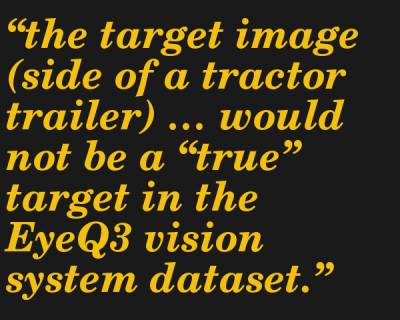
quote-not-a-true-targetThis places no blame on Tesla because the system was simply not designed to handle obstacles travelling at 90 degrees to the car. Because the truck that the Tesla plowed into was sideways to the car, “the target image (side of a tractor trailer) … would not be a “true” target in the EyeQ3 vision system dataset.” Other situations that are outside of the scope of the current state of technology include cut-ins, cut-outs, and crossing path collisions. In short, the Tesla helps prevent rear-end collisions with the car in front of it, but has limited side vision. The driver should have known this.


The NHTSA report concludes that “Advanced Driver Assistance Systems … require the continual and full attention of the driver to monitor the traffic environment and be prepared to take action to avoid crashes.” The report also mentions the recent (post-Florida) additions to Tesla’s Autopilot that help make sure that the driver is in the loop.

The takeaway is that humans are still responsible for their own safety, and that “Autopilot” is more like anti-lock brakes than it is like Skynet. Our favorite footnote, in carefully couched legalese: “NHTSA recognizes that other jurisdictions have raised concerns about Tesla’s use of the name “Autopilot”. This issue is outside the scope of this investigation.” (The banner image is from this German YouTube video where a Tesla rep in the back seat tells the reporter that he can take his hands off the wheel. There may be mixed signals here.)

cropped_shot_2017-01-23-181745There are other details that make the report worth reading if, like us, you would like to see some more data about how self-driving cars actually perform on the road. On one hand, Tesla’s Autosteer function seems to have reduced the rate at which their cars got into crashes. On the other, increasing use of the driving assistance functions comes with an increase driver inattention for durations of three seconds or longer.

People simply think that the Autopilot should do more than it actually does. Per the report, this problem of “driver misuse in the context of semi-autonomous vehicles is an emerging issue.” Whether technology will improve fast enough to protect us from ourselves is an open question.

[via Popular Science].

Paper Toy Can Save Lives

Although there is a lot of discussion about health care problems in big countries like the United States, we often don’t realize that this is a “first world” problem. In many places, obtaining health care of any kind can be a major problem. In places where water and electricity are scarce, a lot of modern medical technology is virtually unobtainable. A team from Standford recently developed a cheap, easily made centrifuge using little more than paper, scrap material like wood or PVC pipe, and string.

A centrifuge is a device that spins samples to separate them and–to be effective–they need to spin pretty fast. Go to any medical lab in a developed country and you’ll find at least one. It will be large, heavy, expensive, and it will require electricity. Some have tried using hand-operated centrifuges using mechanisms like an egg beater or a salad spinner, but these don’t really move fast enough to work well. At the least, it takes a very long time to get results with a slow centrifuge.

[M. Saad Bhamla] and his colleagues at Stanford started brainstorming on this problem. They thought about toys that rotate, including a yo-yo. Turns out, those don’t spin all that fast, either. Then they considered a whirligig. We had forgotten what those are, but it is the real name for a toy that has a spinning disk and (usually) a string. When you pull on the string, the disk spins and the more you pull, the faster the disk spins. These actually have an ancient origin appearing in medieval tapestries and almost 2,500 years ago in China.

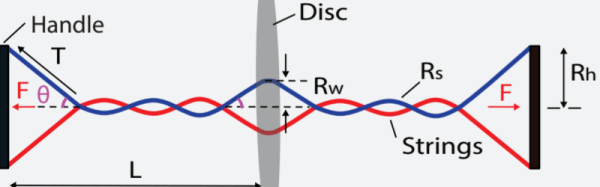
[Bhamla] found that how the toy worked was poorly understood (from a scientific standpoint)  and took pictures of one in operation with a high-speed camera. The team was able to create the “paperfuge”, a human-powered centrifuge that would spin at 125,000 RPM, enough to separate plasma from blood in under two minutes and isolate malaria parasites in 15. Some versions of the device could cost as little as twenty cents and don’t require anything more exotic than paper and string. You can see a video about the paperfuge, below.

Continue reading “Paper Toy Can Save Lives”