Artificial Skin Lets Robots Feel

BioTac Artificial Skin Technology is sure to be a storm with Robotics Designers. Giving them the opportunity to add a third sense to there robotic marvels. Now they can have the sense of touch to go along with existing technologies of sight and of sound.  Thanks to the technology coming out of the University of Southern California making this possible.

They have chosen to call their sensor BioTac, which is a new type of tactile sensor designed to mimic the human fingertip with its soft flexible skin. The sensor makes it possible to identify different types of texture by analyzing the vibrations produced as the sensor brushes over materials. This sensor is also capable of measuring pressure applied and  ambient temperature around the finger tip, expect to see this technology in next gen prosthetics. Let us know your thoughts on it.

[via technabob]
Continue reading “Artificial Skin Lets Robots Feel”
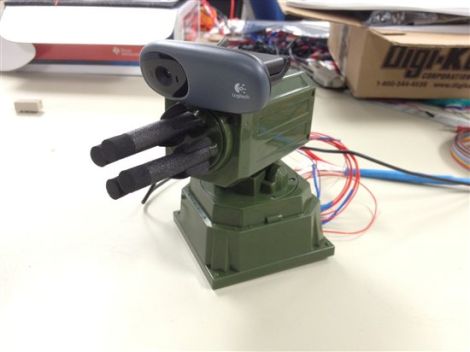
Automated Turret Gives You The Upper Hand In Office Warfare

TI-office-turret

When your co-workers get on your nerves, the mature recourse is to be the bigger person and simply ignore the obnoxious individual. A team of engineers from TI show us a slightly alternative means of dealing with office mates which is not quite as mature, though far more entertaining.

The office toy cum mechanized weapons system relies on a TI MSP430 LaunchPad, coupled with a custom Turret430 breakout board. The former is the brains of the operation, while the latter houses motor drivers for the motorized turret. The system can be steered throughout its 300 degree range of rotation using an attached joystick, but in the interest of catching their target by surprise, they added an automated mode as well. The automated targeting system uses an attached webcam to pick out victims by the color of their clothing, which seems to work pretty well.

To see the system in action, check out the video embedded below.

Continue reading “Automated Turret Gives You The Upper Hand In Office Warfare”

The Minotaur’s Revenge: Dueling Labyrinths

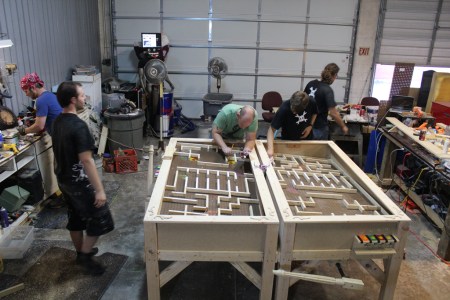
In case you hadn’t noticed, we participated in a contest recently. The RedBull Creation contest. The basic idea was that they gave us 72 hours to build something based on a theme. The whole thing would be streamed live as the 12 teams competed. The theme was “game of games” and the rules were pretty basic. It had to be a game with a clear winner (nothing too general), it had to be safe, and it had to fit in their shipping container.

Our project is called “the minotaur’s revenge”, and is basically a set of dueling labyrinths. A pair of giant tilting mazes that have to be controlled while attempting to trigger traps on your opponents table. We knew that watching us screw some wood together for 3 days would be painfully dull, so we put extra effort into keeping our feed amusing. We had scheduled events like a fire breather, grafitti artists, people in costume, and strange things happening all the time. We took time to answer questions and converse with our watchers. It paid off, our feed was usually host to double the viewers of any other feed.

Keep reading for a full writeup on how everything was made, along with a ton of pictures and some video.

Continue reading “The Minotaur’s Revenge: Dueling Labyrinths”

[Dino’s] Talking Box(es)

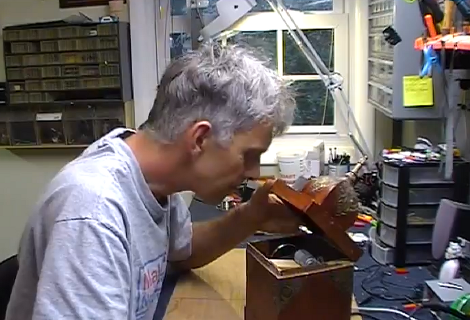
[Dino] is about three-quarters of the way through his talking box project. He’s completed one of the two boxes, and is showing off the technique he uses to marry motion with sound in order to mimic flapping lips with the box top.

You may remember [Dino’s] first look at the EMIC2. It’s a single-board text to speech module which is what provides the voice for the box. But what fun is that without some animatronics to go along with it? So [Dino] started playing around with different concepts to move the box top along with the speech. This is easier said than done, but as you can see in the video after the break, he did pull it off rather well. He built a motor control circuit that takes the audio output of an LM386 amplifier chip and translates it into drive signals for the motor. The shaft is not directly connected to the lid of the box. Instead it has a curved wire which is limited by a piece of string so that it doesn’t spin too far. It lifts the lid which is hinged with a piece of cloth.

Continue reading “[Dino’s] Talking Box(es)”

Motorized Camera Rig Makes Panoramic Shooting Simple

diy-panorama-rig

Where some people might see a pile of junk, Hackaday reader and budget-conscious photo nut [FantomFotographer] sees inspiration. He was in search of a rig that would help him take better panoramic photos and found all that he needed to build one right around him.

He had an old tripod kicking around, which serves as the base for rig. At the top sits a pair of servos [FantomFotographer] attached to the tripod with some scrap wood, screws, and glue. The servos are driven by an Arduino Nano, which sits comfortably in a plastic enclosure he scavenged from trash heap. He uses an IR receiver to control the whole thing, which allows him to not only change shooting angles, but camera settings as well.

While it might sound like all is well with his upcycled camera rig, [FantomFotographer] says that like every project, there is some room for improvement. He’s keeping the source code under wraps at the moment, but once he gets everything working to his liking, he says that he’ll release it.

In the meantime, be sure to check out the cool panoramas he has put together.

Real Life Subtitle Glasses

[Will Powell] sent in his real-time subtitle glasses project. Inspired by the ever cool Google Project Glass, he decided he would experiment with his own version.

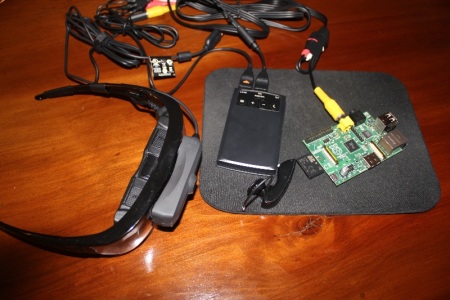
He used two Raspberry Pi’s running Debian squeeze, vuzix glasses, microphones, a tv, ipad, and iphone as the hardware components. The flow of data is kind of strange in this project. The audio first gets picked up by a bluetooth microphone and streamed through a smart device to a server on the network. Once it’s on the server it gets parsed through Microsoft’s translation API. After that the translated message is sent back to a Raspberry Pi where it’s displayed as subtitles on the glasses.

Of course this is far from a universal translation device as seen in Star Trek. The person being translated has to talk clearly into a microphone, and there is a huge layer of complexity. Though, as far as tech demos go it is pretty cool and you can see him playing a game of chess using the system after the break.

Continue reading “Real Life Subtitle Glasses”

copper-islands

Cutting Islands Into Copper-clad PCBs With A Drill

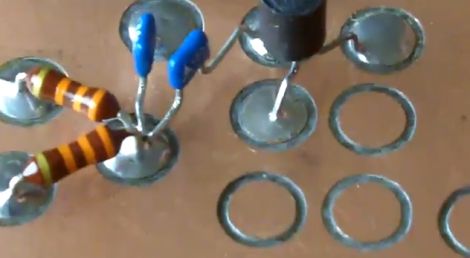
If you’re looking to build some small radio circuits, or if you are simply seeking a new look for your PCBs, you might want to check out what YouTube user [AndyDaviesByTheSea] has been working on lately. He has been building RF circuits as of late and was searching for a better way to create islands or “lands” on copper-clad PCBs.

He says that these sorts of islands are traditionally cut into the PCB with a scalpel or file – hardly an efficient process. [Andy] did a little experimenting and found a great way to quickly and precisely cut lands with a drill. Borrowing a bit of metal from an old VHS tape, he crafted a circular land cutter with a metal file. When mounted as a drill bit, his cutter produces clean, shallow cuts which create perfect lands on which to solder his components.

The only drawback to this method is that [Andy] found his bits were being dulled by the fiberglass boards pretty quickly. His solution was to carefully grind a broken heavy duty drill bit to do the task, which he says works even better than his original cutter.