Dance Floor Power Generation


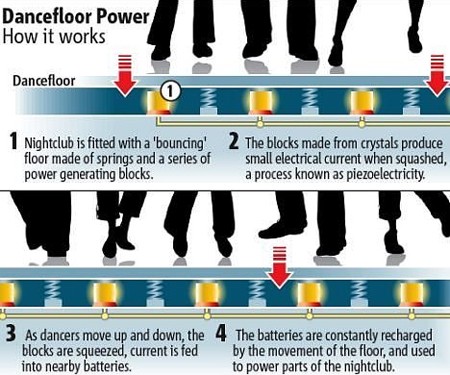
With concerns about the environment at an all-time high, do we roll up our sleeves and fix the situation or set our fears aside and dance the night away? [Andrew Charalambous], a nightclub owner in from Britain, doesn’t think we should have to choose, so he installed a dance floor that harnesses power from dancers into one of his clubs.

The dance floor uses piezoelectrics to collect the power: as clubgoers dance, electricity-producing crystals under the floor are compressed, producing a small current. The current is collect by embedded batteries, which in turn provide the power to lights, audio systems, and other parts of the club that consume electricity.

It’s certainly an interesting idea, but we’d like to know just how much power these floors are able to generate. Is this a gimmick or a genuinely practical solution? [Charalambous]’s club has adopted the somewhat hokey policy of forcing patrons to sign a pledge to be climate-conscious and do what they can to help the Earth, but that’s a small price to pay to earn green karma and have fun at the same time.

[via io9]
Robot Clarinet


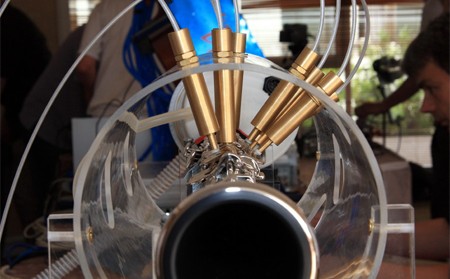
Australian research group NICTA in association with the University of New South Wales won the 2008 Artemis Orchestra Competition with their robot clarinet player. The competition challenges participants to design embedded systems that can play unmodified instruments. NICTA took first prize with their roboclarinet, due mainly to the complexity of the robot’s “mouth.” It uses two servo motors to act as a surrogate tongue and lips, vibrating the reed of the clarinet in a way consistent with human playing. The keys of the clarinet are pushed by a series of brass plungers. All of the robot’s functions are controlled by a computer running Linux. If great sound or novel technology are not enough for you, then the project is at least worth a look for the robot’s attractive, slightly steampunk-esque look. Watch it in action after the break.

Continue reading “Robot Clarinet” →

BackTrack 3 Final Is Out


OpenSuse and Ubuntu are perfectly serviceable Linux distros, but we’ve had a soft spot for BackTrack from the very start. Good news for us, since yesterday was the long awaited release of BackTrack 3 Final. It uses the same 2.6.21.5 kernel as before (to maintain WiFi injection compatibility) and Nessus is still out, but it is not without a great deal of other improvements. Its forensic capabilities are better than ever, largely due to included apps like a fully functional version of SAINT and a special version of Maltego made just for BackTrack. The download is free, but Remote-Exploit is asking users not to distribute it without notifying them first, because they’re trying to keep track of the number of downloads.

[via Midnight Research Labs]

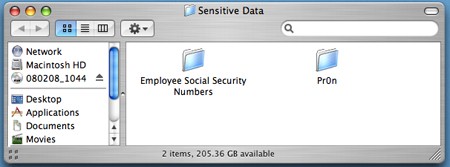
Finding Sensitive Data With Freeware


When an organization’s network grows to a certain size, its difficult to keep track of every single piece of sensitive information like credit card numbers or social security numbers. In order to find and secure this data, companies often turn to data loss prevention (DLP) services. This is not a viable option for many organizations, though, as DLP services can often be expensive and time-consuming to deploy.

Such organizations are not entirely without options: a recent article on Dark Reading lists several DLP tools authored by teams from various universities, all free to download and use. Programs like The University of Texas at Austin’s Sensitive Number Finder and Virginia Tech’s Find_SSN were designed to find pieces of data on computers and servers formatted in ways typical to sensitive information (xxx-xx-xxxx for SSNs, for example). This approach can often lead to false positives, so some measure of human control is required. They are also incapable of scanning application servers or other forms of data in transit. Cornell’s Spider can scan various application server types using different protocols. When used in conjunction, all of these apps can help secure your data without the expense of outsourcing the job.

Ice On Mars


It’s official: the Phoenix Lander has discovered ice on Mars. A few days ago, the lander exposed some bright white chunks of material while retrieving a soil sample. These spots have since disappeared over the following days, suggesting they’ve melted. An additional trench found a hard layer at the same depth as the original ice.

The spacecraft team has been dealing with some data storage issues as well and will be pushing a software patch soon.

Eavesdropping Encrypted Compressed Voice


A team from Johns Hopkins University has discovered a way to eavesdrop on encrypted voice streams. Voice data like the kind used by Skype for its VoIP service sends encrypted packets of varying sizes for different sounds. The team learned that by simply measureing the size of the packets, they could determine what was being said with a high rate of accuracy. VoIP providers often use a variable bit rate to use bandwidth more efficiently, but it is this compression that makes audio streams vulnerable to eavesdropping.

The team’s software is still in its early stages of development, yet incapable of parsing entire conversations. It is capable, though, of finding pre-determined keywords and inferring common phrases bases on the words it detects. It also has a higher rate of accuracy in identifying long complicated words than short ones. The team’s goal was not to eavesdrop, but to expose the vulnerability; team member [Charles Wright] notes, “we hope we have caught this threat before it becomes too serious.”

[via Schneier on Security]
[photo: altemark]

SparkFun’s Logic Level Converter


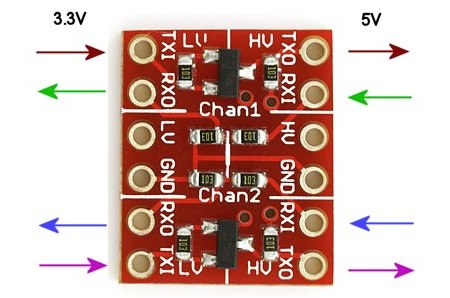
SparkFun has always been good about designing and stocking useful breakout boards. This recently added Logic Level Converter is no exception. It’s uses two BSS138 MOSFETs to shift 5V logic levels to 3.3V. The board handles two separate serial pairs. Just hook up the RX and TX on either side. Provide power at both voltages and the board will happily do the conversion. It’s $2, smaller than the size of a quarter, and perfect for plugging into a breadboard.