Wheel Of Fortune Gets Infinite Puzzles On NES

Wheel of Fortune is a television game show, born in the distant year of 1975. Like many popular television properties of the era, it spawned a series of videogames on various platforms. Like many a hacker, [Chris] had been loading up the retro NES title on his Raspberry Pi when he realized that, due to the limitations of the cartridge format, he was playing the same puzzles over and over again. There was nothing for it, but to load a hex editor and get to work.

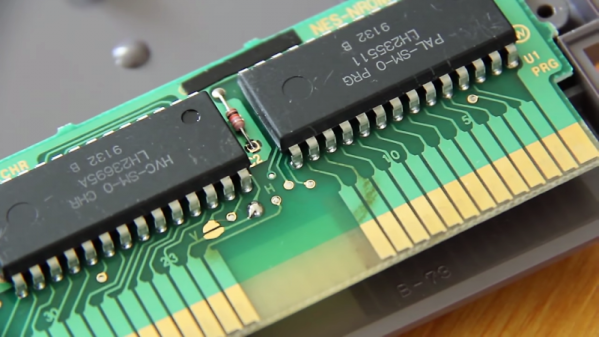
[Chris’s] initial investigation involved loading up the ROM in a hex editor and simply searching for ASCII strings of common puzzles in the game. Initial results were positive, turning up several scraps of plaintext. Eventually, it became apparent that the puzzles were stored in ASCII, but with certain most-significant-bits changed in order to mark the line breaks and ends of puzzles. [Chris] termed the format wheelscii, and developed an encoder that could turn new puzzles into the same format.

After some preliminary experimentation involving corrupting the puzzles and testing various edge cases, [Chris] decided to implement a complete fix. Puzzles were sourced from the Wheel of Fortune Puzzle Compendium, which should have plenty of fresh content for all but the most addicted viewers. A script was then created that would stuff 1000 fresh puzzles into the ROM at load time to minimize the chances of seeing duplicate puzzles.

ROM hacks are always fun, and this is a particularly good example of how simple tools can be used to make entertaining modifications to 30-year-old software. For another take, check out this hack that lets the Mario Bros. play together.

Poké Ball Plus Teardown Reveals No Pikachu Inside

The latest entry in the fan favorite franchise Pokémon saw release earlier this month alongside a particularly interesting controller. Known as the Poké Ball Plus, this controller is able to control Pokémon games that are available on completely separate platforms, as well as transfer data between them. It rumbles, It talks, it lights up, it’s wireless, and [Spawn] uploaded a video that reveals what’s really inside.

Continue reading “Poké Ball Plus Teardown Reveals No Pikachu Inside”

“Yell To Press B” Mod Makes N64 Controller Worse

There’s probably no reason anyone would actually desire a mod like this. Well, no good reason. But [William Osman] had been pondering what it would be like to play some classic games with inputs other than buttons, and decided to make an audio sensor responsible for pressing the B button on an old N64 controller. This “Yell To Press B” mod was also something unique to show his hosts when he visited the YouTube video game aficionados, [Game Grumps].

[William] acknowledges that the build is a bit of a hack job, but the project page does a good job of documenting his build process and covering the kinds of decisions involved in interfacing to a separate piece of hardware. After all, most budding hackers have sooner or later asked themselves “how do I make my gadget press a button on this other thing?” [William] ends up using a small relay to close the connection between the traces for the B button when triggered by a microphone module, but he points out that it should be possible to do a non-destructive version of the mod. Examples exist of reading the N64 controller’s state with an Arduino, which could form the basis of a man-in-the-middle approach of “Yell To Press B” (or anything else) instead of soldering to the button contacts. A video is embedded below, in which you can watch people struggle to cope with the bizarre mod.

Continue reading ““Yell To Press B” Mod Makes N64 Controller Worse”

Super Mario Bros 2 Player Rom Hack

NES Hack Lets The Mario Bros. Play Together

Being relegated to player two used to be a mark of disgrace in the 8-bit era of videogames. Between never being to select a level and having to wait your turn to play, the second player experience was decidedly third rate. Super Mario Bros. on the Nintendo Entertainment System was no different in this regard as it offered no character selection option and also required players to alternate taking control upon failing stages. It made the two player mode more like playing in parallel than actually together. However, there is a new ROM Hack for the original Super Mario Bros. from [Corpse Grinder] that allows players to play as the Brothers Mario simultaneously. Finally, a true co-op experience.

It’s important to note that the level power-ups have not been doubled-up in the patch, so this will no doubt be some friendly competition. Also it would be in both players interest to play with someone around their same skill level as any player dying in a level will cause both to start back at the last checkpoint. Not to worry, [Corpse Grinder] appears to have yet another Super Mario Bros. co-op patch in the works with this video from their YouTube channel below.

Whether you dump your own NES cartridge or extract the ROM image of Super Mario from a Virtual Console download, the patch itself comes in the form of a XDelta file. In order to apply the patch to a ROM image of Super Mario Bros. you’ll need a program like xdelta UI. Make sure to backup a copy of the ROM image before applying the patch, because this process is a one-way street.

Continue reading “NES Hack Lets The Mario Bros. Play Together”

SNES Controller Has A Pi Zero In The Trunk

We’re no stranger to seeing people jam a Raspberry Pi into an old gaming console to turn it into a RetroPie system. Frankly, at this point it seems like we’ve got to be getting close to seeing all possible permutations of the concept. According to the bingo card we keep here at Hackaday HQ we’re just waiting for somebody to put one into an Apple Bandai Pippin, creating the PiPi and achieving singularity. Get it done, people.

That being said, we’re still occasionally surprised by what people come up with. The Super GamePad Zero by [Zach Levine] is a fairly compelling take on the Pi-in-the-controller theme that we haven’t seen before, adding a 3D printed “caboose” to the stock Super Nintendo controller. The printed case extension, designed by Thingiverse user [Sigismond0], makes the controller about twice as thick, but that’s still not bad compared to modern game controllers.

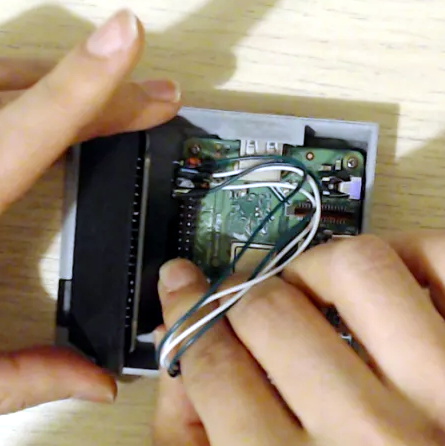
In his guide [Zach] walks the reader through installing the Raspberry Pi running RetroPie in the expanded case. This includes putting a power LED where the controller’s cable used to go, and connecting the stock controller PCB to the Pi’s GPIO pins. This is an especially nice touch that not only saves you time and effort, but retains the original feel of the D-Pad and buttons. Just make sure the buttons on your donor controller aren’t shot before you start the build.

Adding a little more breathing room for your wiring isn’t the only reason to use the 3D printed bottom, either. It implements a very clever “shelf” design that exposes the Pi’s USB and HDMI ports on the rear of the controller. This allows you to easily connect power and video to the device without spoiling the overall look. With integrated labels for the connectors and a suitably matching filament color, the overall effect really does look like it could be a commercial product.

The SNES controller is an especially popular target for hacks and modifications. From commercially available kits to the wide array of homebrew builds, it there’s plenty of people who want to keep this legendary piece of gaming gear going strong into the 21st century

Continue reading “SNES Controller Has A Pi Zero In The Trunk”

Eight Player GameCube Adapter Is Ready For Smash

With the release of Smash Ultimate fast approaching for the Nintendo Switch, [Patrick Hess] wanted to get ahead of the game and make sure his squad had the equipment they’d need. Namely, support for the GameCube controllers that serious Smash Bros players demand. But it wasn’t enough to have one or two of them hooked up, or even four. Not even six GameCube controllers could satiate his desire. No, he needed to have support for eight simultaneous GameCube controllers, and he wanted to look good doing it too.

Enter his meticulously designed eight player GameCube to USB adapter. Made out of dual official Nintendo GameCube to USB adapters (intended for the Wii U) merged together in a 3D printed case, the final result looks like something that could earn the coveted Nintendo Seal of Approval. Or at least, something that might pop up on the import sites in the next month or two for a few bucks.

[Patrick] started the project by recreating the official adapter PCBs and their housings in 3D using a pair of calipers. After a couple of test prints to make sure he had all the dimensions right, he could then move on to designing his final enclosure knowing he had accurate data to model around.

In addition to the two adapter boards, there’s also a four port USB hub inside the device’s case. Each adapter has two USB leads, here shortened to fit inside the case, which connect up to the hub. The integrated hub allows connecting all eight GameCube controllers through only a single USB connection. All controllers worked as expected during intense testing on the Wii U’s version of Smash Bros, though at this point [Patrick] can only assume it will work when the Switch version is released.

If there’s a downside to this project, it’s that the design for the 3D printed case is so intricate that [Patrick] was only able to print it on a machine that supported water-soluble PVA supports. A somewhat tall order for the average hacker; it would be interesting to see if somebody could make a second pass on the enclosure that is geared more towards printability than aesthetics.

While the design of the GameCube controller remains somewhat controversial after all these years, there’s no denying it retains an impressive following. Whether turning them into USB devices, shrinking them to preposterously small dimensions, or just finding increasingly creative ways to use them on Nintendo’s latest console, hackers are definitely in love with the gonzo little controller that’s now pushing 20 years old.

Slack On The SNES Via Satellite

We love seeing hardware and software from bygone eras getting a new lease on life through modern hacks, as longtime readers can surely attest to. Why leave this stuff to rot in a closet somewhere when it can be pushed into service today? Granted it might not always be the most efficient way to accomplish a task in the 21st century, but at least you’ll net some precious Internet Points for originality.

As a perfect example, take a look at this project which lets you read Slack messages through a Super Nintendo game. If your first thought was that such a thing would involve an unreasonable amount of effort and hoop jumping…then you would be correct. [Bertrand Fan] really had to think outside the box to make this one happen, and even admits a bit of imagination is required on the part of the end-user to use it. But it’s undeniably an original approach, so we hereby bestow the customary Internet Points unto him.

So how does this work, and where do the satellites come in? The key is in a fairly obscure Japanese SNES peripheral called the Satellaview, one of Nintendo’s early attempts at creating an online content delivery system for their consoles. Games designed with Satellaview support would be able to pull down new content from regular satellite broadcasts, not too bad for 1995. This means that if you have the hardware, and happen to own a satellite, you can push your own content into an unmodified SNES. No problem, right?

Alright, [Bertrand] didn’t really use a Satellaview modem plugged into an actual SNES. Plus we’re fairly sure he doesn’t have his own satellite network to broadcast Slack messages with anyway. But it turns out some SNES emulators have support for a virtual Satellaview modem, and there’s even software out there that will let you create new content “downloads” for the system’s included game: BS-X: The Story of The Town Whose Name Was Stolen. All he had to do was connect the dots.

[Bertrand] started by stripping the user interface out of SatellaWave, an open source tool for creating Satellaview content, so that it only need to be provided with an XML file of the content to be “downloaded” by the virtual satellite modem. Using the Slack API, he then came up with way to pull the last 10 messages from a server and push them into his modified version of SatellaWave. Each time somebody posts a new message his software kicks in to produce a new satellite download which automatically gets picked up by the SNES emulator and pops up in the game.

If this is still too practical for you, you can always go all in and run Slack on your Commodore 64.

Continue reading “Slack On The SNES Via Satellite”