Parts: 133MHz-16.2kHz Programmable Oscillator (DS1077)

cover

The DS1077 is a 5volt, 133MHz to 16kHz programmable clock source. The internal frequency divider is configured over a simple I2C interface, and the chip requires no external parts. Not bad for under $2. We used the Bus Pirate to test this chip before using it in a project. Grab the datasheet (PDF) and follow along. Continue reading “Parts: 133MHz-16.2kHz Programmable Oscillator (DS1077)”

Uv Oven From An IKEA Cabinet

This may not be an amazingly complicated project, but it is a very elegant and fairly cheap way of building a UV oven for exposing PCBs. [aris] started with an IKEA FIRA cabinet. He basically left the framework as an empty shell and made a make shift top hinged door to enclose it. Mounted in the top is an array of 35 UV LEDs powered by an HP printer transformer.  He did not have a timer circuit, instead he just watched the clock and unplugged it at the right time. You can see from his pictures that his results were quite good.

If you don’t want that piece of furniture taking up room, and don’t mind using a little more elbow grease, you could follow our directions on how to make your own single sided PCB. If money isn’t an issue either, you can always just get your PCBs laser etched.

Parts: Chip Sockets For Dual In-line Package (DIP)

DIP through-hole chips are an old package with instantly recognizable dual in-line pin rows.  Beginners love these chips because they’re large and look easy to solder; we abhor them because we hate messing around with the drill. Whatever your motivation for using a through-hole chip, use a socket whenever possible. A circuit board with socketed chips is easy to test without endangering the parts, and ICs can be removed, tested, and replaced, without resorting to a soldering iron. This week, by request, we looked at several common through-hole chip sockets. Continue reading “Parts: Chip Sockets For Dual In-line Package (DIP)”

Parts: 3.5mm Stereo Audio Jacks

3.5mm stereo connectors for headphones and microphones are almost mandatory for audio projects. X1 (left) is a simple plug with connections for the audio channels (pin 2,3), and ground (pin 1). X2 (right) has pass-through contacts (pin 2,3) that divert audio to an internal speaker when headphones aren’t connected.

Here’s a breakdown of the audio connectors illustrated above. Continue reading “Parts: 3.5mm Stereo Audio Jacks”

Parts: MicroSD Memory Card Holders

SD cards add cheap persistent memory to your project, but the holder takes a lot of board space. A smaller option is the microSD flash format. MicroSD cards are compatible with regular SD cards, and most come with a free adapter. We looked at four holders for our mini web server. Which should you choose? Read about our experience below. Continue reading “Parts: MicroSD Memory Card Holders”

Parts: 0.1uF Decoupling Capacitors

Most ICs need to be decoupled from their power supply, usually with a 0.1uF capacitor between each power pin and ground. Decoupling is usually used to remove noise and to smooth power fluctuations. Every project will need a few decoupling capacitors; our mini web server project has three ICs that require a total of 11. This can be an expensive part to buy in singles, so it’s crucial to stock up online. Read more about our favorite bulk through-hole and surface mount decoupling capacitors after the break. Continue reading “Parts: 0.1uF Decoupling Capacitors”

Parts: LM317 Adjustable Voltage Regulator

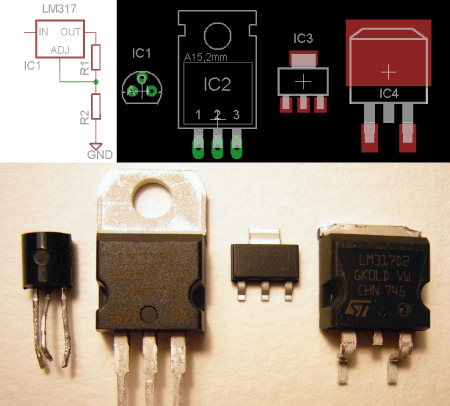
Every project needs a power supply. As 3.3volt logic replaces 5volt systems, we’re reaching for the LM317 adjustable voltage regulator, rather than the classic 7805. We’ve found four different hobbyist-friendly packages for different situations.

A simple voltage divider (R1,R2) sets the LM317 output between 1.25volts and 37volts; use this handy LM317 calculator to find resistor values. The regulator does its best to maintain 1.25volts on the adjust pin (ADJ), and converts any excess voltage to heat. Not all packages are the same. Choose a part that can supply enough current for your project, but make sure the package has sufficient heat dissipation properties to burn off the difference between the input and output voltages.

Continue reading “Parts: LM317 Adjustable Voltage Regulator”